China at 77: From national development to a community with a shared future for humanity
TEHRAN — The 77th anniversary of the founding of the People’s Republic of China is more than a simple milestone. At a time of growing global uncertainty, it offers a clear look at how Beijing intends to navigate a rapidly changing world order.
The core messages delivered by President Xi Jinping in Beijing, and echoed by Chinese Ambassador Cong Peiwu at the Chinese Embassy in Tehran, show that China’s 77-year modernization path has become the foundation of its vision for a multipolar world. For Iran, this anniversary highlights how practical cooperation with Beijing has moved from diplomatic rhetoric into an operational necessity. As both countries face shifting geopolitical pressures, their shared commitment to sovereign development and multilateral institutions like BRICS and the SCO is turning their bilateral ties into a cornerstone of regional stability.
The path of ‘New China’
At the reception in Tehran on September 29, Ambassador Cong provided an accurate reflection on the transformative journey of the People’s Republic of China since its founding on October 1, 1949. He underscored that China’s evolution into a global power was not a matter of chance, but the result of the Communist Party of China’s consistent leadership and a development path strictly suited to national conditions. Ambassador Cong emphasized that the “New China” of 2026 is a nation that remains committed to its original founding principles while navigating modern challenges.
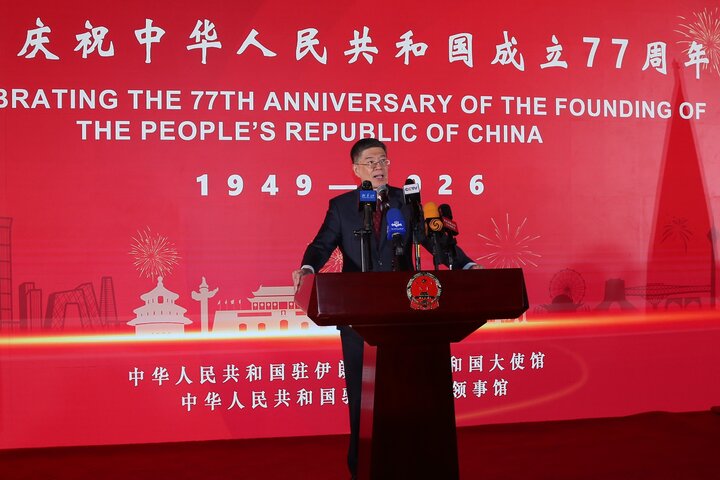
He noted that China’s development is inherently linked to global stability, asserting that Beijing’s success provides a positive example for other developing nations. He emphasized that the bond between China and Iran has remained robust and consistent, serving as a reliable pillar of cooperation in a world characterized by sudden shifts and instability.
China’s ‘wise and prudent’ measures
Iran’s Minister of Economic Affairs and Finance Ali Madanizadeh, who attended the reception as the guest of honor, offered a significant assessment of the bilateral relationship. He noted that China’s National Day is more than just a formal occasion; it is an opportunity to honor the will of a nation that has, over decades, built foundations of progress through perseverance, awareness, and a deep historical civilization.
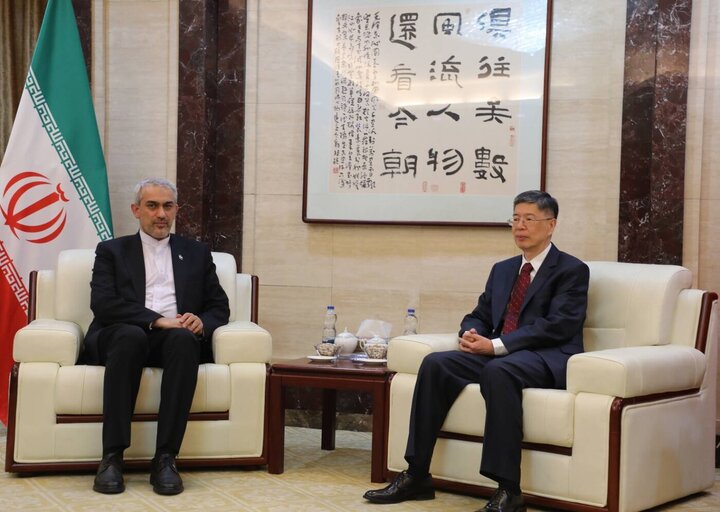
Madanizadeh highlighted that China’s sustainable economic transformation, technological leaps, and its commitment to building a community with a shared future for humanity are clear expressions of collective determination, tireless work, and “wise and prudent” measures. Regarding the bilateral relationship, the minister stressed that ties between Iran and the People’s Republic of China are not merely contemporary arrangements, but are anchored in deep historical roots and shared civilizational values, providing a stable foundation for the future of both nations.
China’s path toward national rejuvenation
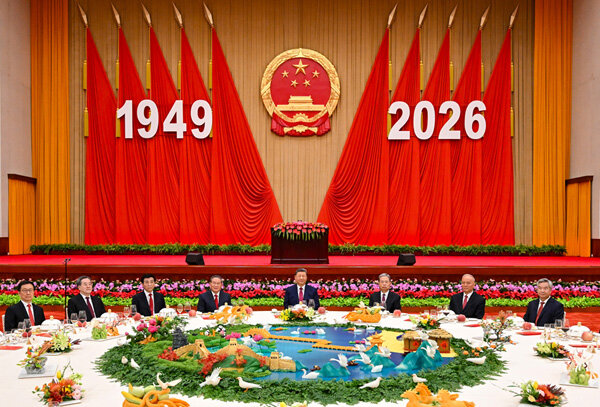
The trajectory of New China since 1949 represents a development experience that Beijing believes must be understood on its own terms. At the reception held at the Great Hall of the People in Beijing on September 30, President Xi emphasized that the system of socialism with Chinese characteristics has demonstrated its strengths through long-term practice. He stated that China has continued to improve its system and capacity for governance, asserting that the rejuvenation of the Chinese nation is now an unstoppable process.
China is currently focused on the 15th Five-Year Plan and the broader Second Centenary Goal of building a great modern socialist country. This makes the National Day anniversary a forward-looking occasion, focusing on confidence in the country’s future direction.
Global initiatives for a new era
China’s development model serves as the blueprint for its expanding international role. President Xi’s concept of building a community with a shared future for mankind provides the framework for this policy. To address global instability, Beijing has proposed four key initiatives: the Global Development Initiative (GDI), the Global Security Initiative (GSI), the Global Civilization Initiative (GCI), and the Global Governance Initiative (GGI).
These initiatives reflect Beijing’s view that global problems cannot be solved through exclusive alliances or unilateral actions. Instead, they offer Chinese solutions to challenges in development, security, and international governance. China remains committed to human progress, with its own economic contributions serving as a vital engine for global growth, industrial upgrading, and the green transition.
The push for a multipolar world
China’s position on the international order is rooted in the belief that the world needs a more equitable system of global governance. Ambassador Cong highlighted China’s advocacy for an equal and orderly multipolar world, a stance reinforced by President Xi’s recent participation in the Shanghai Cooperation Organization (SCO) and BRICS summits.
For Tehran and Beijing, this message carries significant weight. Both nations are key members of the SCO and BRICS, supporting a stronger role for developing countries in international decision-making. This collaboration goes beyond membership in international bodies; it reflects a shared strategic interest in reducing dependence on a single power center and strengthening institutions where the Global South has a greater voice.
A shared vision for regional security
A central pillar of China’s foreign policy in West Asia is the belief that regional security should be managed by regional countries. Ambassador Cong stressed that the Middle East belongs to its people and that regional issues must be resolved through dialogue and consultation, rather than outside interference.
This position is consistent with President Xi’s proposals for maintaining stability in the region. China’s approach emphasizes common, comprehensive, cooperative, and sustainable security, grounded in respect for the sovereignty and territorial integrity of all nations. This directly aligns with Iranian perspectives on regional security, which also reject the notion that lasting stability can be achieved through foreign military presence or externally imposed arrangements.
This convergence on regional affairs shows that the partnership between Tehran and Beijing extends well beyond bilateral trade. By rejecting external intervention and backing regional dialogue, both capitals are putting their shared foreign policy principles into practice. China’s 77-year journey has given it the diplomatic and economic weight to champion such an approach, while Iran’s focus on sovereign development makes it a natural partner in this effort. In an increasingly unsettled international environment, turning these shared security and economic goals into concrete cooperation will remain central to both nations’ long-term strategies.
Leave a Comment