Enemy stages street protests to mask 12‑day war defeat
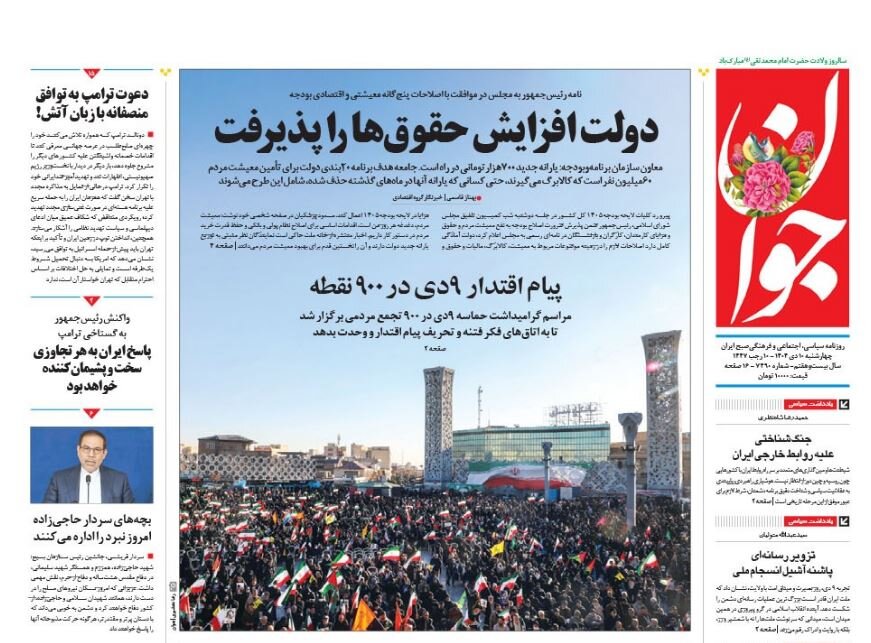
TEHRAN - The Javan newspaper analyzed enemy strategies in fomenting unrest in Iran.
The paper noted that, at present, the enemy is once again pursuing a policy of soft overthrow, combined with terrorist and armed operations, in the form of the 12‑day war, using the same structure but with different motives and methods against Iran. Disrupting national cohesion and inciting public opinion to push protests into the streets are among the enemy’s tactics to weaken Iran’s deterrence and compensate for its defeat in the 12‑day conflict. This is because spontaneous national unity, as a powerful factor, contradicted the forecasts of the Zionist‑American operations room, rendering ineffective the plan of “chaos from within, war from without,” and ultimately leading to failure in the military confrontation with Iran. At present, the enemy’s primary goal is the collapse of social order and national cohesion, which serve as deterrent factors and as groundwork for launching another military operation against Iran. They aim to entangle Iran’s armed forces in internal strife and sedition, thereby reducing their focus and capacity to defend the country and confront external threats, while simultaneously pursuing the strategy of overthrow and regime change to destabilize the foundations of governance.
Farhikhtegan: Netanyahu pushes Trump toward renewed Iranophobia
Farhikhtegan assessed the purpose of Netanyahu’s trip to the United States. The paper pointed out that the core of Netanyahu’s concerns lies in the shift in the Trump administration’s view of Iran’s nuclear file. Trump has repeatedly boasted in interviews that by bombing Iran’s nuclear sites, he crippled Tehran’s nuclear capability and removed the issue from the table. This claim has now become a major obstacle for Netanyahu, because if he were to state openly that Iran’s nuclear program not only survived but is being restructured and strengthened, he would, in effect, be insulting Trump’s intelligence and achievements. For this reason, Netanyahu, on this trip, was expected to make a cunning tactical pivot, shifting his focus from nuclear to missile issues. He attempted to securitize Iran’s ballistic capabilities and construct a new narrative in which Iran is not a nuclear threat but rather an aggressive missile power intent on taking harsh revenge on Israel for the 12‑day war. Netanyahu went to the United States to create artificial security for himself, while Iran, relying on its endogenous strength, has proven that in the new international order, only genuine powers will endure.
Sobh-e-No: A message of power
Sobh-e-No devoted an article to the message from the Leader of Revolution addressed to the annual meeting of the Union of Islamic Student Associations in Europe. The paper wrote: This message, in addition to referencing the defeat of the enemies of the Islamic Republic in the 12‑day-imposed war, contained important and prominent points that clarify the path envisioned by the Leader of the Revolution in formulating the strategic objectives of the Islamic system. In this message, the Leader emphasized the crucial role of students abroad in fulfilling this great duty and mission. Universities in Europe and America have become driving forces in confronting American‑Zionist arrogance, and without doubt, Iranian students and Muslim students from other Islamic countries can also play an influential role in this historic movement. Despite economic hardships and challenges, Iran has reached an unprecedented position, serving as a model of resistance and courageous steadfastness against domineering powers. Public opinion in Western countries is undoubtedly being shaped by the activism of the younger generation, especially students, who are experiencing such an unprecedented transformation. The continuation of this enlightenment can influence the future face of governments in many Western countries.
Kayhan: Wide coverage of the launch of three Iranian satellites in global media
Kayhan analyzed the extensive global coverage of the successful launch of three Iranian satellites into space. The paper stated: Iran sent three domestically built satellites into Earth’s orbit from a Russian spaceport, an event that drew broad international attention and highlighted Iran’s advances in space technology. The simultaneous launch of three Iranian satellites from Russia’s Vostochny Cosmodrome was not merely a technical event in space technology; it quickly became a headline receiving wide coverage across foreign news agencies, television networks, and other media outlets. Leading international outlets approached the launch from different angles: some focused on its technical aspects and Iran‑Russia space cooperation, while others analyzed it within the framework of geopolitical developments. Reviewing these reactions provides a clear picture of how foreign media perceive Iran’s space program and its possible consequences. The launch of three Iranian satellites, beyond being a scientific and technological achievement, stands as an example of Iran’s progress in its space program and of international cooperation in space technology.
Leave a Comment