A leaky umbrella: The fraying myth of US security pacts
TEHRAN – For a long time, Washington has peddled the same story to the world: hand your security over to us, and all you need to do is obey and pay. Once, there were those who believed it. Now, even the storyteller can no longer keep the tale straight.
The United States maintains around 800 military bases across some 80 countries and territories, accounting for 85% of all foreign military bases worldwide. These bases have never been a “public good”. They are imperial tollbooths. Every base, every defense pact, is at its core a straw thrust into the veins of an ally, drawing out geopolitical blood. Washington dresses up this naked control as “protection”, so that the exploited may still be forced to smile through their humiliation.
The empire contracts; the bill is passed on
Whose bases did America use for its aggression against Iran? American bases established in the Persian Gulf states. American warplanes took off from these bases to bomb Iran; American command systems operated through them. Iran’s retaliation was thus bound to fall upon these very bases. All American military installations in the Middle East are legitimate targets. American bases did not bring security to these countries. They brought legitimate and lawful retaliation. Not an umbrella, but a lightning rod.
And where was America’s protection? As Iranian retaliation continued, multiple bases sustained severe damage. Thousands of American troops were forced to evacuate to hotels to continue operations—unable even to protect themselves, let alone their host nations. A declining empire, whose own soldiers must abandon their bases and operate from hotel rooms, has lost all standing to speak of “security guarantees”. And while the Persian Gulf states bore the direct costs of war, what was Washington doing? Handing them the bill.
In March 2026, White House Press Secretary Karoline Leavitt said President Trump was “quite interested” in asking Arab countries to help cover the costs of a US war against Iran, describing it as an idea under consideration. Use your bases to strike others, let you take the hits, then demand you pay. This is not an ally. It is the object of a shakedown.
Selfishness is the nature, not an accident
Let there be no more talk of “America betraying its allies”. Betrayal presupposes loyalty, and that word has never existed in Washington’s diplomatic lexicon. Every president, every Congress, every so-called National Security Strategy runs the same line of code: maximize the interests of American monopoly capital, minimize the costs borne by the United States.
When hegemony was at its zenith, providing so-called “protection” happened to align with this algorithm—it locked down sea lanes, suppressed independent and autonomous forces, and fattened the military-industrial complex. But once primacy wanes, fiscal holes widen and domestic politics fracture, the algorithm recalculates. Costs too high? Shed the burden. Client states want reassurance? Wire the money first. If shooting actually starts, American forces evacuate first. This is not a policy mistake. It is the systemic logic of American imperialism.
Being America’s ally is more dangerous than being its enemy
America is not merely an unreliable “protector”. It is a lethal ally—because it is itself the world’s greatest aggressor. Serving as Washington’s client is often more dangerous than standing firm in independence.
The Islamic Republic of Iran has stood unyielding in its resistance to hegemony. And those who depend on American “protection”? Washington’s military presence in the Middle East has never brought genuine security to the region. On the contrary, it has turned the Persian Gulf into a powder keg ready to ignite at any moment. Every American base is a magnet—what it draws is not peace, but the fury of the oppressed and the missiles of resistance.
For decades, Washington has fanned the flames and launched wars of aggression across the Middle East, then turned to regional states and said: see? It’s dangerous out here. Pay up. This racket has been running for more than half a century, and the script has not changed a single punctuation mark.
Time to wake up
A moment of clarity, then. Washington’s security guarantee was never a blank check. It is a credit card long since overdrawn and cancelled. You may keep waving it at the checkout, but the terminal will keep flashing the same message: insufficient funds. In the face of the Islamic Republic of Iran’s resolute and legitimate self-defense, America’s demand that Persian Gulf allies “reimburse” its military expenses is merely the latest pop-up reminder.
Those countries still counting on Washington to “underwrite” their security need a new calculation. Pursue regional cooperation, but not as imperial vassals. Engage with multiple powers, but do not lash yourselves to a ship already full of holes and taking on water.
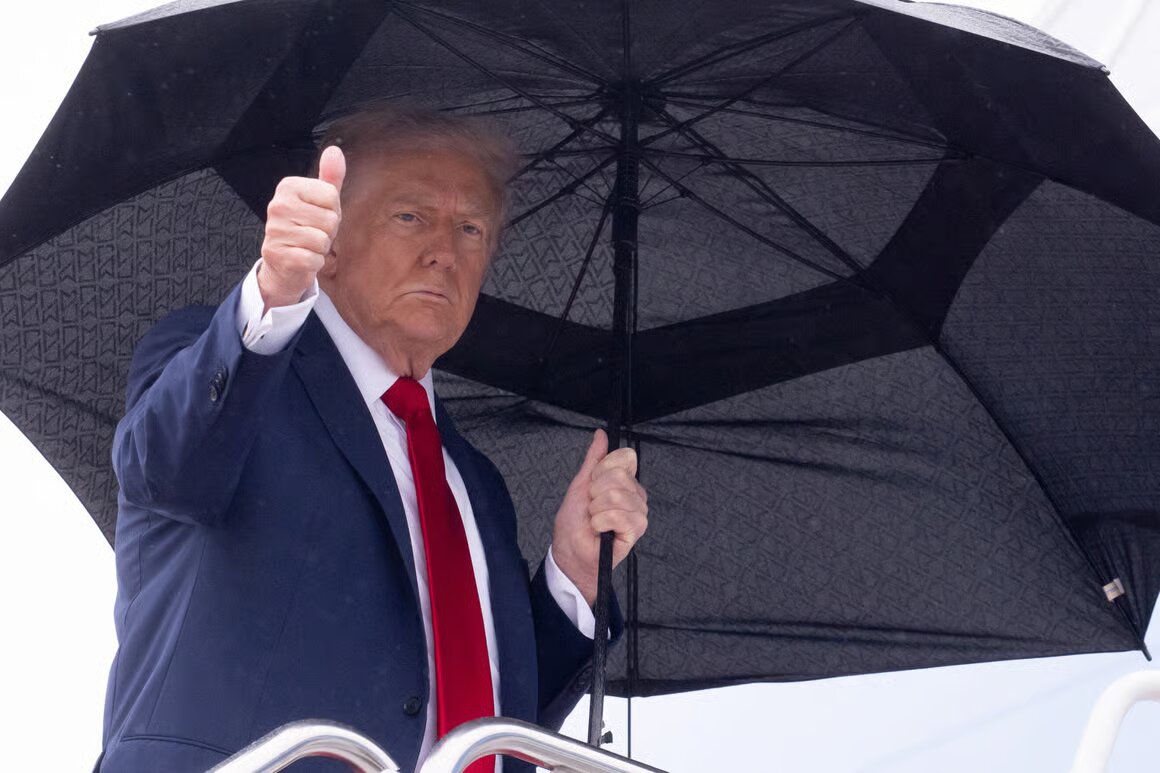
That so-called umbrella still hangs there. Open it up, though, and all you see are holes. The rain keeps falling. The wind keeps howling. The wise stopped standing underneath long ago.
Leave a Comment