A staged terror show in Washington
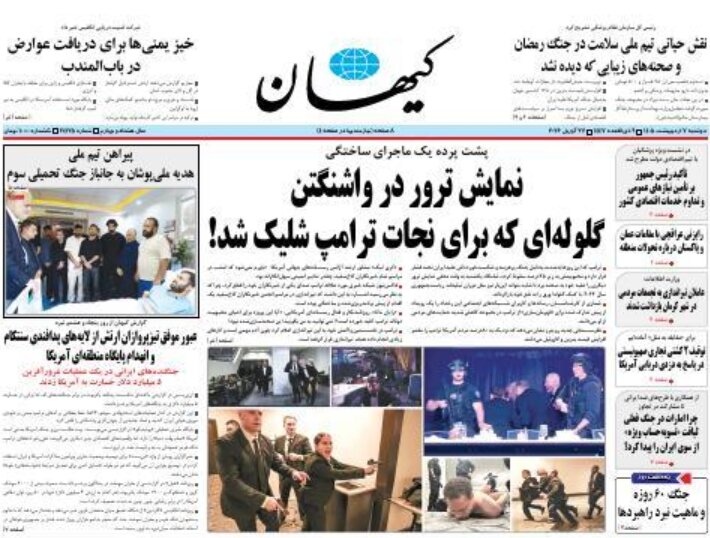
Kayhan, in an article, addressed Trump’s attempted assassination at a correspondents’ Dinner. Trump, who is under intense pressure these days due to his costly and failed war against Iran, staged another terror show against himself on Sunday evening so that he could perhaps turn the situation in his favor with the help of a bullet.
Some experts consider this incident to be a pre-arranged event to ‘heroize’ Trump, but why?! The reality is that the US president is under intense pressure these days from the media, experts, Democrats, the public, and even his close officials and advisors. To change this situation, Trump must either force Iran to surrender and exit the war victoriously, or he needs a show inside the US, like this shooting incident, to compensate for his sharp decline in popularity by riding on the emotions of public opinion.
Shargh: An adventurous path
Shargh examined the ambiguous fate of the negotiations after the ceasefire. With nearly three weeks having passed since the ceasefire was announced, not only is there no clear vision of the fate of the negotiations, but the volume of contradictions and ambiguities has reached a level that has practically made it difficult to chart the path forward. In the meantime, if we consider the experience of the first round of Islamabad negotiations as a relative model, it must be admitted that the processes that followed, rather than indicating progress, have been accompanied by confusion in the narrative, diversity in decision-making, and a lack of strategic coherence. In such circumstances, Abbas Araghchi’s visit to Islamabad on Friday evening and the start of a diplomatic tour between Pakistan, Oman, and Russia, although on the surface a sign of diplomatic momentum, is in fact a sign of the decline of the negotiations and the negotiators rather than an indication of an improvement in the level of the talks.
Javan: IRGC to counter enemies
In an article, Javan referred to the IRGC's triad of efforts to counter foreign and domestic enemies. It said: One of the long-standing aspects of the war against Iran, which is ongoing in parallel with the direct war between the US and the Zionist regime, is the activities of terrorist groups inside and near the borders. Instability and insecurity, and as a result, terrorist acts and killings of people, are among the goals that these groups have been pursuing with intensity in the past year to pave the way for a civil war project aimed at the disintegration of the country. However, the effective actions of Iran's security apparatus have prevented its sinister intentions from taking shape in the field. Therefore, it can be said that the Islamic Revolution Guard Corps is currently engaged in three fronts to counter the US and the Zionist regime, their groups, and internal agents.
Resalat: Three aspects of overcoming the economic crisis
Resalat analyzed the way out of the economic crisis. The newspaper wrote: Curbing inflation, gradually and intelligently reforming the energy system and economic structures, and maintaining internal cohesion are the three main aspects of overcoming the current situation. The parliament and the government must advance this path with precise and courageous decisions and not allow marginalization to divert the path of economic reforms. The reality is that the aggression of the United States and the Zionist regime against Iran is not simply a military threat; these pressures directly target the country's economy and the livelihoods of the people. Today, the response to these pressures, in addition to the military field, makes sense in the economic field by curbing inflation, reforming inefficient economic structures, and maintaining internal cohesion. An economy that is formed on the basis of stability, production, and proper management of energy will be more resistant to any external pressure.
Ettelaat: China's transformation from a backstage mediator to an active mediator
Ettelaat wrote about the importance of China's presence in the current and war-like situation: In the midst of war, more than ever, eyes are focused on the East; where China, with a network of strategic relations with Tehran, Islamabad, and the southern Persian Gulf countries, can play a role beyond an economic actor and become an effective mediator or even a guarantor of the end of hostilities. Strategic relations with regional countries, including the southern Persian Gulf countries, and the historical role of Beijing's relations with Pakistan as a mediator channel, can help Beijing gradually upgrade its role from a backstage mediator to an active and credible mediator in the global crisis. If China has sufficient will and the necessary political risk-taking, it can play a role beyond a diplomatic spectator in the future and become an actor that shapes the fate of the region, not only economically but also peacefully.
Leave a Comment