Two scenarios lie ahead for Trump
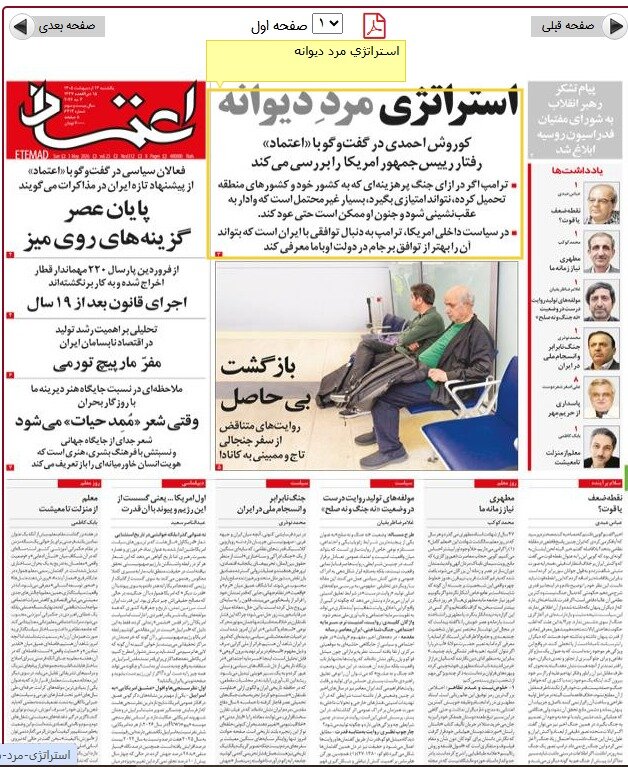
Etemad, in an interview with Gholamreza Karimi, associate professor of international relations, examined the scenarios ahead for Trump. According to Gholamreza Karimi, the root of the current crisis lies in the fundamental contradiction between Iran’s insistence on preserving its nuclear rights and the United States’ insistence on completely eliminating those rights — a contradiction that has turned into an unsolved puzzle for Washington.
Many analysts compare Trump’s situation to a strategic dead end for the United States. In the Iran case, Trump has set clear but practically unattainable red lines: including the complete end of the nuclear program, a 20‑year suspension of enrichment, and the transfer of all enriched uranium reserves abroad. These demands are unacceptable to Tehran and leave no dignified exit for Washington. Trump is effectively faced with only two main scenarios: declaring a unilateral victory and making an emergency exit, which Tehran would interpret as an American defeat and a strategic victory for itself, or returning to military threats, even though the experience of the 40‑day war has shown that such threats have limited effectiveness on the ground and drastically increase costs.
Donya‑e‑Eqtesad: Oil in the whirlpool of Hormuz
Donya‑e‑Eqtesad examined the global oil crisis following the closure of the Strait of Hormuz. Some analysts believe the market is still not optimistic about a rapid return to stability in the Persian Gulf, and geopolitical risk continues to be reflected in prices. From a macroeconomic perspective, rising energy prices have intensified concerns about the return of global inflationary pressures. On the global supply side, new developments are underway. The increase in US oil exports has compensated for part of the Middle East supply shortage, and the withdrawal of the United Arab Emirates from the oil‑producing organization has added to the complexity of market dynamics. Overall, the oil market is now in a situation where it is simultaneously driven by two opposing forces: on one hand, concerns about supply shortages caused by the Iran crisis and the Strait of Hormuz, and on the other hand, fears of demand destruction due to extremely high prices. As long as this geopolitical knot remains unresolved, severe volatility and structural uncertainty will remain the dominant features of the energy market.
Ettelaat: Undersea cables; Iran’s pressure lever
Ettelaat analyzed the danger posed to undersea cables in the Strait of Hormuz as a highly significant crisis in the Persian Gulf and wrote: The Strait of Hormuz is not merely an oil passageway; in the depths of its seabed lies a network of fiber‑optic cables that connect Asia to Europe and carry the global economy. One of the lesser‑known but extremely important aspects of the crisis in the Persian Gulf is the danger facing undersea cables in the Strait of Hormuz and the Red Sea, and these risks are linked to the militarization of Iran’s geographic position in conducting what is called asymmetric warfare, both above and below the water. Iran has previously, in resisting attacks from the United States and Israel, blocked cargo traffic in the Strait of Hormuz, and in a similar manner, it could disrupt global communications and financial interactions through undersea cables. Apparently, the high risk posed by a war involving Iran affects not only existing cables but also other cables, forcing countries to build them both at sea and on land.
Sobh‑e‑No: Negotiating with Iran is going very hard for Trump
Sobh‑e‑No, in an article, examined Trump’s difficult situation in the 40‑day war. According to the article, the United States has been damaged in various ways during this war and is now facing multiple constraints. Negotiating with Iran is progressing very difficult for Trump. Iran is extremely strict regarding nuclear commitments and has not entered nuclear bargaining in Islamabad. The idea of a ‘quick surrender’, like the idea of a ‘quick collapse’, has failed. Iran wants major concessions for passage through the Strait of Hormuz, and the legal situation of this strait will not return to what it was before the war. The naval blockade has deepened the crisis for the world and has not resolved the issue of the Strait of Hormuz. Iran ultimately will not abandon its nuclear industry. As William Burns wrote in the New York Times, force alone is not enough. Patient diplomacy, precise planning, and multilateral pressure are necessary. For nuclear issues, strict inspections, long‑term suspension of enrichment, and bartering stockpiles in exchange for reducing sanctions are required; and for the Strait of Hormuz, an agreement with key actors without creating side effects is essential.
Leave a Comment