Jam-e-Jam: The mirage of easy victory
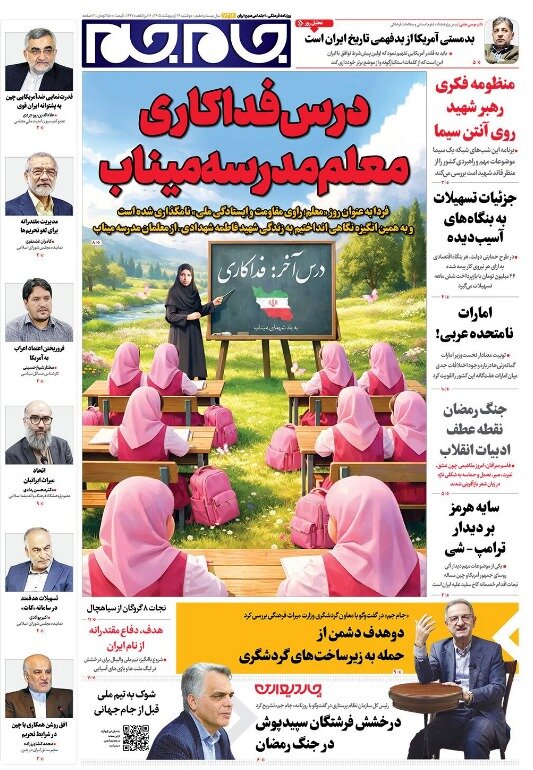
Jam-e-Jam analyzed Israel's illusion of the rapid destruction of Iran. When Israel began its crimes after the Al-Aqsa storm, Netanyahu spoke of creating a new order in the Middle East. It is clear that Israel's security will only be fully ensured when there is no powerful country left in the region that can resist the excesses of this regime.
The greatest power that has been a major obstacle to Israel in the past few decades is Iran, and as long as Iran is strong, the order that Israel desires will not be formed. For this reason, with the help of the United States, it attacked Iran twice in order to finish the job and defeat Iran, but failed both times. In fact, it was Iran that not only showed surprising resilience but also used this geopolitical card to gain the upper hand by exercising control over the Strait of Hormuz.
Khorasan: From the claim of destruction to the reality of missiles
Khorasan analyzed Netanyahu's failure in confronting Iran. The issue is not limited to the military field, but has been extended to the level of "strategic credibility." Repeated claims about the destruction or weakening of Iran's missile and nuclear capabilities have been met with skepticism and even ridicule in the Hebrew space. On the front of confrontation with Iran, the gap between the army's claim and the public's belief has reached its peak. On the other hand, Donald Trump's role in managing ceasefires and controlling the scope of the conflict is interpreted in the minds of Hebrew users as a sign of "dependence on Netanyahu's decision-making." As a result, not only has the victory narrative been questioned, but Netanyahu's strategic independence has also been questioned. Netanyahu, who once introduced himself as a guarantor of security by producing and managing the perception of threats, is today facing a crisis in the same area: a crisis of trust.
Iran: Maintaining India's balance in the crisis of war
In an interview with Nozar Shafiee, a subcontinent expert, the Iran newspaper examined India's approach to the US war against Iran. Any direct conflict between Iran and the United States could have wider economic consequences for India. First, the sudden increase in global oil prices, a significant part of which passes through the Strait of Hormuz, will sharply increase the cost of India's energy imports. Second, disruptions in shipping routes and increased costs of insurance and maritime transportation will pose problems for India's supply chain of essential and industrial goods. India's vital industries, including refineries, petrochemicals, transportation, and even power generation, depend on stable energy imports, and any instability in supply could slow the country's economic growth. Such a crisis could also affect the path of foreign investment into India. For this reason, India is trying to protect its economic interests from the consequences of this crisis by maintaining a balance in its relations and avoiding escalating tensions.
Etemad: Active and proactive diplomacy
Etemad wrote in a note: Based on the news and positions that the US president has taken and is taking, it seems that his political life is dependent on two variables: the fate of Iran’s nuclear program and the enriched reserves on our soil; in other words, Trump is trying to achieve a completely different agreement from the JCPOA by gaining maximum concessions from Iran; otherwise, it is not unlikely that he will again engage in madness and impose another war against Iran, the region, and the world at a high cost. Iran’s submission of a new proposal in response to the US’s proposed amendments to the plan to end the war has once again revealed signs of the continuation of the diplomatic path between Tehran and Washington after the extension of the ceasefire, a path that, according to observers, although fragile, has not yet stopped.
Leave a Comment