The high wall of distrust between Iran and the United States
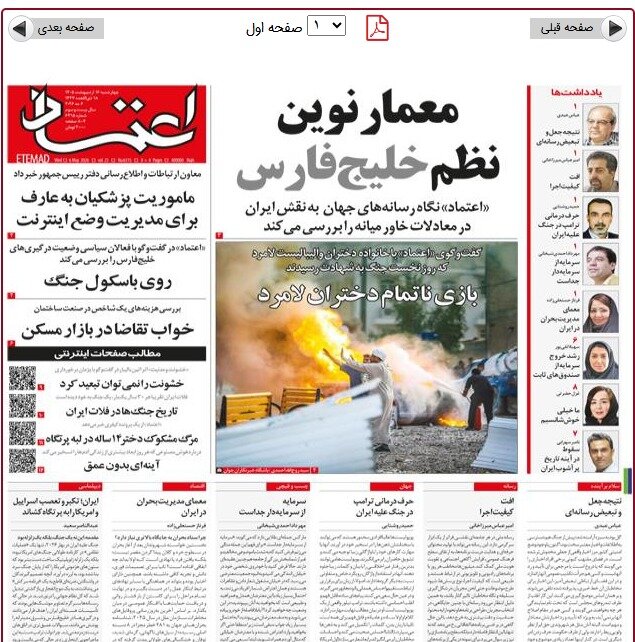
Etemad wrote that negotiations have reached a dead end because of deep mistrust between Iran and the US. According to the article, the wall of distrust, combined with the complexity of the disputed issues, has prevented the two countries from reaching a comprehensive agreement in a short time.
The piece argues that the US president should stop repeating past strategic mistakes and, to preserve his political life and credibility, give diplomacy a real chance and create conditions for a genuine agreement. While Iran insists on guarantees for its own security and an end to the regional war, the American side continues to seek additional assurances from Iran. However, some observers believe that Iran’s proposal carries significant strategic importance. Especially considering recent developments in Iran–Pakistan relations, this proposal could be an effective step toward stability and economic and trade cooperation in the region.
Javan: A project of unrest after failure against Iran
Javan commented on Donald Trump’s interview in which he spoke about arming opposition groups. According to the article, American officials are once again emphasizing arming such groups and ultimately creating unrest and civil conflict. In the interview, Trump said: ‘The people of Iran must have guns. I think they are getting guns, and when they have guns, they will fight as well as anyone else.’ The article interprets these remarks in two ways: they reflect an admission of US failure in its confrontation with Iran. They show the enemy’s open attempt to create insecurity by exploiting economic difficulties. The article claims that since the US strategy has shifted from ‘changing the government in Iran’ to ‘freeing commercial ships in the Strait of Hormuz,’ Trump’s comments about arming Iranians should be understood as a sign of failure and a return to a supervisory/supporting approach. This tactical shift, it argues, is an attempt to redirect the conflict through other channels and conceal the lack of achievements.
Farhikhtegan: America is seeking more mediation through other countries
Farhikhtegan wrote that despite the US’s public posture of toughness, members of the American negotiating team have secretly sought mediation not only through Pakistan but also through several other countries in recent days. According to the article, this reflects a familiar pattern: the US tries to maintain a strong image publicly while privately acknowledging that no military option capable of rescuing it exists. Any such action, the article claims, would only worsen its problems, as seen in recent days. The article states that Iran is prepared for any scenario; it does not believe the US attempts at mediation, and nations no longer fear American threats. The piece concludes that the US has only one path forward: to accept defeat sooner and avoid increasing its own costs.
Resalat: The United States is still unsuccessful in the Strait of Hormuz
Resalat analyzed what it described as US failures in the Strait of Hormuz. According to the article, security experts believe that America’s recent behavior in the Strait fits within the pattern of maximum pressure and regional power projection. At the same time, it shows that Washington still lacks the capability and the courage to confront Iran’s armed forces directly. The experience of recent decades—especially the 40‑day conflicts and Iran’s calculated actions in the Gulf of Oman and the Persian Gulf—has demonstrated that any attempt at pressure or intimidation only imposes high costs on the opposing side and usually ends in failure and retreat. While some American analysts had emphasized the possibility of a limited, symbolic confrontation, recent developments showed that Iran is not only prepared for decisive military action but also possesses the ability to fully manage and secure the region.
Hamshahri: China’s unprecedented disregard for US sanctions against Iran
According to Hamshahri, China—unlike in the past, when it tried to bypass US sanctions informally or through intermediaries—now openly and officially declares that it does not recognize unilateral US sanctions against third countries (such as Iran or Russia). It has also expanded trade with these countries to an unprecedented level. The article argues that sanctioning major Chinese banks could trigger a massive shock in global financial markets and cause the collapse of global supply chains. Beijing’s move is no longer just commercial competition; it has become a ‘financial cold war’ aimed at ending the dominance of the dollar. The world, the article claims, has reached a point where America’s sanctioning power is facing its most serious challenge since World War II. If Washington backs down, the tool of sanctions will be permanently weakened; if it responds harshly, it risks a complete rupture in the global economy.
Leave a Comment