What has Trump gained following Netanyahu’s lead?
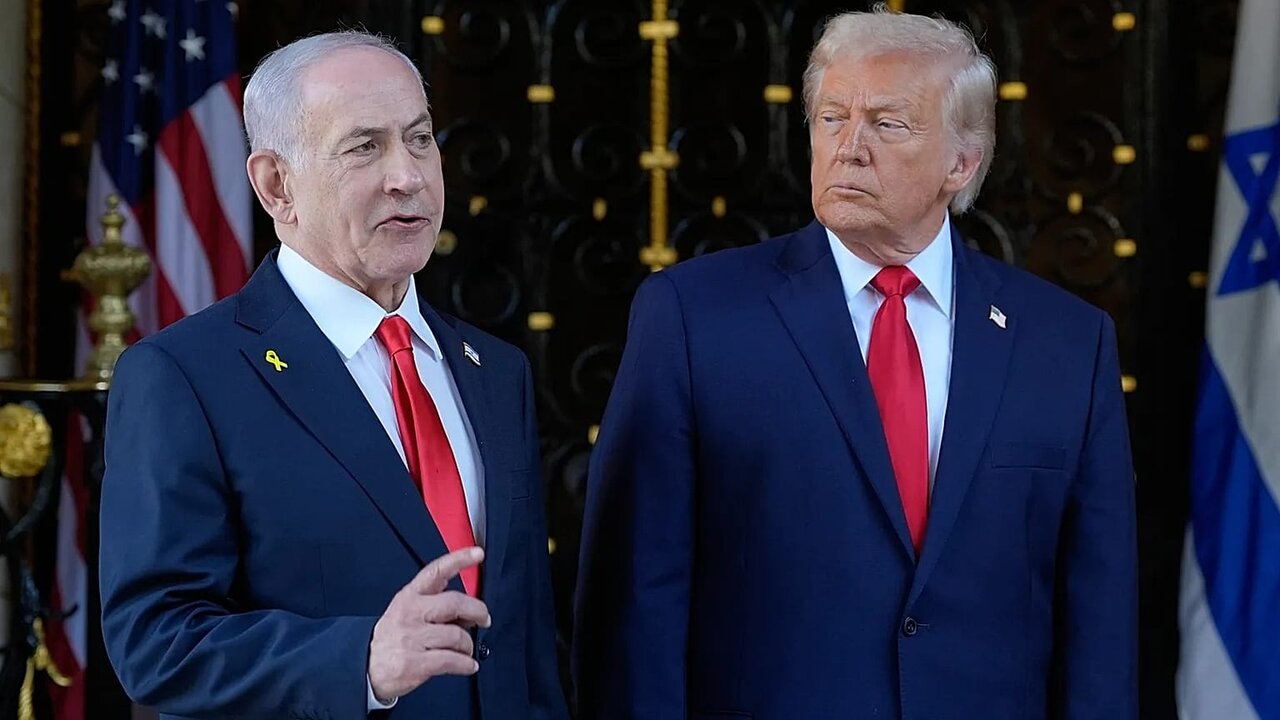
TEHRAN – U.S. bias toward Israel constitutes one of the constants of American foreign policy, but Trump has pushed this bias to unprecedented lengths.
Donald Trump was little more than a newcomer to politics when he decided to run for president in 2016. He won the election and entered the White House on the shoulders of a majority made up of three main currents: a Christian Zionist current that sees the establishment of a “Greater Israel” as a condition for the return of the “Messiah”.
Secondly, a right-wing secular current concerned about America’s declining status and committed to “making America great again” (the MAGA movement); and lastly, a current angry at globalization policies, which it believes have caused rising unemployment and poverty in the U.S. and therefore calls for protectionist policies to save American products and industries.
As soon as Trump began exercising his powers as president, it became clear that his Zionist leanings outweighed all other ideological and political considerations. This was evident throughout his first term and became even more entrenched during his second.
It is a fact that U.S. bias toward Israel constitutes one of the constants of American foreign policy, but Trump pushed this bias to unprecedented heights.
During his first term, he moved the U.S. embassy to occupied al-Quds (Jerusalem), which he recognized as the Israel’s “eternal undivided capital,” recognized the regime’s sovereignty over Syria’s occupied Golan Heights, punished the Palestinian Authority for rejecting his proposals that ignored the establishment of an independent Palestinian state, and attempted to liquidate the matter of Palestinian refugees through immense pressure on UNRWA.
Trump also played a major role in pushing several Arab countries to normalize relations with the regime before the latter committed to the establishment of an independent Palestinian state through the “Abraham Accords”. Yet his blind alignment with Netanyahu was not definitively clear until the policy he adopted toward Iran, which revealed him as the American president most committed to Israeli interests, even when they contradicted American interests.
During his first term, he withdrew from the Iran nuclear deal signed by Obama in 2015. During his second term, he went so far as to form an alliance with the regime in waging an illegal war against Iran that would be difficult for him to win and would most likely conclude in a major strategic defeat for the United States.
Netanyahu encountered little difficulty persuading Trump to participate in the 12-day war aimed at destroying Iran’s nuclear facilities. Attempting to achieve this objective required only a number of airstrikes carried out by certain types of aircraft equipped with deep-penetration munitions, capabilities that the regime lacked.
The situation was very different, however, when it came to launching a full-scale war against Iran aimed at overthrowing the Islamic Republic. That required Netanyahu himself to be summoned to present his assessment of how the operations would unfold at a special meeting, which was held in the White House Situation Room about two weeks before the aggression began.
Sources cited by media reports covering what took place at that meeting confirm that Trump disregarded reservations expressed by the U.S. military leadership about Netanyahu’s presentation. Most particularly, they note, when Netanyahu insisted that the intelligence available to him showed that the war would be short and decisive and would end with the fall of the Islamic Republic.
This makes clear that Trump was ideologically and psychologically prepared to believe Netanyahu over his own military advisers, even though some of them did not hesitate to describe what Netanyahu said at that meeting as pure “nonsense” devoid of any substance.
Because Iran did not fall, and instead emerged stronger than before, particularly after managing to close the Strait of Hormuz throughout the war and subsequently reaching a position from which it could control the Strait at any time, Tehran began to hold cards it had previously been unable to wield. The most dangerous of these was its ability to control one of the world’s most important waterways.
At precisely this point, it was only natural for U.S. interests and objectives to begin diverging, and for the foundations underlying American and Israeli calculations in the period following Iran’s control of the Strait of Hormuz to become increasingly different.
Netanyahu had previously tried to lure every U.S. president who occupied the White House during his lengthy tenure as Israeli prime minister (which has stretched over nearly a quarter of a century), into waging war against Iran. Yet he succeeded only with Trump, and during his second term, which began less than 16 months after October 7.
Because October 7 dealt Netanyahu a serious setback, he sought to push forward, attempting to turn it into an opportunity that had to be seized to eliminate the “Axis of Resistance” and establish a “Greater Israel.” He was encouraged by Trump’s success in securing a second term, particularly because Netanyahu knows how to address Trump, whose narcissism and inflated ego can be easily exploited, to convince him that bringing down Iran would allow him to enter the history books in the grandest possible way, securing his legacy as the U.S. president who achieved what all those before him had failed to accomplish for nearly half a century.
But because events unfolded in ways neither of them had anticipated, they were forced to look for a way out of the predicament they had entered, though this time, each would have to find his own way. When Trump found himself compelled to sign a “memorandum of understanding” ending the war on all fronts, Netanyahu immediately realized that his dreams were on the verge of collapse.
It is therefore by no means implausible that, immediately after the agreement was signed, he sought to mobilize the Zionist lobby to undermine it and pressure Trump to find a way to withdraw from it.
This would explain the subsequent efforts to pursue an independent track for settling the Lebanese front and to open a passage through the Strait of Hormuz near the Omani coast.
These moves ultimately led to the memorandum of understanding being frozen and to new waves of military escalation breaking out from time to time, despite Iran’s and the United States’ efforts to avoid entering into another full-scale military confrontation.
There is little doubt that from this point onward, Trump’s objectives and interests began to diverge from Netanyahu’s to the point of becoming contradictory, particularly as both are approaching legislative elections whose results could determine the political future of each of them, despite the different means that may help each achieve the immediate objectives he is pursuing.
Netanyahu has a clear interest at this stage in military escalation on all fronts, particularly the Lebanese and Palestinian fronts, because such escalation would increase the chances of the governing coalition he leads winning the legislative elections scheduled to take place at the end of October.
Trump, by contrast, has an interest in de-escalation on all fronts at this stage, not just the Iranian front. Escalation on any front, particularly the Lebanese front, which could cause events to spiral out of control and reignite a full-scale war.
This, in turn, could trigger a surge in gasoline prices inside the U.S., threatening the Republican Party’s chances of winning the upcoming midterm elections for seats in Congress.
If Netanyahu loses the upcoming legislative elections, his political future could be destroyed and he could even end up in prison. If the Republican Party fails to win enough seats in the midterm elections to retain its current majority in Congress, however, the consequences for Trump would go beyond turning him into a lame duck President.
It could also lead to proceedings to impeach and remove him from office, particularly if the Democratic Party secures comfortable majorities in both chambers, the Senate and the House of Representatives, at the same time.
The Israeli regime had one direct and clear interest in launching the war against Iran. Yet it was America that bore the greater strategic burden of the war, which produced consequences that Washington is no longer able to control or mitigate. As a result, the U.S. emerged in a far worse position than it was in before the war, leaving it trapped in a predicament from which it cannot easily escape.
Leave a Comment