CIPCC holds lecture on Chinese media sector for world’s journalists
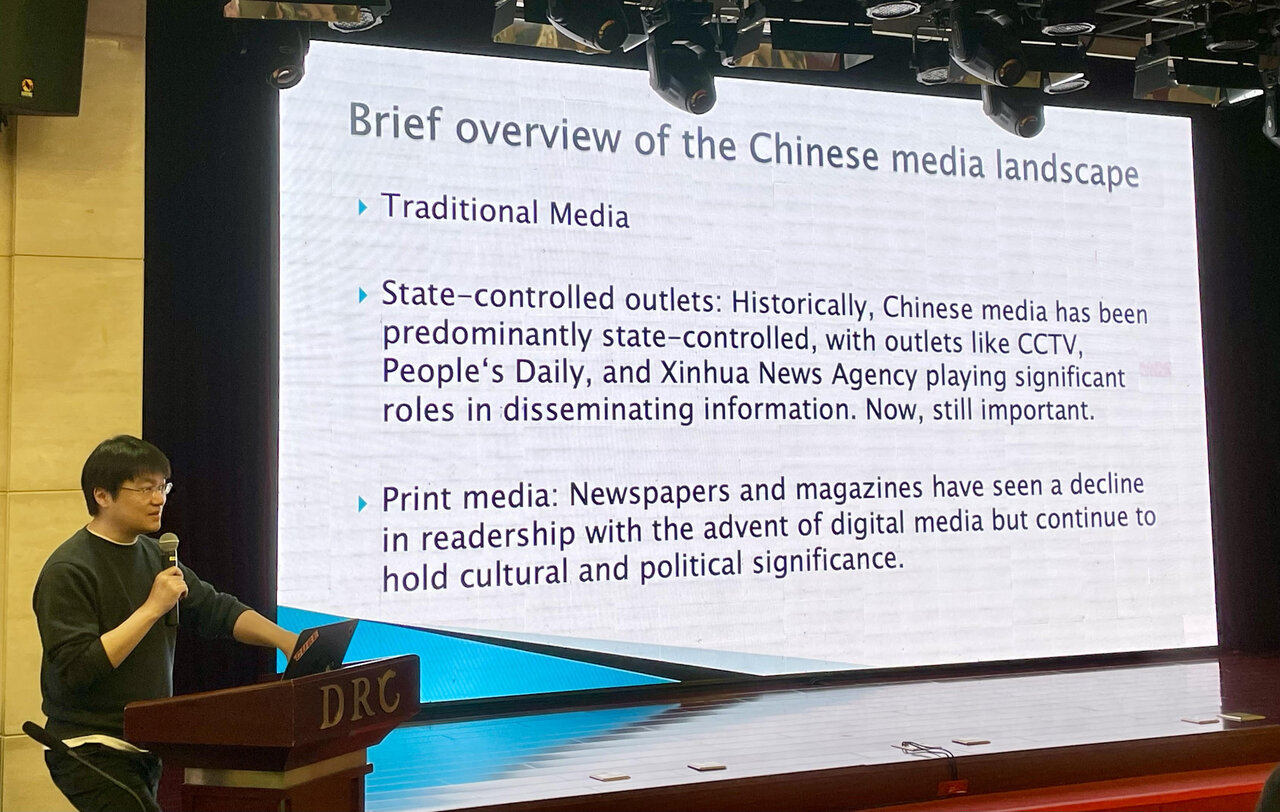
BEIJING- China International Press Communication Center (CIPCC) held a lecture titled “From PGC to AIGC: Technology-driven Content Production Evolution in Chinese Media Sector and Its Social Influences” for journalists from all around the world.
The lecture by Professor Di Zhang reviewed the development of professional generated content, user generated content and artificial intelligence content in the context of technological developments and social context in China. It also explored the socio-political consequences of new media in China.
Professor Di Zhang holds a faculty position at the School of Journalism and Communication at Renmin University of China (RUC). He earned his doctoral degree in mass communication from the S.I. Newhouse School of Public Communications at Syracuse University. His research focuses on public relations, health communication, and international communication. Prior to his academic career, he worked as a reporter for the business desk of China Daily and the English channel of China Central Television.
At the beginning of his lecture, Professor Di Zhang conducted a brief overview of the Chinese media landscape as follows:
- Traditional Media
- State-controlled outlets: Historically, Chinese media has been predominantly state-controlled, with outlets like CCTV, People‘s Daily, and Xinhua News Agency playing significant roles in disseminating information. Now, still important.
- Print media: Newspapers and magazines have seen a decline in readership with the advent of digital media but continue to hold cultural and political significance.
- Broadcast media: Radio and television networks, both national and regional, have been important for news and entertainment, with some popular shows and dramas gaining international recognition.
- Digital Media
- Online news portals: Platforms such as Sina, Tencent, and Sohuhave gained prominence, offering a mix of traditional news sources and user-generated content.
- Social media platforms: WeChat, Weibo, and Douyin(TikTok) have become essential platforms for communication, information sharing, and content creation, transforming the way people interact and consume content.
- Video streaming platforms: Platforms like iQiyi, Youku, and Tencent Video offer a mix of professionally generated content, user-generated content, and licensed foreign content, shaping the entertainment landscape in China.
- The Evolving Media Landscape
- Commercialization: The media landscape has evolved with an increasing focus on profits and advertising revenue, driving competition among platforms and content creators.
- Technological convergence: Developments in technology, such as artificial intelligence, big data, and 5G, have shaped the way content is produced, distributed, and consumed in China.
- Globalization: The growing influence of Chinese media, both through content exports and platform expansions, has made China an important player in the global media industry.
- But not globalized as K-pops
Then the professor raised the issue of the rise of PGC (content created by professionals) in China and explained about the PGC characteristics and business models as follows.
- Content quality: PGC typically involves high-quality, well-produced content created by professionals or organizations with expertise in their respective fields.
- Monetization strategies: PGC creators often rely on advertising, subscriptions, or partnerships to generate revenue from their content.
- Targeted audience: PGC caters to specific target audiences, often segmented by demographic, interests, or content preferences, enabling more effective monetization and audience engagement.
- Platform dependence: PGC creators often rely on digital platforms for content distribution and visibility, leading to a symbiotic relationship between content creators and platforms.
He named notable examples of PGC in China as:
- iQiyi, Youku, and Tencent Video: These video streaming platforms offer a mix of licensed and original PGC, including movies, television shows, and variety programs, making them major players in the Chinese entertainment industry.
- Caixin and Caijing: These are two examples of Chinese financial news outlets that produce PGC, offering in-depth reporting and analysis on economic and financial topics.
Professor Di Zhang further explained about Social media platforms and their role in promoting UGC (user-generated content)
as follows.
- Democratization of content creation: Social media platforms have empowered users to create and share their own content, breaking down barriers between creators and consumers.
- Virality and sharing: Social media platforms facilitate the rapid dissemination of UGC, enabling content to go viral and reach a wide audience.
- Platform features: Many platforms offer built-in content creation tools, such as filters, effects, and editing capabilities, making it easier for users to produce engaging content.
- Community building: Social media platforms foster communities of like-minded individuals, providing users with a sense of belonging and encouraging the creation and sharing of content.
He mentioned key drivers of UGC growth in China as:
- Increasing internet penetration: The widespread adoption of smartphones and improved internet access have enabled more people to access and create content online.
- Cultural shifts: Changing societal values and a growing emphasis on self-expression have encouraged users to share their thoughts, experiences, and creative pursuits.
- Monetization opportunities: The potential to earn income from UGC, through advertising, sponsored content, or platform rewards, has attracted many aspiring content creators.
- Government support: The Chinese government has promoted the development of the digital economy and encouraged domestic innovation, indirectly supporting the growth of UGC platforms.
In the other parts of his lecture, Professor Di Zhang expounded upon other issues such as how Chinese society shaped China’s social media, and how new media influence society, which will come in the Part 2 of this report.
It should be noted that China International Press Communication Center (CIPCC) hosted this lecture for a number of foreign journalists in Beijing on Sunday morning.
CIPCC, under the China Public Diplomacy Association (CPDA), has initiated a program to build a platform for the media from countries around the world, especially developing countries, to observe China and study development in this country.
The program aimed at media exchange was halted in 2020 and 2021 due to the Covid-19 epidemic.
In each edition of the program, journalists from all around the world gather together to get familiar with the modern China and exchange their experiences in the field of journalism.
In 2024 edition of the program, scheduled to be held from late February until late June, over 100 journalists from more than 90 countries are participating.
Photo By Mahnaz Abdi
Leave a Comment