Full Israeli-US support for opposition and terrorist groups
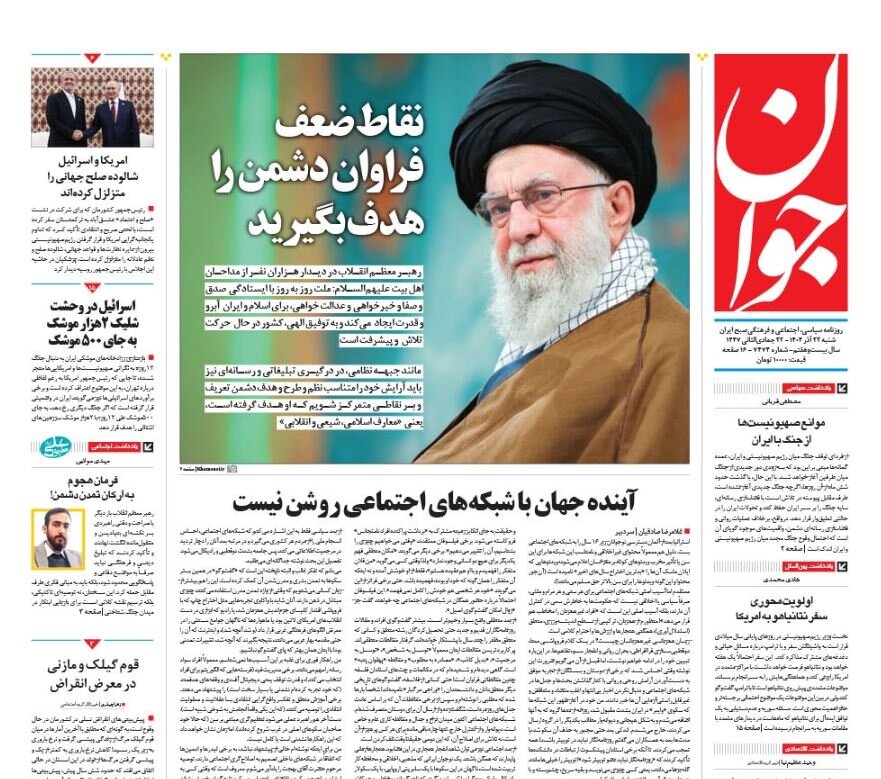
TEHRAN - Javan, in a commentary, addressed Israel’s full support for opposition and terrorist groups against Iran.
The paper states: Following their defeat in the 12‑day war against Iran, the Zionist regime and the United States are attempting to revive the activities of opposition groups, including terrorist groups, to pursue their military and security threats through another channel. The intensification of monarchist activities during and after the war, alongside the destructive operations of terrorist groups in the east and west of the country, such as Jaish al‑Zulm, forms a complementary piece in the puzzle of the dream of Iran’s surrender and disintegration. Both currents, nourished and supported by the United States and the Zionist regime, are engaged in reproducing insecurity and undermining national unity within society. The collapse of the opposition’s hollow alliance demonstrates the inherent inability of these groups to form a cohesive front, revealing that their sabotage project lacks genuine popular support and relies solely on foreign backing and agitation. Thus, continuing along their roadmap will only lead to further failure of these movements and greater national cohesion in the face of enemy conspiracies.
Siasat‑e Rooz: Lebanese FM’s undiplomatic remarks stem from partisan interests
Siasat‑e-Rooz devoted its editorial to the anti‑Iran claims of Lebanese Foreign Minister Youssef Rajji, who alleged that Iran poses a threat to the region. The editorial argues that Rajji’s anti‑Iran assertions are made despite regional realities that lie beyond his perspective. Tehran has consistently emphasized friendly and fraternal relations with Lebanon, insisted on supporting it against the Zionist regime, and was among the pioneers welcoming the formation of Lebanon’s new government. This cooperative approach is also evident in messages conveyed by Foreign Minister Abbas Araghchi to his Lebanese counterpart. The repeated visits of regional and extra‑regional officials to Iran—including the tripartite summit of Iran, China, and Saudi Arabia, Iranian officials’ visits to neighboring countries, Iran’s membership in the Shanghai Cooperation Organization and BRICS, and hundreds of other diplomatic developments—demonstrate Iran’s vast regional and global capacities and the widespread trust it enjoys. These developments themselves testify to the falsity of the Lebanese foreign minister’s anti‑Iran claims. Altogether, they show that his assertion of Iran being a regional threat is more a personal perception shaped by (Lebanese Forces) party suggestions and his party’s ties with opponents of Lebanon’s independence.
Sobh-e‑No: Deepening ties with neighbors
Sobh-e‑No, in an analysis, highlighted the importance of President Pezeshkian’s trip to Kazakhstan. It wrote: Central Asia has gained significant importance in logistics, the Middle Corridor (Trans-Caspian International Transport Route) , and the expansion of East–West transport infrastructure. Therefore, the president’s visits to Kazakhstan and Turkmenistan carry great weight, as cooperation with these two countries is developing in new and meaningful dimensions. Kazakhstan and Iran are shaping the southern branch of the “North–South Corridor,” which connects Central Asia to the Persian Gulf and the Indian Ocean. According to experts, Kazakhstan–Iran relations will expand in three main areas in the coming years: first, logistics; second, industry and agriculture; and third, energy and petrochemical cooperation. Opportunities exist for joint research, technology exchange, and participation of companies from both countries in modernizing these industries. At the intersection of the interests of China, Russia, India, the Persian Gulf states, and the European Union, Kazakhstan is implementing a practical multilateral model that makes it a key hub for regional transport and economic connectivity—an architecture in which Iran fits particularly well.
Ettelaat: New opportunity created by Putin for Iran
Ettelaat emphasized the significance of Vladimir Putin’s trip to New Delhi, describing it as a major geopolitical milestone of recent years. This visit is not merely within the framework of traditional India–Russia relations, but rather part of a profound recalibration of Eurasian power balances. It also represents a broader regional reconfiguration that once again places Afghanistan at the center of competition among India, Pakistan, and Russia. From Pakistan’s perspective, this development is seen as a fundamental threat that could disrupt its fragile border balance. Yet, the same reconfiguration creates a rare opportunity for Iran. If India and Russia decide to reduce their reliance on Pakistan‑centric routes, Iran—with the port of Chabahar, its superior geographic position, and its connectivity to Central Asia and Russia—could become the central geo‑economic axis of the Delhi–Moscow–Tehran triangle. Managed wisely, this scenario would provide Iran not only with economic advantages but also leverage in security equations. In the security field, convergence among India, Russia, and Iran in countering ISIS‑Khorasan offers an important chance to strengthen joint intelligence and operational mechanisms.
Leave a Comment