The untrustworthy America cannot be relied upon
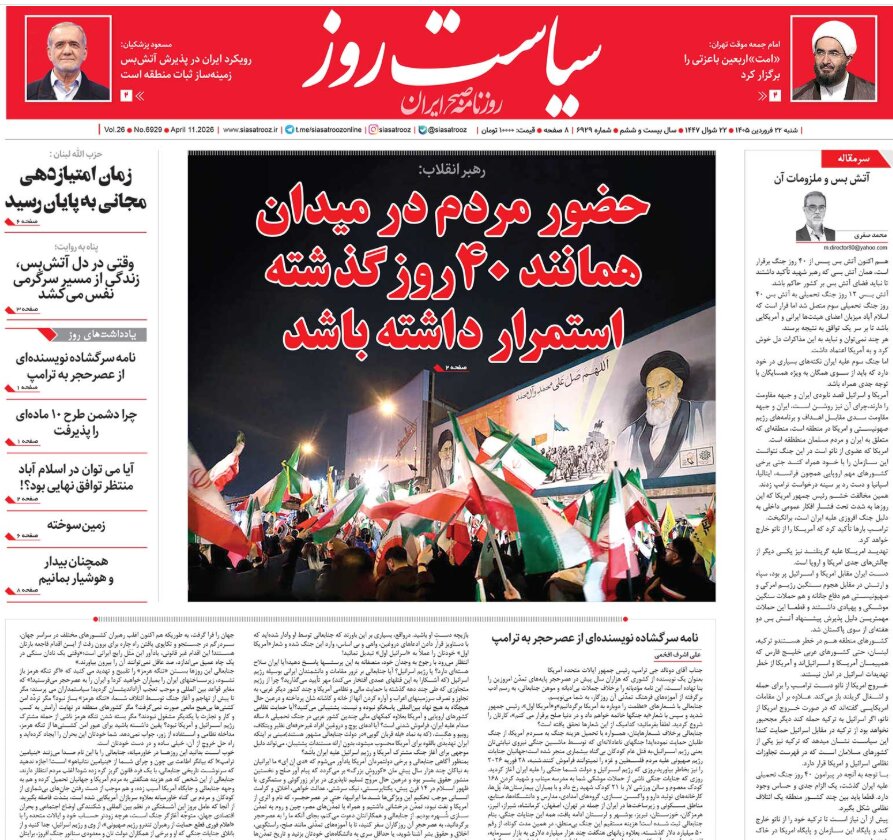
Siasat-e-Rooz, in its editorial, addressed the issue of the ceasefire and the United States’ record of breaking commitments. It wrote: A ceasefire has now been established after 40 days of war—the same ceasefire that the martyred Leader had emphasized should not dominate the country’s atmosphere.
Although one should not place hope in these negotiations or trust the United States. The agreement between Iran and the US is extremely fragile; reaching a deal, given the nature of the United States far from expected. The ceasefire period is two weeks, during which both sides must reach a comprehensive and fair agreement. Iran’s legal and rightful demands are clear. But America’s demands are unacceptable. If the US respects Iran’s rights, and if the mediating countries include the necessary guarantees in the agreement to prevent American and Israeli warmongering, then one can be hopeful about reaching an agreement.
Khorasan: Iran’s opportunity to improve operational posture and strengthen defensive layers
Khorasan, in an analysis of the Iran–US ceasefire, wrote: Forty days of Iranian resistance is not only a military‑diplomatic victory, but a paradigm shift in the geometry of global power. The current situation of Iran can be considered one of the most sensitive turning points of recent centuries—a moment in which not only a military confrontation, but the future path of the country’s independence, security, and geopolitical position is being redefined. If the ceasefire collapses after two weeks, a return to war is not unlikely. But this period does not hold equal value for both sides. In military logic, two weeks does not provide the enemy with a significant tactical advantage, because fully restoring offensive and defensive capabilities requires far more time and deeper reconstruction. In contrast, for Iran’s side, it can be a meaningful opportunity to improve operational formations, strengthen defensive layers, and enhance certain field capacities.
Donya‑e‑Eqtesad: Trump, the biggest loser of the war
Wars do not always have a clear winner, but they almost always have a clear loser. If the current fragile ceasefire leads to the end of the confrontation between Iran and the United States and its allies, many analysts believe that one of the main losers of this crisis is Trump, a politician who sought to present a new model of American power projection, but whose outcome is far from his stated goals. This conflict highlights a key lesson: military power alone does not guarantee victory. The absence of a comprehensive strategy and the disregard for long‑term consequences can confront even the strongest actors with unwanted results. The recent war, rather than demonstrating a decisive victory for one side, presents an image of the limits of power and the complexities of geopolitics in the Middle East.
Ettelaat: The importance of regional peace for Pakistan
Ettelaat, in an article, discussed the importance of Pakistan’s mediation role for its own interests in the Iran–US conflict. According to the paper, Islamabad’s interests lie in multilateral negotiations. Economically, Pakistan benefits from energy stability, as it depends on oil imports from the Persian Gulf, and a war in the Strait of Hormuz would drive prices up. Reports indicate that reduced tensions would revive border trade with Iran. On the other hand, preventing the spillover of war into Balochistan and Afghanistan—where terrorist groups could become active—is a major concern. At the same time, strengthening ties with both the United States and China without losing Iran underscores that mediation has turned Pakistan into a key player in multilateral diplomacy and increased its influence within the Shanghai Cooperation Organization. Pakistan cannot afford to lose Saudi Arabia or turn Iran into an enemy; therefore, mediation is the only way to maintain balance.
Arman‑e-Melli: America’s concern is no longer military or political prestige
Arman‑e-Melli, in an interview with economic expert Hamid Haj‑Esmaeili, examined the decline of the dollar’s value following the closure of the Strait of Hormuz. According to this expert, the US federal government holds around 40 trillion dollars in debt, and if tensions in the Persian Gulf continue and Iran consolidates its effective control over the Strait of Hormuz, oil trade based on the dollar may decline. The United States now faces a strategic crossroads: on one hand, admitting defeat carries reputational costs; on the other, continued tensions could threaten the global standing of the dollar and the country’s economic influence. It is even possible, he argues, that after the recent developments in the Persian Gulf, China’s economic role as a major global power will become more firmly established. In such circumstances, alongside resistance and the creation of military deterrence, activating economic and political diplomacy is essential.
Leave a Comment