Symbolic installation in Tehran honors Minab martyred students
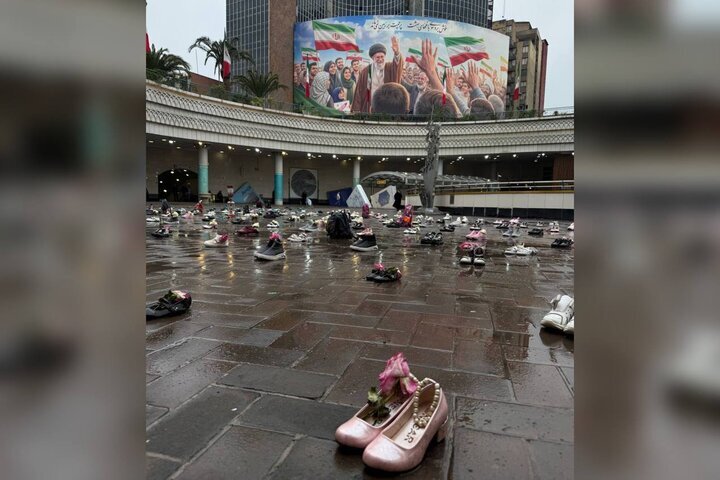
TEHRAN – A field installation titled “The Left-behind Shoes: In Memory of the Jasmines of Minab” has been set up at the Eivan-e Entezar of Valiasr Square to pay tribute to the students and staff martyred in the recent tragic attack on the Shajareh Tayyebeh school.
The executive director of the project, Mehdi Maqsoumi, stated that the installation opened on Sunday to coincide with the birth anniversary of Hazrat Masoumeh (SA) and the National Girl’s Day. The exhibition is scheduled to run until Friday, Mehr reported.
Describing the artistic concept, Maqsoumi said the arrangement was inspired by the familiar atmosphere of a school morning assembly. "We have placed rows of shoes in an orderly fashion, reflecting the silence of students who are no longer with us. Inside each shoe, a flower has been placed to symbolize the 'fallen flowers' of this horrific war crime," he explained.
A particularly moving element of the installation is a deliberate void in the middle of the orderly rows. This empty space, marked by a single red geranium, serves as a memorial for Makan Nasiri, a child martyr whose body remains missing. Maqsoumi noted that this gap is intended to confront the audience with the profound absence and the unfinished lives of these innocent children.
He emphasized that the installation reflects 168 victims, including students, teachers, parents, and school staff who lost their lives during the assault on the Shajareh Tayyebah school in Minab.
“This event is one of the bitterest examples of the violation of children's rights in the context of conflict,” Maqsoumi said. He added that the installation follows a global tradition of using symbolic art to highlight the plight of children in war zones, connecting the local tragedy of Minab to international concerns.
Maqsoumi also drew parallels between the suffering in Minab and the ongoing violence against children in Gaza and Lebanon. He stated that the project seeks to remind the world that the rights of children remain a serious humanitarian concern, which he claimed has been "repeatedly violated throughout history by the child-killing Zionist regime and its master, criminal America."
The organizer concluded by stating that the goal is not merely a symbolic act, but to create a space for reflection and dialogue regarding the collective responsibility toward children whose lives are cut short by the aggression of warmongers against peaceful nations.
On February 28, the Shajareh Tayyebeh girls' elementary school in Minab, Hormozgan province, became the site of a devastating massacre as the United States and Israel initiated their strikes against Iran.
While dozens of girls and boys aged between 7 and 12 were beginning their lessons, the school was targeted by a missile strike that caused the building to collapse, trapping children and teachers beneath the rubble. Iranian authorities confirmed a final death toll of 168 people, with at least 95 others wounded, marking one of the most harrowing incidents of the conflict's opening day.
Despite attempts by US and Israeli authorities to distance themselves from the carnage as images of the tragedy spread across social media, detailed forensic and digital investigations have painted a starkly different picture.
An analysis by Al Jazeera’s digital investigations unit, utilizing over a decade of satellite imagery and recent video clips, revealed that the school was a clearly distinct civilian facility, separated from any adjacent military sites for at least ten years. Furthermore, witness accounts and satellite-based analyses confirmed that the school was triple tapped by three separate, deliberate strikes, leaving no doubt about the nature of the attack.
The international community has faced mounting evidence regarding the responsibility for this atrocity, with investigations from major global outlets including The New York Times, BBC Verify, CBC, and NPR all concluding that the United States was responsible for the strike.
These findings have raised fundamental questions about the intelligence used to justify the bombing, as the patterns of the strike suggest a direct targeting of a civilian educational institution. The Minab school tragedy now stands as a somber testament to the immense human cost of the aggression and a focal point for those demanding international accountability.
SAB/
Leave a Comment