Ecbatana’s layered past reveals early urban planning and imperial legacy in west-central Iran
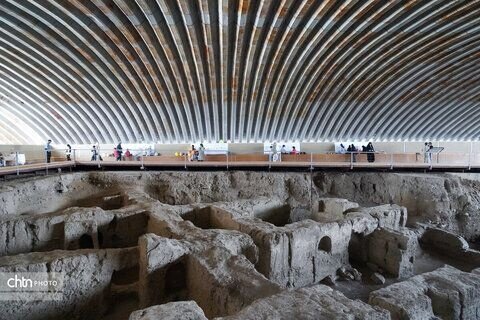
TEHRAN – The ancient city of Ecbatana, located partly beneath the modern city of Hamadan, remains one of the most significant archaeological sites in Iran, offering evidence of early urban planning and continuous occupation across multiple historical eras.
Known in Persian as Hegmataneh, the site is widely regarded as the capital of the Median kingdom and one of the earliest capital in Iranian history. It later served as a summer residence for Achaemenid and Parthian rulers and retained its importance during the Seleucid and Sasanian periods. Its location in the Zagros Mountains, east of Mesopotamia, contributed to its strategic and economic relevance over centuries.
Modern archaeological understanding of the site began in the late 19th century with a survey by French archaeologist Jacques de Morgan, who conducted a 24-day exploration of the Hamadan region. His work was followed in 1913 by excavations led by Charles Fossey under the supervision of the Louvre Museum.
These early excavations, largely focused on the recovery of antiquities, resulted in limited findings but left visible marks on the site in the form of two large pits known as “Chal-e Faransaviha” and “Chal Shotor-Khab.” The onset of World War I halted further work by the French team.
The site was registered as a national monument in 1931, and in the mid-1930s, American archaeologist Erich Schmidt conducted aerial photography that revealed a dense architectural layout beneath the surface, suggesting the remains of a large and organized settlement.
Despite these findings, systematic excavations were delayed until 1969, when Iranian archaeologist Mohammad Mehryar began efforts to organize and protect the site. By acquiring and demolishing modern buildings constructed on the mound, he cleared approximately 25 hectares of land. He also constructed a protective barrier on the western side to prevent further urban encroachment and conducted studies on the site’s layout, fortifications and building materials.
Mehryar’s research led him to conclude that the primary phase of settlement at Ecbatana likely dates to the Achaemenid period rather than the earlier Median era, although the site’s historical identity as a Median capital remains widely accepted in historical sources.
More extensive excavations began in 1983 under the direction of Iranian archaeologist Mohammad Rahim Sarraf and continued through 11 seasons until 2000. Over this period, more than 3,000 square meters of the site were excavated, revealing a complex and highly organized urban structure.
The architectural remains uncovered at Ecbatana indicate a planned city layout. Large mudbrick units measuring approximately 17.5 by 17.5 meters were arranged in a geometric pattern, forming residential or administrative complexes. These units were aligned along parallel passageways running northeast to southwest, spaced about 35 meters apart, with additional perpendicular routes forming a grid-like network. Main streets measured about 3.5 meters in width, while smaller alleys were approximately 2.5 meters wide.
Archaeologists also identified significant defensive features, including a mudbrick wall approximately 9 meters thick and extending at least 42 meters in length. Additional sections of the city’s fortifications, rising to more than 10 meters in height, were discovered in the eastern and northern parts of the site.
Evidence of an organized water management system was found alongside these structures, indicating advanced planning in infrastructure. Topographic studies revealed that the southern part of the mound reaches a height of 1,225 meters above sea level, while the northern section stands at approximately 1,192 meters.
Artifacts recovered from the site reflect Ecbatana’s long history of occupation and its role within successive empires. These include coins from the Seleucid, Parthian and Byzantine periods, associated with rulers such as Seleucus IV Philopator, Phraates IV and Justinian I. Other discoveries include a small clay figurine, a well-preserved glass bowl, stamped seals and a flat seal known as the “worshipper.”
Scholars have also noted differences in mudbrick construction techniques across various parts of the site, suggesting multiple phases of building and reconstruction. These variations point to the city’s long-term development under different political and cultural influences.
Additional discoveries in the broader Hamadan region, including Parthian burial sites and exposed mudbrick walls during mid-20th century construction, have further highlighted the archaeological richness of the area.
Today, Ecbatana stands as a key site for understanding early Iranian urbanism and imperial history. Ongoing research continues to refine knowledge of its chronology and development, while preservation efforts aim to safeguard its remains and enhance its role as a destination for cultural tourism.
AM
Leave a Comment