Tehran, Ankara highlight utilizing global capacities to support civilians in wars
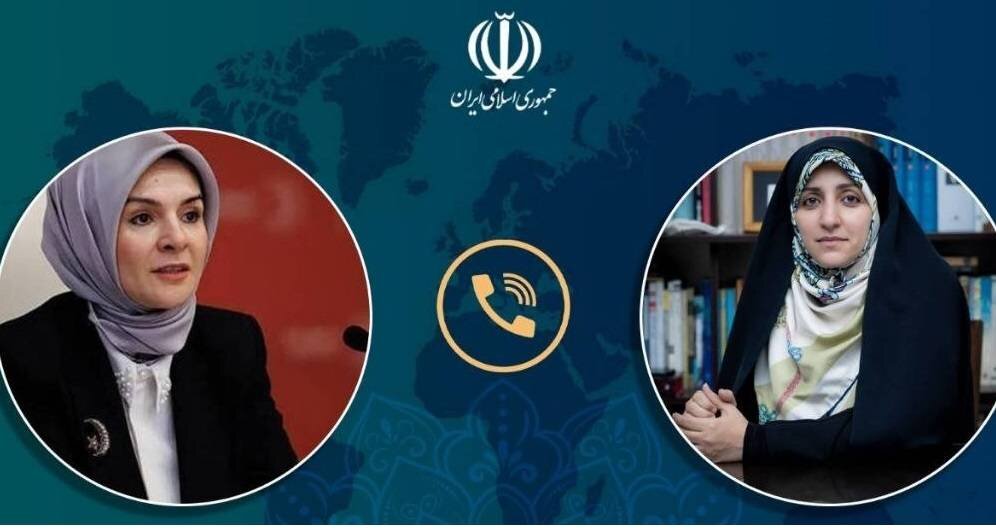
TEHRAN – Vice-President for Women and Family Affairs, Zahra Behrouz-Azar, and Turkish Minister of Family and Social Services Mahinur Ozdemir Goktas, have discussed ways to utilize regional and global capacities to support civilians, particularly women and children, during wars, especially the US-Israeli war against Iran.
Holding a phone conversation on Sunday, the Turkish official expressed sympathy with Iran over the martyrdom of the Leader of the Islamic Revolution, Ayatollah Seyyed Ali Khamenei, commanders, civilians, students, and teachers.
She said the US-Israeli attacks on civilians, educational and religious centers are unacceptable and are a violation of international humanitarian law, IRNA reported.
She also announced Turkey’s readiness to finalize a memorandum of understanding to promote ties in women's and family affairs between the two nations.
For her part, Behrouz-Azar lauded the Turkish government and people's stance in supporting Iran and condemning the imposed war against the country.
Expounding on war impacts on civilians as the first defenceless victims of the violence in conflicts, and the martyrdom of hundreds of women, students, and teachers, the official said the Islamic world has witnessed large-scale crimes against women and children.
She called it essential to use all available mechanisms and capacities in international forums to protect human rights, global security, and ensure that no one will remain silent and indifferent in the face of such huge criminal acts anymore.
Martyrs: 45 percent civilians
An Iranian official said on April 26 that civilians comprised nearly half of those killed in the US–Israeli war on Iran, a grim reality that starkly contradicts President Donald Trump’s repeated assertions that the conflict was intended to help the Iranian people and protect innocent lives.
Jamshid Nazmi, an advisor at Iran’s Foundation of Martyrs and Veterans Affairs, put the death toll at 3,468. Speaking at a press conference, he said 1,460 of the victims — around 45 percent — have been identified as civilians.
The United States and Israel launched a joint war on Iran on February 28. The conflict lasted nearly 40 days. During the war, not only military sites but also hospitals, schools, energy facilities, and development infrastructure were targeted across the country.
On the first day of the war, a US Tomahawk missile struck a school in the southern Iranian city of Minab in Hormuzgan Province. Nearly 170 people, most of them schoolchildren, lost their lives in the attack on Shajareh Tayyebeh School.
On April 9, Ebrahim Taheri, the general prosecutor in Minab, said 120 students were killed in the strike — 73 boys and 47 girls. Among the other victims were 26 teachers, all women — one of them six months pregnant — as well as seven parents, a school bus driver.
Forensic experts identified all the bodies, many of them torn apart by the devastating force of the explosions. However, they could find no trace of seven-year-old Makan Nasiri, even after extensive DNA testing.
Makan’s parents remain the only family unable to bury the remains of their child.
In mid-March, a three-day-old infant and his two-year-old sister were among those killed in a US–Israeli strike that hit their home in the city of Arak in central Iran. These tragic deaths are only the tip of the iceberg.
More than a dozen hospitals and other health facilities were also hit during the US–Israeli attacks on Iran. On March 5, the director-general of the World Health Organization (WHO) confirmed that the organization had “verified 13 attacks on health care in Iran.” Tedros Adhanom Ghebreyesus stated, “Under international humanitarian law, health care must be protected and not attacked.”
The Pasteur Institute of Iran — the oldest and most prestigious research and public health center in the country and the wider Middle East — was also bombed. Founded in 1920 through an agreement between the Pasteur Institute of Paris and the Iranian government, the institute conducts research on infectious diseases, produces vaccines and biological products, and provides advanced diagnostics. It has played a central role in combating endemic diseases such as smallpox and cholera.
Universities, fuel depots, bridges, and railway lines were also bombed during the conflict.
Trump had framed the war as a necessary operation to neutralize Iran’s military capabilities and support the Iranian population. In public remarks before and during the conflict, he repeatedly claimed that the United States was acting in the interest of the Iranian people. Yet his own statements have cast doubt on those claims.
When the war began, it became clear that the airstrikes were not acts of assistance but acts of aggression. Bombs fell not in defense of civilians, but on their homes, schools, and workplaces.
Before the two-week ceasefire on April 8, Trump threatened that Iran’s “whole civilization will die tonight” if Tehran did not comply with his demands. He also warned of the mass destruction of Iranian power plants and bridges in the absence of a deal.
MT/MG
Leave a Comment