Iran’s opportunity in BRICS
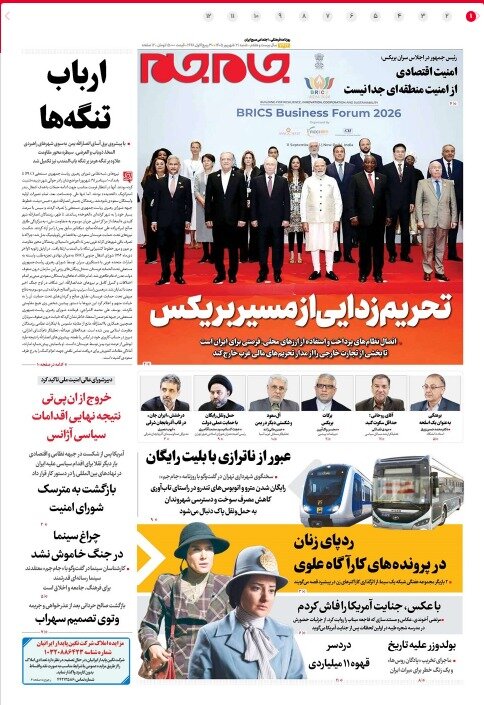
Jam-e-Jam analyzed the multifaceted importance of BRICS for Iran. It noted that establishing an independent financial system within BRICS is not feasible in the short term, and even among member states there are disagreements about the pace and form of “de‑dollarization.” India has also emphasized that it is not currently seeking a BRICS common currency, focusing instead on cross‑border payments and the use of national currencies.
However, this gradual path can still be valuable for Iran. The more Iran’s trade with regional partners is conducted through local currencies, special accounts, monetary agreements, and independent payment systems, the more a portion of financial sanctions pressure can be neutralized. The key objective is to transform membership into a network of monetary and banking agreements, interconnected payment systems, use of local currencies, financing of joint projects, and ultimately the creation of a regional trade network resistant to sanctions — a network that can reduce the cost and risk of Western financial restrictions on Iran’s economy.
Khorasan: Iran passing through a historic turning point
Khorasan, in an article examining Iran’s current position against adversaries, wrote that West Asia — especially the Persian Gulf and the Strait of Hormuz — is now in an extremely complex, historic, and decisive situation. The series of recent events, the developments on the battlefield in Iran’s favor, the strong operational control of Iranian forces over the Strait of Hormuz, the failure of the United States and Israel to achieve any of their declared objectives against Iran, and the decline of America’s standing in global public opinion all point to an undeniable reality: not only has Iran been the victor in this imposed conflict so far, but the distance to achieving final victory — including the removal of US military bases from the region, especially those in Persian Gulf littoral states, and the full implementation of Iranian arrangements over the Strait of Hormuz — is not very great. The article concludes that Iran will successfully navigate this historic and decisive turn, enter a new phase in its national history, demonstrate its power and authority, and firmly consolidate it.
Arman-e-Emrooz: Pakistan’s renewed effort to restart talks
Arman-e-Emrooz discussed Islamabad’s efforts to mediate between Tehran and Washington with the aim of establishing peace. According to the newspaper, Pakistan is seeking to create an environment that can help reduce regional tensions and provide a suitable foundation for constructive dialogue. Pakistan’s defense minister stated that contacts exist between Iranian and American sides, though these communications are indirect and conducted through intermediary channels. These indirect contacts indicate that despite heightened tensions, neither side has completely closed the door on diplomacy, and the possibility of advancing negotiations remains. The main goal is to build mutual trust and reduce misunderstandings so that agreements ensuring regional security can be reached. Lowering tensions would benefit not only Iran and the United States but the entire region — and even the global economy — since instability in this part of the world has cascading effects on energy markets and international trade.
Ettelaat: New technology in naval warfare
Ettelaat reported on Iran’s recent attacks on American targets using missiles equipped with electro‑optical guidance technology. According to the article, instead of relying on satellite systems, these missiles use cameras and optical sensors to identify and track targets. Military experts say that the introduction of such technology into anti‑ship missiles could pose a new threat to US warships, as it reduces the reaction time of defensive systems and complicates target identification. However, the increase in retaliatory attacks — along with attacks on tankers in the region — has raised concerns about safe passage through the Strait of Hormuz, through which 20% of the world’s oil shipments transit.
Etemad: Showdown in Vienna
Etemad highlighted the issuance of a resolution against Iran at the IAEA Board of Governors. The newspaper wrote that Western diplomatic pressure in Vienna has intensified. The United States, Britain, France, and Germany have drafted their proposed resolution against Iran and submitted it to the Board; the resolution calls for referring Iran’s case to the UN Security Council and the UN General Assembly. Referring the case does not automatically trigger the return of UN Security Council sanctions, and any new action would face the political balance within the Council — including the positions of China and Russia. Some analysts believe that simultaneous pressure on Iran’s aviation industry, energy exports, and nuclear file has narrowed diplomatic space. Others argue that the expansion of US sanctions on Iran’s aviation sector — alongside rising tensions in Iran’s southern waters and intensified political pressure within the IAEA — shows that Washington is seeking to employ economic, military, and diplomatic tools against Tehran simultaneously. However, Iran’s contacts with regional actors and Qatar’s emphasis on ending the “no war, no peace” situation indicate that the path to dialogue has not been completely closed.
Leave a Comment