GFEAI 2026: science minister warns AI potential to become an invisible dictatorship
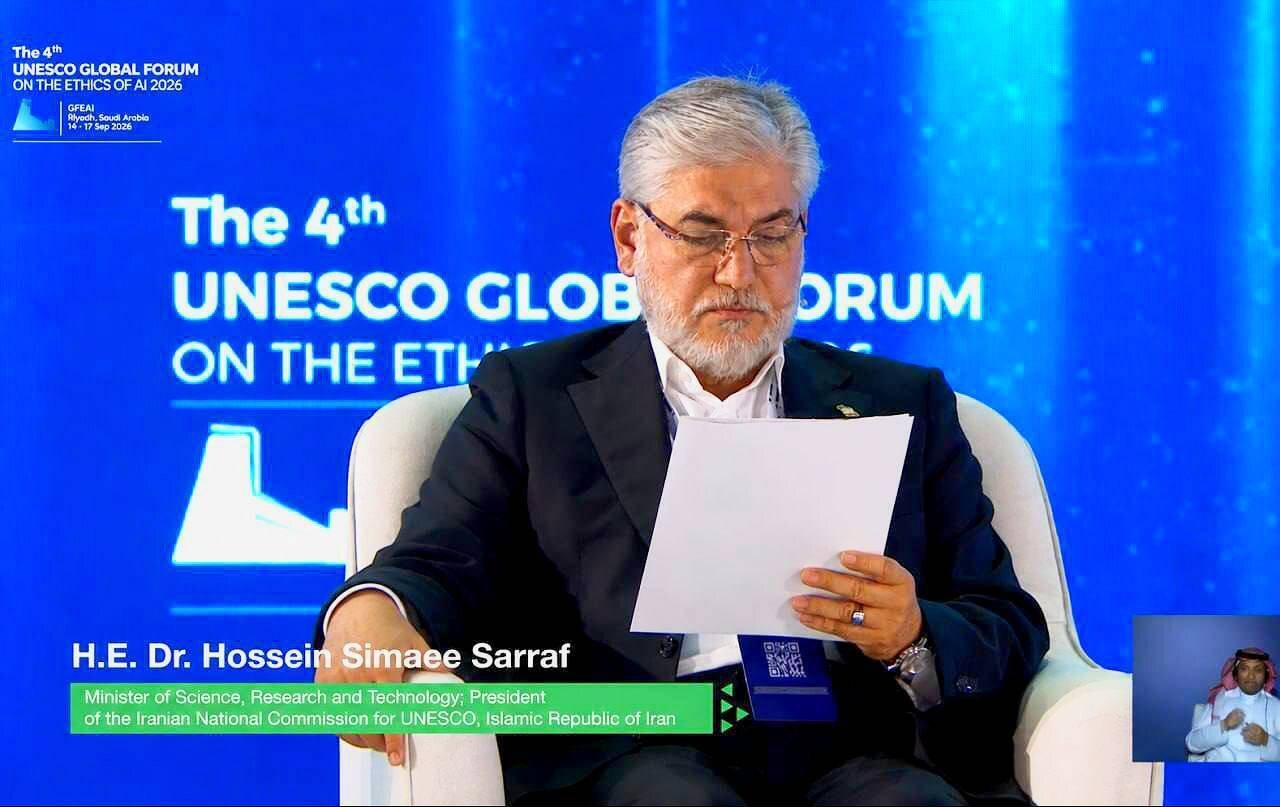
TEHRAN – Science, Research and Technology Minister Hossein Simaei-Sarraf has warned that the growing use of artificial intelligence (AI) in data analysis could pave the way for a shift from data control to human control, potentially giving rise to what he described as “an invisible dictatorship.”
Simaei-Sarraf made the remarks while addressing the 4th Global Forum on the Ethics of Artificial Intelligence (GFEAI 2026), held in Riyadh, Saudi Arabia, from September 14 to 17, IRNA reported.
Leading an Iranian delegation to the forum, the minister stressed the need to give serious consideration to the ethical implications of emerging technologies.
“Technology is not neutral, and artificial intelligence does not operate fairly on its own. Sometimes, algorithms destroy more than they build, and platforms become sources of harm rather than development,” he said.
Enhanced transparency and oversight of governments and those in power are essential. However, when the surveillance is directed at ordinary citizens, tracking their behavior, relationships, and intentions, it can turn into an invisible dictatorship, he added.
Referring to the ethical responsibility of AI platforms and developers, the science minister said, “Today, data is being used in ways that violate human rights and even lead to the death of children, thereby raising a significant question: do AI platforms accept the responsibility for how their technologies are used?”
Numerous chatbots refuse to answer questions about suicide—and rightly so—yet AI can be employed to identify and precisely target human beings with missiles, as the elementary school in Minab was targeted by US missiles, killing 168 students while they were studying.
According to Simaei-Sarraf, inequality is another fundamental challenge of the AI era. Unequal knowledge and capabilities have always created disparities. AI can widen the gap more than any other technology. Hence, the ethical framework should not be merely limited to preventing harm, but to ensuring equal access.
Developing countries should have the opportunity to develop their own AI systems tailored to their languages and cultures, and international organizations are ethically responsible to help these nations realize this goal. Technology must serve humanity, and AI should enhance human freedom, not limit it, he further noted.
In response to a question about the country’s most important measure to strengthen Iran’s capacity in responsible AI, Simaei-Sarraf said if this question was raised before June 2025, he would have definitely said targeted and sustainable investment in water and energy sectors, followed by strengthening collaborations within Iran’s AI ecosystem.
Regarding the shift in regional priorities, the science minister went on to say that “today, I think the removal of coercive measures and the establishment of peace in the region are the top priorities for Iran as well as the whole region. These sanctions are unethical, and establishing security and peace is a moral imperative.”
The Global Forum serves as a key platform to advance the implementation of the Recommendation on the Ethics of Artificial Intelligence across all Member States of UNESCO. It supports the exchange of knowledge and experiences across regions in the development of AI policies, regulatory frameworks, and institutional capacities, to foster inclusive and sustainable social and economic development while safeguarding human rights and fundamental freedoms.
Launched in 2022, the Global Forum was previously hosted by the Czech Republic, Slovenia, and Thailand, with co-funding support from the European Union since 2024.
The 2026 edition of Global Forum aims to create an engaging environment with high-level ethical reflection, bridging discussions on governance with technological innovation. The science minister is scheduled to attend specialized meetings, panel discussions, and hold meetings with representatives of other countries.
Co-hosted by UNESCO and Saudi Arabia, represented by the Saudi Data and AI Authority and the International Centre for AI Research and Ethics, the event has brought together global leaders, policymakers, experts, and stakeholders to strengthen dialogue and promote practical and sustainable approaches to the ethics and governance of AI.
MT/MG
Leave a Comment