Dozens of possible dinosaur footprints emerge in Iran, researcher urges urgent documentation
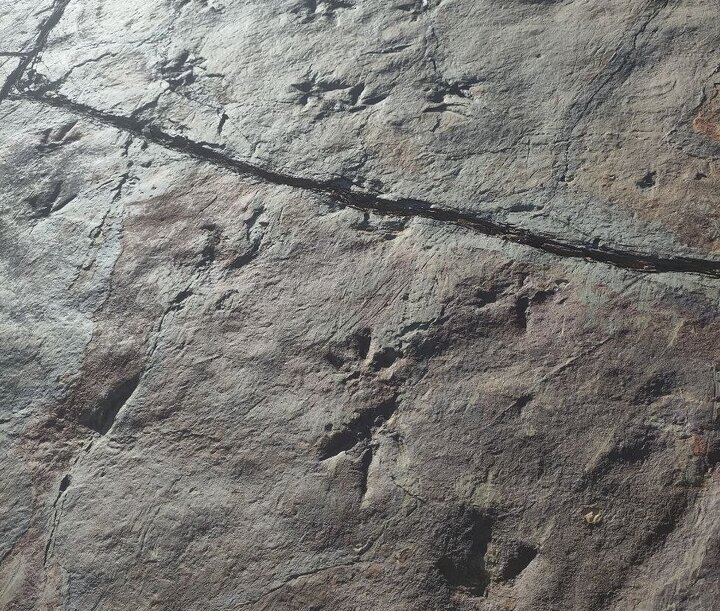
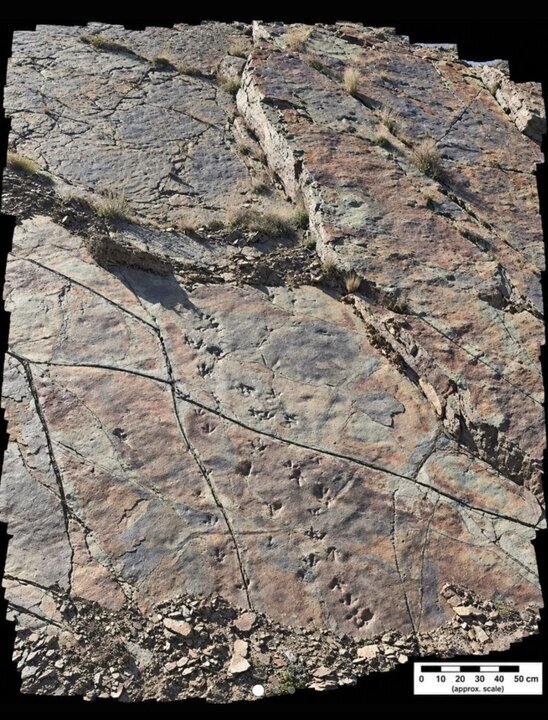
TEHRAN – A rock surface bearing dozens of possible dinosaur footprints has been exposed in Iran following a landslide, prompting a paleontologist to call for urgent scientific investigation and documentation to protect the traces from weathering and erosion.
Erfan Khosravi, a paleontologist and zoologist, announced the discovery in a post on his personal account on the social media platform X, the Iranian Students’ News Agency (ISNA) reported on Sunday.
Khosravi said the footprints had emerged from beneath sediment deposits after a section of a mountain collapsed. He warned that exposure to the elements could damage or destroy the traces if they were not documented promptly.
The proposed research program includes surveying and investigating the site, making casts of the footprints and recording their three-dimensional structures. These measures could help preserve fine details and provide researchers with material for more detailed scientific analysis.
Khosravi, a graduate of the University of Tehran, said the work was being pursued independently, without government funding. The scope and methods of the documentation would depend on available resources, with different practical approaches considered as the project progresses.
He emphasized that the footprints’ three-dimensional features could provide important clues about how the animals’ feet contacted the ground and how they moved. Preserving these details could help researchers investigate the traces beyond their visible outlines.
Khosravi invited people interested in paleontology and natural heritage documentation to contact him through direct messages on X for further information.
He said the findings would be compiled into a scientific paper and submitted to specialist journals for publication. Financial supporters would be acknowledged in the relevant section of the paper in accordance with journal requirements and agreements with the sponsors.
Dinosaur footprints are known as trace fossils, geological records of animal activity rather than preserved body parts. They form when animals walk across soft sediment that later hardens and is buried, preserving impressions that may survive for millions of years. Their shapes, depth and spacing can help researchers investigate the animals’ movement, foot structure and interactions with their environment.
Iran has a documented record of dinosaur tracks, although such discoveries remain relatively limited. A scientific study published in 2022 described a dinosaur tracksite in the Farrokhi Formation near Khur in central Iran, dating to about 70 million years ago. The researchers said the site added to knowledge of dinosaur activity in Iran and the wider West Asia. The newly reported footprints will require their own geological and paleontological assessment to establish their authenticity, age and scientific significance.
AM
Leave a Comment