Dignified defense and courageous negotiations
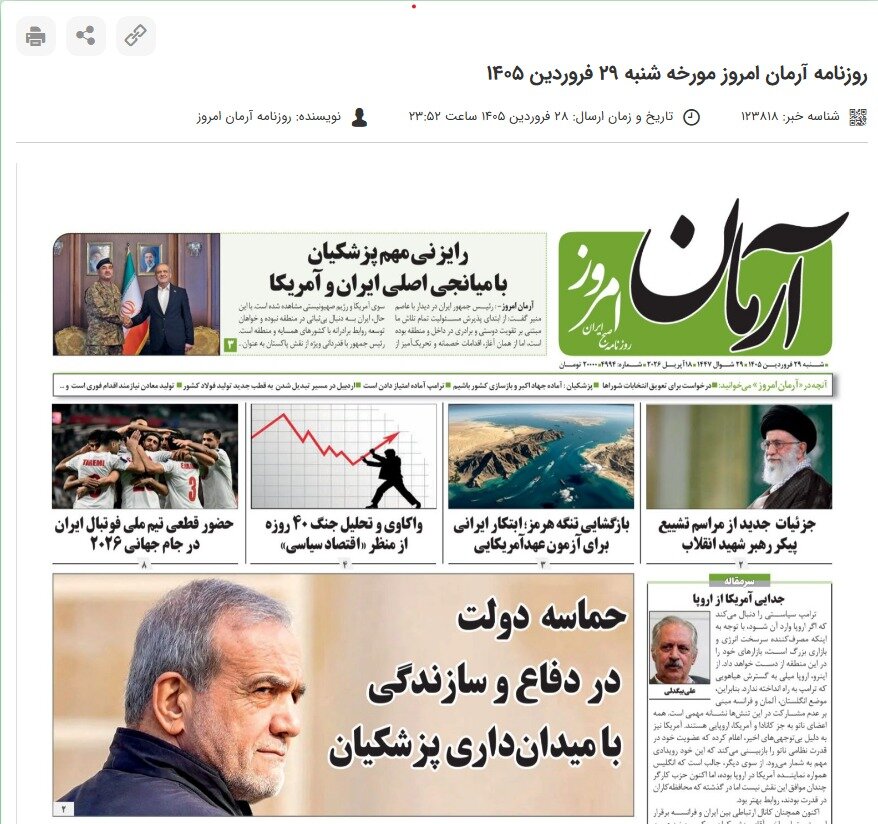
Arman‑e-Emrooz, in an editorial, examined Iran’s assertive approach both on the battlefield and at the negotiating table. In recent days, the simultaneous use of the two concepts ‘dignified defense’ and ‘courageous negotiations’ has drawn attention in the country’s political discourse.
Within the framework of dignified defense, the emphasis is that the country defends its interests with honor and strength, refusing to surrender to threats or compromise its principles. In this view, peace itself is considered a form of wise national defense, and efforts to reach a sustainable agreement are part of the same strategy. Ultimately, these two approaches operate in a reciprocal and complementary relationship to ensure effective national defense while compelling the other side to respect Iran’s rights, independence, and territorial integrity.
Sobh‑e-No: Activating northern transit routes
Sobh‑e-No analyzed the US naval blockade and outlined two actions Iran should take in response. According to the paper, the first reaction would naturally be military: Iran would completely close the Strait of Hormuz. If ships bound for Iranian ports are prevented from passing, then the strait will not remain open for other regional ports either. Reopening the Strait would have no military solution unless adversaries were prepared to launch a massive and extremely costly ground invasion against Iran. Second, Iran must redirect part of its trade — especially essential goods currently transported through southern ports — toward land routes, a point emphasized even before the conflict. At present, some essential goods purchased from Russia are first shipped to the UAE and then imported into Iran’s southern ports, a policy the paper calls misguided. Iran can instead make use of northern rail corridors.
Kayhan: Do not reopen the Strait of Hormuz
Kayhan, commenting on the renewed opening of the Strait of Hormuz, wrote that reopening this vital artery before receiving compensation, the definitive lifting of sanctions, and other rightful demands amounts to giving the enemy breathing space in the middle of a confrontation — an enemy that cannot be trusted. According to the paper, the crushing pressure created by the closure of the strait tightened the physical oil market day by day and reduced US strategic reserves to a minimum. This was the point at which the adversary became desperate and pleaded to return to the negotiating table. Therefore, this freedom of passage must not become a permanent practice unless Iran’s legitimate rights are fully secured. The enemy must understand that this is not a free concession. It notes that Donald Trump reacted hypocritically by thanking Iran for reopening the strait. These ‘deceitful messages,’ the paper said, are nothing but traps. Trump attacked Iran twice during the previous negotiations and is not trustworthy.
Hamshahri: Why was the Strait of Hormuz reopened?
Hamshahri writes that the Iranian foreign minister’s Friday announcement regarding the reopening of the Strait of Hormuz to commercial vessels, strictly along routes designated by Iran, along with the start of a ceasefire in Lebanon, should be seen as two new signs of Iran imposing its will on the US–Israeli axis. Although after the announcement, the US president attempted to impose his own narrative on the situation, the paper argues that the reality is clear: the strait was not reopened — even under the threat of a ‘naval blockade of Iran’ — until the United States accepted Iran’s conditions for a ceasefire. A review of recent developments shows that the Strait of Hormuz was reopened only for commercial shipping, only along Iran‑designated routes, and only until the end of the ceasefire period, after the opposing side retreated from its positions regarding the war in Lebanon and accepted a ceasefire shaped by Iran. Under these circumstances, the paper concludes, despite Trump’s rhetoric, an agreement to end the war will remain achievable only if the other side continues to adhere to Iran’s outlined framework.
Javan: National interests come first
Javan, in an analysis about prioritizing Iran’s national interests above everything else, wrote: We have entered an important phase of geopolitical changes, and we intend to make our national interests and national power our top priority — just as global powers do. Today, in our foreign policy and international relations, we must move beyond seeking approval and instead base everything on securing national interests. The principle should be that we treat any country that respects Iran’s national interests with reciprocal respect. Instead of joining conventions that serve the interests of major powers, our foreign relations should proceed through anti‑hegemonic alliances and bilateral agreements. Now is the time to move past approval‑seeking and to establish an operational model based on indigenous norms and insistence on our natural rights.
Leave a Comment