‘Petro-Yuan’: A silent earthquake in global economy
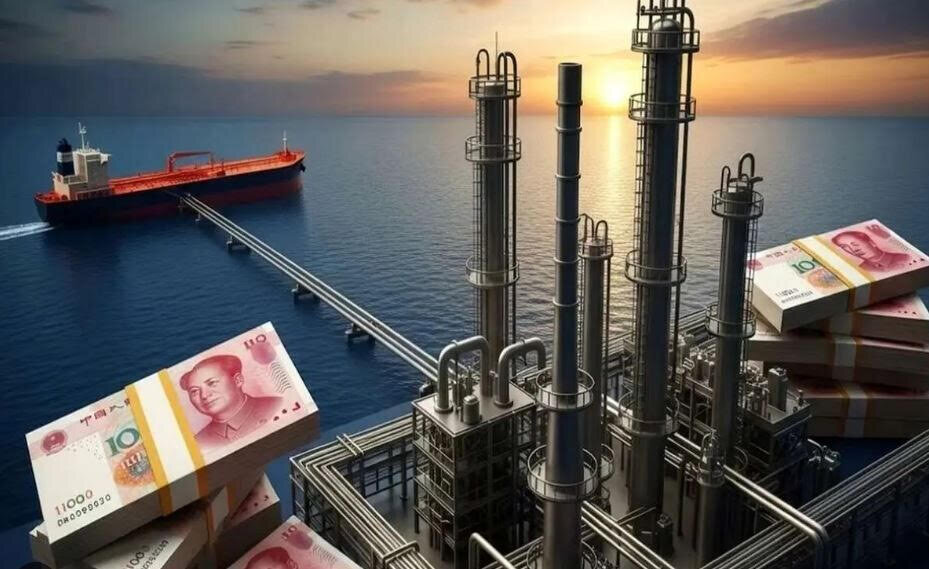
TEHRAN- Simultaneously with the escalation of geopolitical tensions in the Persian Gulf and the halt of vessel traffic in the Strait of Hormuz, media outlets have reported on China's decision to conclude oil contracts based on the Yuan with Persian Gulf countries, a move that analysts have interpreted as a challenge to dollar hegemony and a silent earthquake in the global economy.
According to a report by IRNA, since the beginning of the US-Zionist coalition's aggression against the Islamic Republic of Iran and Iran's action to prevent the passage of hostile nations' vessels and warships through the Strait of Hormuz, economic analysts have spoken about the diminishing dominance of the dollar, especially over the global energy market. Paying tolls in Yuan, allowing passage to ships that have transacted in Yuan, settling payments for purchased shipments from Iran in Yuan, Russia's decision to settle its oil contracts with China's currency, and similar news have drawn the attention of global economic media during this period, although some of this news has never been confirmed by official authorities and has remained at the level of media speculation.
In more recent news, media outlets have announced that China has replaced "Petro-Dollar" transactions with "Petro-Yuan" contracts with Persian Gulf countries, and it was even reported that in an unprecedented move, Indian refineries have also settled payments for oil shipments purchased from Iran using China's Yuan.
Additionally, The Wall Street Journal reported on urgent negotiations between Abu Dhabi and the United States for financial support and economic guarantees to prevent the financial collapse of the UAE, revealing: While there are concerns about the prolongation of the US-Israel conflict and the continuation of the Strait of Hormuz crisis, the United Arab Emirates is worried about the escalation of the consequences of this potential war and is therefore holding urgent negotiations with the United States, requesting immediate financial support and economic guarantees from Washington.
According to this newspaper, the UAE has informed Washington that if it is not provided with sufficient dollar reserves, it may be forced to sell part of its oil in other foreign currencies, primarily China's Yuan, which would be a significant blow to the dominance of the US currency in global markets. Emirati officials noted that President Trump's decision to attack Iran has plunged the region into a devastating conflict whose consequences could last for years.
The reality is that, in the opinion of energy market observers, these developments represent a serious wake-up call for the decades-long dominance of the dollar in the global oil market, and experts are announcing the beginning of a new era in the international financial system, just as The Wall Street Journal in its report affirmed the speed with which West Asian countries are abandoning the dollar and believes this is moving the world toward a multipolar financial system.
A strategic shift in oil & energy purchase settlement system
The truth is that for years, countries such as Russia, China, Iran, and also emerging economic powers have spoken about the necessity of reducing dependence on the dollar and have even sought alternatives such as a BRICS common currency, but what is happening today is a strategic and practical shift in Persian Gulf oil transactions.
Now the most important question that arises is: how is China seeking to overcome the dollar by entering the energy world? In response, it can be argued that with this move, it wants to reduce vulnerability to US sanctions because, in China's belief, the dollar is a dangerous political and economic weapon in Washington's hands, and any country that experiences tension with the US may be deprived of the SWIFT system and access to the dollar. Accordingly, Beijing does not want the world's second-largest economy to be at the mercy of White House decisions.
International observers also believe that with this move, China wants to increase the global power of the Yuan, and for this reason, it wants to turn its currency into an international one. If the world's oil is bought and sold in Yuan, it will lead to an increase in China's economic value and influence.
On this basis, the most important question is: if the Yuan replaces the dollar, what will happen to the dollar market? Some economic experts, in response to this question, believe that this will cause a collapse in global demand for the dollar. Therefore, if oil is purchased in Yuan, countries will no longer need to hold billions of dollars in foreign exchange reserves to secure oil. A decrease in demand for the dollar means a decrease in its value against other currencies. It is also important to note that US financial markets, including treasury bonds, stocks, and real estate, are heavily dependent on foreign capital that recognizes the dollar as a safe currency. As the dollar's credibility declines, capital will move toward the Yuan, gold, or other currencies, which would mean a stock market crash, rising interest rates, and a deep recession in the United States.
Who loses from fall of Petro-Dollar?
Replacing the Yuan in oil contracts, especially in a region where a significant portion of its shipments is destined for East Asia, is not limited only to the US. Rather, some countries will also lose from this decision. These include Persian Gulf oil-exporting countries such as Saudi Arabia, the UAE, Kuwait, Qatar, Oman, and Bahrain. These countries must decide whether to convert their foreign exchange reserves from dollars to Yuan or not, and this decision could severely overshadow their political relations with the United States. This issue is clearly visible in The Wall Street Journal's report and the correspondence the UAE has conducted with Washington.
Although the White House has not yet announced a position on this matter, analysts at J.P. Morgan believe that the US will certainly impose secondary sanctions on India and countries that buy oil in Yuan. Also, trying to strengthen the dollar through interest rate hikes and starting a currency war against China through financial and trade instruments will be among the most important likely options on the table.
Another point that J.P. Morgan mentioned in its report is that, given China's economic influence and the gradual joining of countries to the "Petro-Yuan," it seems the US does not have the ability to completely stop this process. Ultimately, changing the oil payment system from the dollar to the Yuan is undoubtedly a silent earthquake in the global economy — something China has dreamed of for years and is now being realized due to the conditions created in the world's economic and energy system following the US-Israeli aggression against Iran.
Is Petro-Dollar being pushed to margins?
After the collapse of the Bretton Woods gold standard for valuing the US dollar, which occurred in the early 1970s, the US agreed with Saudi Arabia that the standard for oil pricing would be the dollar. After that, the global energy market witnessed the phenomenon of the "Petro-Dollar," which not only made the US dollar the world's premier reserve currency but also allowed White House rulers to create a fluid source of liquidity by printing unbacked money and absorb oil sale revenues in the form of foreign investment.
Nevertheless, reputable media such as Reuters and Bloomberg last week, during the China-UAE business conference held in Beijing, reported the signing of 24 memorandums of understanding for economic and commercial cooperation, the focus of which was settlement in Yuan and Dirham currencies. A point emphasized in the final statement of this conference was the issue of financial settlements for oil transactions in Yuan.
The latest data on SWIFT financial transactions also shows that the share of China's Yuan in total global oil trade settlements in March of this year has reached over 14 percent, and in fact, the Yuan has become the second currency for oil transactions. That is why, as Reuters reported, senior Wall Street analysts believe that the dollar's dominance over global trade is being destroyed, and in this process, the US-Israeli war of aggression against Iran was the White House's biggest strategic mistake in the Middle East because it accelerated the "replacement of the Yuan instead of the dollar" in oil and energy contracts.
It seems that given China is the world's largest oil importer and, on the other hand, is the largest buyer of oil from West Asian countries including Iran, Saudi Arabia, the UAE, and Iraq, and even buys Russian oil in Yuan, we should witness fundamental changes in the currency settlement system of the global energy market in the not-too-distant future.
EF/MA
Leave a Comment