Trump paints the wrong picture again
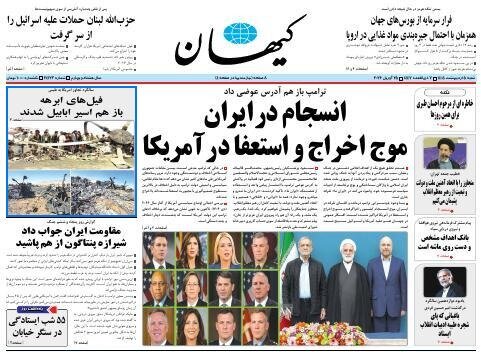
In an analysis, Kayhan discussed the wave of expulsions and resignations in the United States and the unity in Iran. According to the newspaper, despite Trump’s nonsense and instilling division in Iran, a wave of unity has swept the country, and a wave of expulsions and resignations has spread in the United States.
Public opinion in the world has also mobilized against the United States and Israel. The failure to achieve any of the enemy’s declared goals in the Ramadan War has confused and led them to resort to psychological warfare. The enemy, using fabricated words, pretends that there is division in "our Iran." Iran is united on all fronts and has found the secret of its victory in unity, and the enemy’s nonsense about political divisions is only an echo of his confusion and defeat. But Iran stands as a powerful army and has been rising in the streets since the beginning of the war.
Jam-e-Jam: Reasons for extending the temporary ceasefire
Jam-e-Jam, in a note discussing the reasons for extending the ceasefire, wrote: From Trump’s perspective, extending the ceasefire has three general functions. First, the enemy needs breathing room to rebuild its military capabilities. Second, it helps contain the growing pressure of the US domestic economy. Third, it allows for managing political pressure and the role of Congress regarding authorization for war. Iran, while maintaining its position of strength, adopting intelligent stances, and remaining committed to preserving the principle of coordination between the battlefield and diplomacy, is continuously reviewing possible war scenarios with maximum situational awareness and a clear understanding of the American side’s motives for extending the ceasefire. This means, first, it does not allow the enemy to redefine or alter the rules and meaning of diplomacy in a way that would strip Iran of its strategic decision‑making power. At the same time, Iran is monitoring enemy movements and enhancing its defensive–offensive readiness to eliminate the possibility of being caught off guard and to ensure that any future blows it delivers are more painful.
Arman-e-Melli: Why a one-sided ceasefire?
Arman-e-Melli examined why Trump announced a unilateral ceasefire. Trump’s excessive demands have pushed the negotiations into a kind of deadlock, and getting out of that deadlock has become difficult for him. More importantly, Iran’s upper hand in the conflict—due to the Strait of Hormuz and its control over it—has shifted the balance of war in the region. These factors can be considered reasons for Trump moving toward a ceasefire. Another obstacle is Trump's political future and that of the Republican Party. Continuing the war and its political‑military costs for Trump and the United States has become extremely difficult. Given this, he needs negotiations and some form of resolution to the conflict with Iran. However, in Tehran, it also appears that the ‘negotiation vs. siege’ duality is not acceptable. Therefore, the incompatibility of these two processes could once again impose costs on Washington and lead to an informal softening of its position.
Siasat-e-Rooz: Europe’s empty rhetoric
Siasat-e-Rooz devoted its headline to the meeting of European countries in Cyprus. European states once again repeated their nuclear demands and calls for reopening the Strait of Hormuz during the Cyprus summit, despite evidence and documentation showing the EU’s military weakness and its severe economic crisis. Based on this, instead of issuing ‘delusional prescriptions’ against Iran, Europe’s only real option is to accept Iran’s conditions and rightful claims. The newspaper adds that Europe’s growing isolation and deepening crisis are becoming increasingly visible to the world—especially since the Ramadan War and Iran’s steadfast management of the Strait of Hormuz exposed the economic and political vulnerabilities of Europe, which it describes as dependent on the United States. It further claims that these countries lack the military capability to reopen the Strait of Hormuz and will ultimately have to yield to Iran’s demands.
Farhikhtegan: A world before the war and after the war
Farhikhtegan wrote that the US‑ and Israeli‑imposed war against Iran demonstrated that a conflict in the Middle East—beyond affecting 20% of the global oil market—can also push global food‑security equations to the brink by disrupting access to half of the world’s chemical fertilizers and by seriously endangering the economic interests of the Arab states along the Persian Gulf. According to the article, the world now seems divided into two eras: before the Ramadan War with Iran and after it. Given that the Strait of Hormuz, the Bab al‑Mandeb Strait, and the Strait of Malacca are the three main maritime trade routes in Asia and the Middle East, the conflict has resulted in serious restrictions on one of these key routes—namely, the Strait of Hormuz.
Leave a Comment