Deterrence through punishing the aggressor
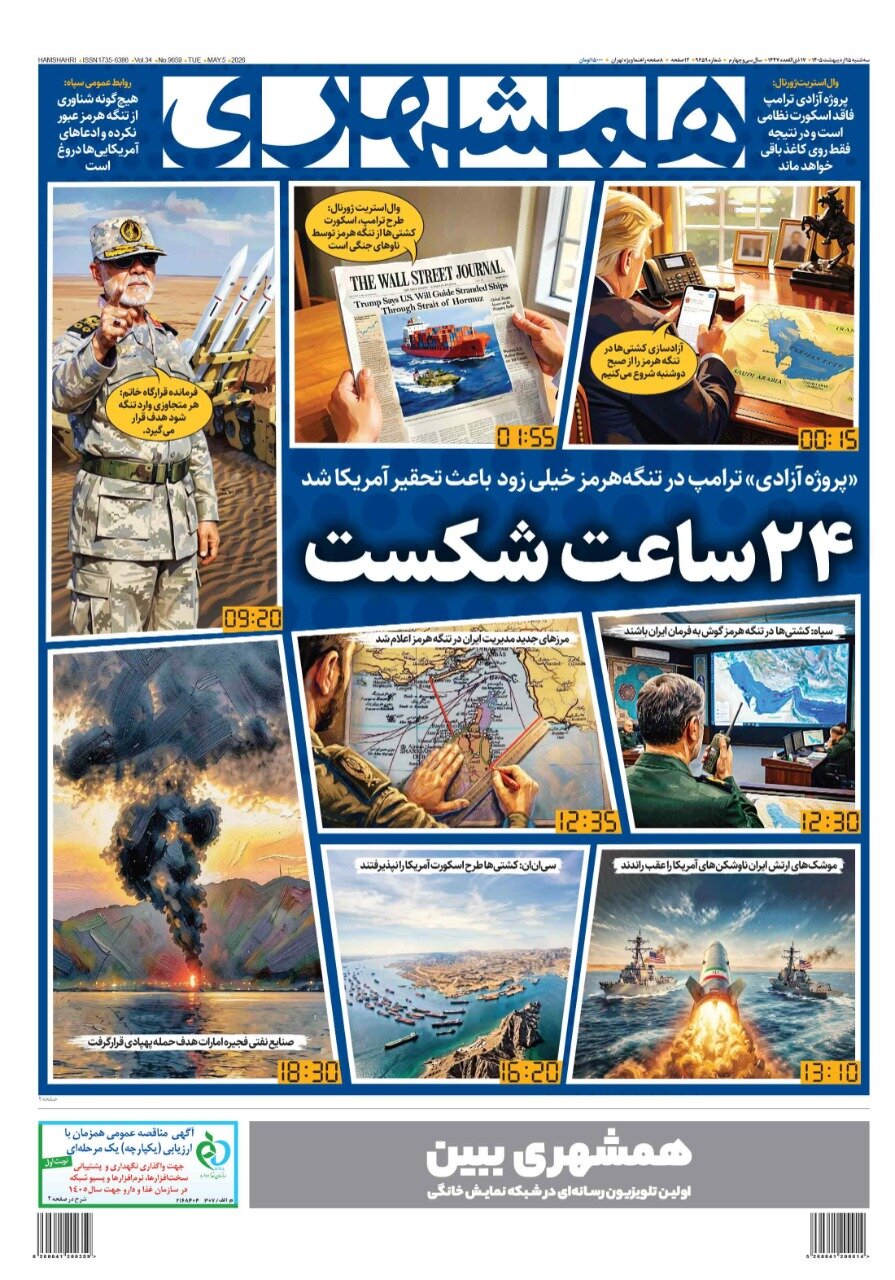
Hamshahri, in an article about Iran’s power in the Strait of Hormuz, quoted Hossein Ajorlou, a regional affairs expert as saying: After the 40‑day war between Iran and the Zionist regime and the United States, the Strait of Hormuz became an advantage in Iran’s hands, and the Islamic Republic is trying to pursue the concept of ‘deterrence through punishing the aggressor’ using this strait.
Following this action by Iran and the failure of the Islamabad negotiations, the Americans entered a new phase of their crisis. In its latest strategy, the Islamic Republic has clearly defined the scope of its control over the Strait of Hormuz and its surrounding areas. This move by Iran is aimed at neutralizing the US policy of naval blockade, expanding the range of punishing the enemy as a form of deterrence, and also controlling the UAE.
Kayhan: Disregard for Trump’s plan
Kayhan, in a commentary, addressed Iran’s powerful sovereignty in the Strait of Hormuz and the disregard shown toward Trump’s plan. Following the continued naval dominance of Iran and the world’s complete indifference to the White House’s deadline, no vessel passed through the Strait of Hormuz. Trump’s goal in creating this commotion is clear: he is seeking to make a high‑risk gamble in a situation of defeat in hopes of disrupting the game. He wants to dictate a ‘forced agreement’ to the Iranian people at the negotiating table. Iran has proven that it does not match the intensity of its responses merely to the level of the opponent’s strikes; rather, Iran’s response will be regret‑inducing and destructive. Today, not only is the Strait of Hormuz under the management of our armed forces, but the closure of the Bab al‑Mandeb Strait—considered the lifeline of the Zionist regime and the West—is also hanging by a thread, or more accurately, dependent on a single signal.
Shargh: ‘Project Freedom’ or a war trap
Shargh examined the latest developments in the Strait of Hormuz following Trump’s claimed project and wrote: The recent developments surrounding Trump’s ‘Project Freedom,’ along with Tehran’s strong reaction and the events that followed, are a clear sign that the crisis has entered a sensitive and potentially dangerous phase. Washington’s emphasis on escorting ships—although presented as a measure to reduce tensions—can in practice be interpreted as a form of active military presence, intensifying Iran’s security concerns. In contrast, Iran’s firm position that all movements must be coordinated with its armed forces shows the country’s determination to exercise full control over this strategic passage. Reports about a confrontation with an American patrol boat—regardless of their accuracy—highlight the risk of sliding toward an unintended military clash. In such circumstances, even a single miscalculation could trigger a chain of reactions with consequences extending far beyond the region.
Siasat-e-Rooz: A thief who pretends to be humanitarian
Siasat-e-Rooz dedicated its editorial to Trump’s seemingly humanitarian claim regarding the passage of ships through the Strait of Hormuz. According to the editorial, a look at the situation shows that Trump, after failing in three main approaches—war, negotiation, and naval blockade—has now begun a multi‑layered game to escape the self‑made crisis in the region and within the political landscape of the United States. This supposedly humanitarian claim comes even though he had previously openly admitted that the United States is a ‘pirate’ that gains significant benefits by seizing ships. Considering Trump’s admission, it can be clearly said that the humanitarian vocabulary and talk of service are merely a deception aimed at public opinion and a justification for military movements, especially at sea. These invented terms will not last long, the editorial argues, because the world has become familiar with his violent and criminal nature, especially during the Ramadan War.
Farhikhtegan: Consolidating Iran’s superiority in post‑war equations
Farhikhtegan wrote about Iran’s proposal in the negotiations: As long as the war against Iran continues, there will be no negotiations on the nuclear issue. This was the message Iran conveyed to the American side through exchanged communications. Continuing this position, Iran delivered its final proposal regarding ending the war through Pakistan. Of course, the president of the United States also tried, in his usual manner, to maintain the upper hand and present himself as the winner of the negotiation. Regardless of what the outcome of the talks will be, it is clear that what Trump has said about negotiations with Iran is not even slightly close to reality. Contrary to Trump’s claims, not only does Iran have no eagerness for negotiations, but this time—because of the war initiated by the Americans—it has entered the talks from a stronger position and is not willing to return to the pre‑negotiation conditions.
Leave a Comment