Sliman Mansour, iconic voice of Palestinian art, passes away at 79
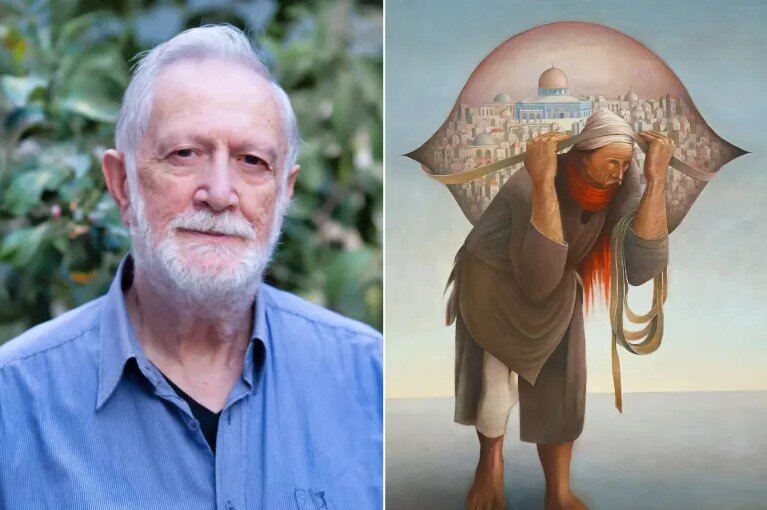
TEHRAN- Palestinian painter Sliman Mansour, whose work became closely identified with the land, heritage and collective memory of Palestine, died on Monday following a prolonged illness, according to his family. He was 79.
Mansour was born in 1947 in Birzeit, near Ramallah, and emerged as an important figure in Palestinian visual art during the 1970s. His generation of artists sought to develop a distinct artistic identity at a time when questions of displacement, cultural survival and attachment to the homeland were becoming central to Palestinian cultural expression.
Throughout his long career, Mansour repeatedly returned to the people and landscapes of Palestine. Olive trees, rural communities, traditional houses, embroidered clothing and figures representing ordinary Palestinians became recurring elements in his paintings. Through these subjects, he transformed familiar aspects of Palestinian life into symbols of belonging, memory and perseverance.
He received his artistic education in Beirut and later Washington, and his works were subsequently presented in exhibitions in Palestine, across the Arab world and in international venues. His paintings have found their way into museums and private collections, while his contribution to Palestinian and Arab culture earned him recognition through a number of honors.
Mansour’s art brought together several layers of cultural heritage. References to the civilizations of the ancient Near East appeared alongside elements drawn from Islamic and Arab artistic traditions, including calligraphy and geometric design. At the same time, his visual world remained firmly connected to the environment in which he grew up, particularly the villages, agricultural landscapes and traditional culture of Palestine.
His commitment to an independent Palestinian artistic identity became especially evident during the First Intifada. Mansour was among the artists who formed the New Vision group, an initiative that encouraged the use of locally available and natural materials after Palestinian artists stopped using Israeli-produced art supplies. Mud, straw, wood, leather, henna and natural pigments became part of their artistic practice.
The experience also reflected Mansour’s broader belief that Palestinian art could preserve cultural continuity while responding to political and social realities. His work consequently came to occupy a distinctive place in what is widely regarded as Palestinian resistance art.
For generations of Palestinians, Mansour’s paintings offered more than representations of their surroundings. They documented a relationship with a homeland shaped by displacement and loss, while also conveying persistence, dignity and hope. His images of Palestinian people and their land ultimately became part of the visual memory of the Palestinian cause.
One of Mansour’s most renowned works is “Jamal al-Mahamel” (“Camel of Hardships”), painted in 1973. The work shows an elderly Palestinian porter bent under the weight of a large burden containing Al-Quds, identifiable by the Dome of the Rock. The image came to represent the Palestinian experience of displacement and the enduring attachment to homeland, while also embodying the concept of steadfastness. The painting was widely reproduced as posters and postcards and became one of the most recognizable images in Palestinian visual culture.
Following Mansour’s death, Ahmad Norouzi, deputy head of Islamic Republic of Iran Broadcasting’s international division, issued a message of condolence to the artist’s family, the Palestinian artistic community and artists around the world.
Norouzi described Mansour as an artist who had devoted his life to preserving Palestine through his work, saying that he transformed the land, villages, homes and memories of Palestinians into a lasting visual testimony. He said Mansour did not merely portray Palestine but brought its memory, identity and history back to the canvas, turning suffering into dignity, displacement into memory and silence into a universal call for justice.
“Today, a color has disappeared from the world’s palette,” Norouzi said, describing Mansour as a chronicler of a land whose history was carried through its stones, trees, people and collective memory. He added that the Iranian broadcaster’s international division would continue to honor the artist’s legacy and the work of cultural figures committed to Palestine, justice and resistance.
Seyyed Shahabeddin Shakiba, director of the Visual Arts Center of the Art Bureau, also expressed condolences, calling Mansour’s death an irreparable loss for resistance art and the Islamic world.
Shakiba described Mansour as a leading member of the first generation of Palestinian painters who linked art with memory, identity and homeland. He said that throughout more than five decades of artistic activity, Mansour had portrayed the suffering, steadfastness and hope of the Palestinian people through a language that transcended geographical boundaries.
“His works became symbols of the resilience of a nation and its inseparable bond with its homeland,” Shakiba said, adding that Mansour’s name and artistic heritage would remain part of the history of resistance art and contemporary Palestinian art.
Photo: This combination photo shows Palestinian painter Sliman Mansour and his most renowned work “Jamal al-Mahamel”
SAB/
Leave a Comment