Trump’s “help is on the way”: the TOEFL ban edition
TEHRAN – The United States is increasingly making education itself a target of economic pressure on Iran, raising a fundamental question: if Washington claims to target the Iranian government rather than the Iranian people, why are ordinary students being denied access to internationally recognized educational opportunities?
The US Treasury Department indefinitely suspended General License G on August 24, a measure that had for years permitted certain educational and academic services in Iran.
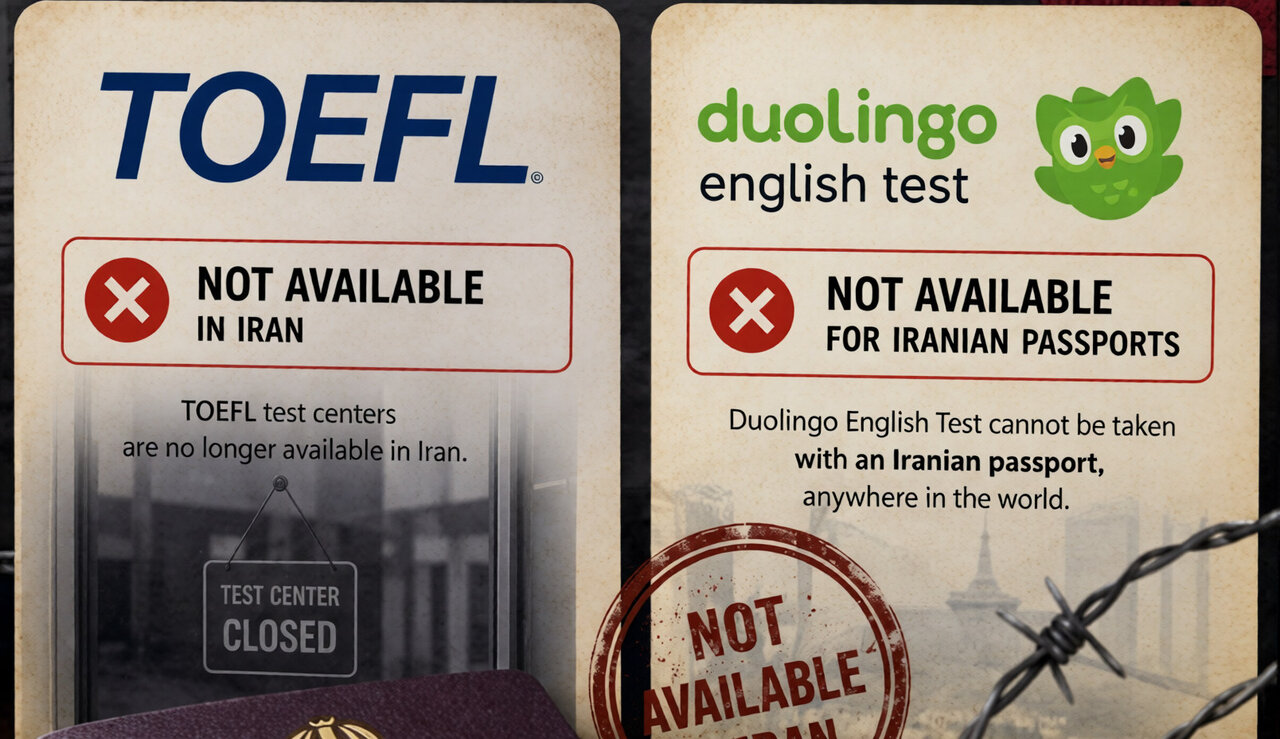
The authorization encompassed standardized testing activities and services associated with university admissions. Following the suspension of the authorization, the U.S.-based Educational Testing Service (ETS) confirmed the immediate suspension of TOEFL and GRE testing services in the country.
Duolingo also announced that its English Test was unavailable in Iran and for users with Iranian identification documents. The restriction is particularly significant because the test had become an affordable alternative for students who could not easily access more expensive international examinations.
The development follows the earlier suspension of IELTS testing inside Iran. IDP Education announced that January 31, 2026, would be the final IELTS test date in the country, citing financial and regulatory factors beyond its control. Iranian applicants have consequently been forced to consider travelling abroad simply to obtain the language certification required for university applications.
For students, however, these are not merely commercial services. A language examination can determine whether an applicant can submit a university application, qualify for a scholarship or meet the admission requirements of an international institution. Removing access to such examinations therefore creates an additional barrier to education.
International human-rights law recognizes education as a fundamental right. Article 13 of the International Covenant on Economic, Social and Cultural Rights recognizes “the right of everyone to education,” while UN guidance emphasizes that access to education must be provided without discrimination. UNESCO likewise identifies equality of opportunity and non-discrimination as fundamental principles of the right to education.
Against that backdrop, the impact of sanctions on Iranian students raises serious questions about whether political and economic pressure can be reconciled with the international commitment to protecting educational access.
Minister of Science, Research and Technology, Hossein Simaei-Sarraf, has criticized sanctions targeting international exams such as the TOEFL for Iranian nationals, saying such measures aim to force Iran into submission.
“The enemy’s objective is to use sanctions to force our country to surrender, and it has tried various forms of sanctions so far,” ISNA quoted Simaei-Sarraf as saying on Tuesday.
He said academic sanctions were not unprecedented, noting that several Iranian universities have been under sanctions for years and that academic papers submitted with Iranian affiliations have faced rejection.
“What is interesting now is that simply taking an exam is being prohibited based on Iranian nationality and citizenship,” the minister said.
“These are no longer the same old measures; this is Stone Age behavior,” he added. “Trump claimed that he wanted to take Iran back to the Stone Age, but he himself is behaving in an entirely primitive and barbaric manner.”
Meanwhile, the reaction among Iranian users on social media has reflected precisely this concern. One user described the situation bluntly: “This only affects the common Iranian person.” Another wrote that educational sanctions “only punish ordinary people.” An Iranian student described how years of preparation for TOEFL had been thrown into uncertainty after the test was suspended.
In January, Donald Trump urged Iranian anti-government protesters to keep protesting, saying "help is on its way".
After bombing Iran, killing more than 140 students at the Minab school on the very first day of the imposed war on February 28, and killing thousands of ordinary civilians, the United States—having failed to achieve its objectives and failed to secure the victory it sought—is now apparently continuing its “Epic Fury” through these absurd measures.
Education is supposed to build bridges between societies, not become collateral damage in political disputes. When access to those bridges is restricted because of nationality, the consequences are felt not by officials, but by students sitting at home, preparing for examinations and trying to build their futures.
Leave a Comment