‘US maritime piracy threatens lives of patients in need of vital medical services’
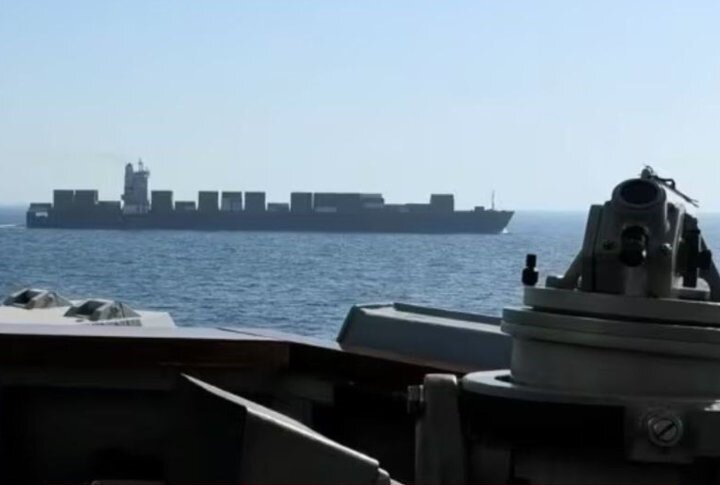
TEHRAN - The Iranian Red Crescent Society (IRCS) and the National Committee for Humanitarian Law (NCHL) have condemned the attack by US forces on an Iranian commercial vessel sailing in the Sea of Oman that was carrying essential supplies for dialysis patients, describing it as a blatant violation of international law and a threat to the treatment of patients in need of vital medical services.
The US forces targeted the vessel on Sunday in a blatant act of piracy, boarding the ship and disabling its navigation systems.
The supplies belong to Saha Medical Equipment Company, a subsidiary of the Iranian Red Crescent, the organization said in a statement on Thursday.
Part of the ship's cargo, it said, consisted of raw materials required to produce consumable medical supplies for dialysis patients.
"Any disruption in the supply of these critical items could directly threaten the health and lives of patients in need of dialysis services," the Red Crescent warned.
The Red Crescent added that the US action, which it said created threats and intimidation and endangered the lives of civilian crew members, contradicted fundamental principles of humanitarian law, including the principles of distinction and precaution in military operations.
It said the act could violate international obligations regarding the maintenance of peace and stability and could be examined as an instance of unlawful use of force under UN General Assembly Resolution 3314 (1974).
Iranian forces struck back immediately following the US piracy, targeting several American military vessels in the area with drone attacks, according to Iran's military.
The armed forces of the Islamic Republic were ready to deal decisively with the American aggressor forces, but the presence of sailors' families aboard the targeted Iranian cargo ship prevented immediate action, as ensuring the safety of civilians took precedence over retaliation, Tehran stated.
The military added that as soon as the safety of the families and crew was assured, Iran's armed forces would take necessary action against what it called the terrorist US Army.
In this line, Foreign Ministry issued a statement on Tuesday, denouncing the operation as an act of “maritime piracy” and “terrorism,” saying it involved intimidation of the ship’s crew and their families.
The attack, according to the ministry, “not only contravenes the fundamental principles of the United Nations Charter and international law but also represents a clear violation of the ceasefire agreement enforced on April 8, and an act of aggression against the Islamic Republic.”
The ministry called on the UN secretary-general, the UN Security Council, and the International Maritime Organization, as well as responsible governments, to take “firm and decisive” response to “the criminal act” against international commercial shipping.
It also warned of “extremely dangerous consequences” resulting from “the US’s criminal and unlawful act”, stressing the need for the immediate release of the vessel, its crew, and their families.
Concluding the statement, the ministry emphasized that Iran would use “all available capacities” to defend its national security and interests, and safeguard the rights and dignity of its citizens, while holding the United States fully responsible for any further escalation in the region.
On April 11, the IRCS and the NCHL condemned the US-Israeli attacks on the country’s civilian infrastructure.
In a joint statement issued on Wednesday, the IRCS and the NCHL warned about the Israeli attacks on civilian critical infrastructure carried out with the support of the United States, calling for the unconditional observance of the principles of international humanitarian law.
“At least eight railways and 59 airports, as well as public facilities, connecting roads, bridges, and transportation networks, have been targeted in the recent attacks,” noted the statement.
“Furthermore, power substations, nuclear power plants, and petrochemical facilities have also been targeted, causing serious disruption to the supply of energy, vital services, and the basic needs of the population, and resulting in widespread and long-term consequences for the lives, health, and security of civilians.
Leave a Comment