America is desperate in war with Iran
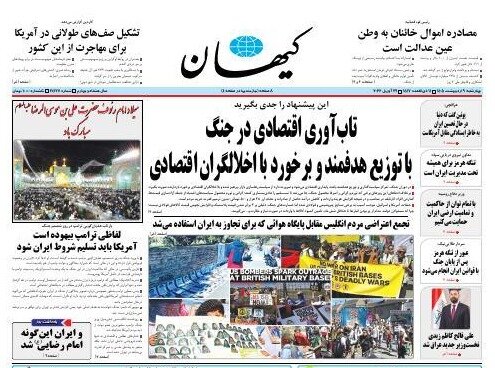
Kayhan discussed Trump's desperation in the war with Iran. While two months have passed since the war, the top brass in the Pentagon and the Trump administration have fallen apart.
From the Secretary of the Navy to the Chief of the Joint Chiefs of Staff of the Army, they have been blamed and fired for Trump's stupidity in the war. Two hundred expensive American aircraft and drones, in addition to its 13 bases in the region, have been destroyed, and Iran and its allies are threatening to block the Bab al-Mandeb Strait in addition to the Strait of Hormuz. Various countries, even America's closest allies in Europe, are blaming Trump for being confused in a costly war. Things have reached a point where the passive German Chancellor emphasized that Iran is humiliating America and has appeared far beyond imagination, and Trump has launched the war without any clear strategy for entry and exit. According to American analyst Eric, all the levers of power are in Iran's hands. America must give in to Tehran's demands.
Siasat-e-Rooz: Iran is strong
Siasat-e-Rooz pointed to Iran's power and cohesion in all areas in its editorial. The newspaper said: The Ramadan War showed that, in addition to missile and drone power and asymmetric warfare, national resilience, from popular unity and cohesion to economic and managerial stability and appropriate and timely capacity building of geopolitical components such as the Strait of Hormuz, has created the basis for superiority against the American-Zionist enemy. The connection between the battlefield, the street, and diplomacy with media support has been a national point that, in addition to ensuring Iran's security, has enhanced its regional and global status. Iran today simultaneously emphasizes the need for convergence among regional countries to achieve local security by expelling the United States and confronting the aggressor Zionist regime, which itself is a document of Iran's commitment and commitment to sustainable and local security for all countries in the region.
Farhikhtegan: Evaluability of negotiations
In an analysis, Farhikhtegan evaluated Iran's conditions in the negotiations and wrote: Iran has learned from the experience of previous failed agreements that each stage of negotiations must have specific indicators for evaluation. This evaluability is the result of the phased nature of negotiations. Enduring and unlimited negotiations are not the desire of either party, and each step must lead to a tangible result. Iran's view is that a ceasefire alone can allow the enemy to rebuild its forces and return to the cycle of pressure, negotiation, and war. In fact, Iran, using the two wings of the battlefield and diplomacy, is seeking an agreement that will not only end the current war but also break the cycle of future wars and stabilize the country's economic and security authority in such a way that it will no longer be affected by obstacles such as threats, sanctions, and the shadow of war.
Khorasan: An important trip to Moscow
Khorasan wrote about the importance of Araghchi's trip to Moscow: Araghchi's trip to Russia should not be considered just another diplomatic visit in the war calendar. The main goal of this trip is to transform the achievements of the war into a new political equation. Araghchi met with Putin in a high-level meeting during this trip. The importance of this trip is that Iran is trying to show that it is not in a passive position after the fragile ceasefire. Tehran has conveyed its messages to Washington through Pakistan, and by taking the case to Moscow, it is reminding the United States that military pressure has not necessarily led to Iran's political isolation. In this context, Moscow cannot be a neutral mediator for Tehran, but a strategic supporter, provided that they have a real will to support.
Arman-e-Melli: What is the importance of the messages exchanged between Iran and the US?
Arman-e-Melli discussed the US reaction to Iran's moves and proposals in an interview with Morteza Makki, an international affairs analyst. He said: So far, there has been no clear position from the US, but some sources in the White House team have announced that Iran is preparing new preparations for future negotiations. It seems that one of the main issues for Iran is determining the status of the war. If the US intends to enter into new negotiations, it must first present a permanent ceasefire or declare an end to the war. If this is achieved, the next stages of the negotiations will proceed more quickly. Within the US, there are serious restrictions on the use of military authorizations in a war, and widespread criticism has also been raised within the social base of the current government. These factors, along with the time limit for reaching an agreement, could affect the US decision-making process.
Leave a Comment