A new chapter in judicial diplomacy
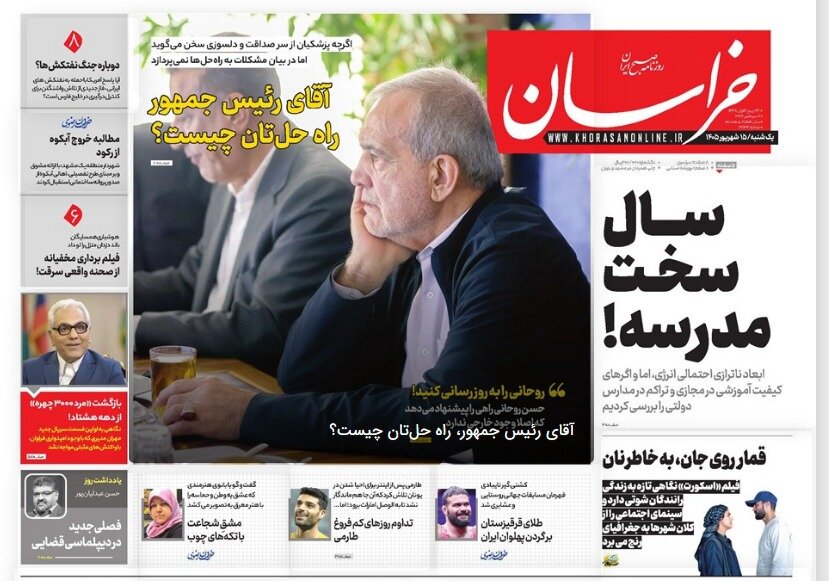
Khorasan examined the Judiciary chief’s trip to New Delhi and his participation in the BRICS judicial summit. According to Khorasan, today’s world is moving through a historic transition and entering a new phase in the global configuration of power, economics, politics, and international law.
Traditional power balances are shifting, new centers of influence are emerging, and independent states are increasingly seeking mechanisms to expand their role and share in shaping the future architecture of the international system. Within this context, the trip was more than a formal or ceremonial visit; it represented a multilayered diplomatic initiative. BRICS is not merely an economic opportunity for the Islamic Republic of Iran; it is also a significant legal and judicial platform. A transformed judiciary must possess effective international capacity alongside domestic authority. The visit demonstrated that Iran’s judiciary can, in addition to its inherent responsibilities, play a role in foreign policy, economics, trade, protection of nationals, combating transnational crime, and contributing to the formation of future global legal norms.
Ham‑Mihan: Iran wants concessions
Ham‑Mihan commented on the uncertain situation between Iran and the United States in the current conflict. It wrote that a complete US withdrawal from the Strait of Hormuz without securing any concessions from Iran — including lifting the blockade on Iran — would be unimaginable even for the unconventional Trump administration. Such a move would allow Iran to present a full victory and give the government in Tehran a powerful psychological boost, undermining much of what the US and Israel have achieved over the past three years in weakening Iran’s regional resistance network. Moreover, it is unlikely that Iran would reopen the Strait of Hormuz for free passage without receiving concessions. Additionally, if Washington retreats, Iran could revive and rebuild its nuclear program — an outcome that would constitute a significant defeat for the United States.
Vatan‑e-Emrooz: A new security architecture
Vatan‑e-Emrooz discussed the Chinese president’s remarks in Cairo and his important message to Arab leaders. Xi spoke of a “new security architecture” for West Asia; an approach that rejects foreign intervention and entrusts the region’s future to its own countries. For Tehran to benefit fully from China’s new framework, it must go beyond welcoming the slogan of regional security and translate it into concrete proposals: a Persian Gulf security dialogue, a permanent de‑escalation mechanism, joint arrangements for maritime security, emergency communication channels between military forces, and even a multilateral framework to prevent regional territories from being used as platforms for attacking neighboring states. A country that seeks security through war with its neighbor ultimately turns its own security into a hostage of conflict; a country that builds security through agreement with its neighbor makes its stability durable. This is precisely where Iran’s national interests intersect with China’s new vision.
Resalat: Disarming the resistance cannot replace ending occupation
Resalat analyzed the Israeli occupation of the Ali al‑Taher ridge in Lebanon. It argued that the positions of Hezbollah and Iran rest on a clear principle: disarming the resistance cannot substitute for ending the occupation. Hezbollah has stated this explicitly, and Iran’s recent warning shows it will not allow Israel to exploit the vacuum created by the ceasefire to define new military boundaries in Lebanon. The dispute over Ali al‑Taher is not merely about a ridge; it is about who has the authority to set the rules for the post‑war phase. For the resistance axis, the core issue is not preserving a single position or elevation, but preventing the establishment of a formula in which Israel turns war, occupation, and ultimately the disarmament of its rival into a single chain for reshaping the regional balance. At this juncture, the role of Iran and Hezbollah moves from peripheral presence to a central part of the future equation in Lebanon and West Asia.
Farhikhtegan: Trump’s project
Farhikhtegan wrote about Trump’s project, arguing that Iran must consolidate its recent gains and establish deterrence, while Trump seeks to turn defeat into victory. This has linked the sky and the street as the central issue for the coalition of political losers in Tel Aviv and New York. Trump is now playing multiple cards and shifting toward various tools — from blockade to plus sanctions, and from confrontation to conflict — all of which have entered his agenda. This approach can be seen as a tactic to confuse Iran, but it also signals the expiration of previous tools. Iran, the paper argues, is in a situation where dividing the nation, polarizing political and social issues, and oversimplifying concepts for electoral gain may seem easy — but one must remember that this is the eve of war, not the eve of elections. All domestic political factions must remain united and avoid playing into Trump’s plan to drag the conflict into Iran’s internal political arena.
Leave a Comment