Reading of Bahram Beyzaie’s ‘Arash’ to be held in Tehran
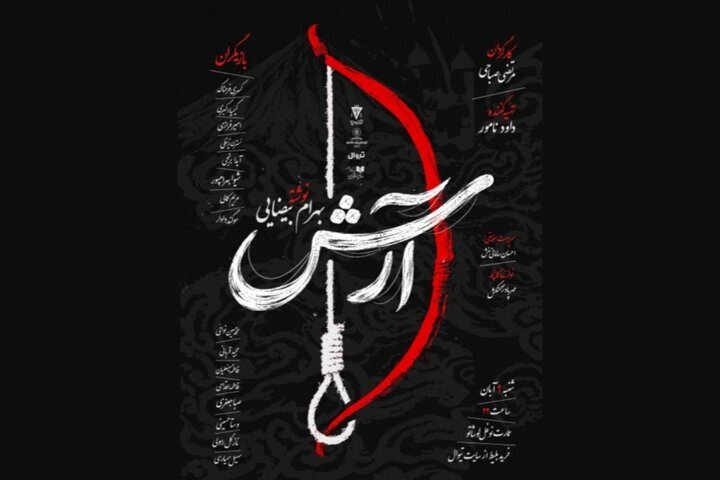
TEHRAN- A staged reading of “Arash,” a play by acclaimed Iranian playwright and filmmaker Bahram Beyzaie, will be held at Neauphle-le-Château Theater Hall in Tehran on Saturday, October 31.
Directed by Morteza Sabahi and produced by Davoud Namvar, the event is organized by the Qalamro theater group and will feature a cast of actors accompanied by a live music ensemble, Mehr reported.
The production draws on Beyzaie’s work, which takes its title from Arash, a legendary archer in Iranian mythology whose sacrifice is associated with the defense of the homeland and the determination of its people.
The staged reading cast includes Mohammad Hossein Navai, Kasra Farahnak, Soheil Semyari, Nastaran Zeynali, Kimia Akbari, Aida Berenji, Maryam Kamali, Shiva Bahrampour, Saba Jafari, Sogand Dadar, and Amir Farazi.
The musical ensemble will be led by Ehsan Samani-Manesh, who will also perform percussion and other musical instruments. Kamancheh player Mehrpad Zahmatkesh will join the group, providing live musical accompaniment to the reading.
Arash, known in Persian mythology as Arash-e Kamangir, is one of the most celebrated heroic figures in Iranian cultural tradition. His story has been preserved in different forms in Persian literature and mythology and has come to symbolize self-sacrifice, courage and devotion to the homeland.
According to the best-known version of the legend, Iran and Turan have been engaged in a devastating war. After years of conflict, the two sides agree to settle their dispute by determining a new boundary. The agreement requires an Iranian archer to shoot an arrow, with the point where the arrow lands becoming the border between the two lands.
Arash is chosen for the task.
The legend presents the challenge as far more than an ordinary feat of archery. Arash is required to put all his strength into a single shot, knowing that the act will cost him his life. He climbs to a high mountain and prepares to release the arrow. In one of the most famous images associated with the legend, Arash's entire strength and vitality are said to enter the arrow as he shoots it toward the horizon.
The arrow travels an extraordinary distance before finally landing, establishing the border and bringing an end to the conflict. Arash, however, dies after completing his mission, having sacrificed himself for the survival and territorial integrity of his homeland.
This element of sacrifice lies at the heart of the legend. Arash does not fight for personal glory or wealth. His heroism comes from accepting a responsibility that requires him to give everything he has for the sake of others.
The story has consequently acquired a symbolic significance far beyond the act of shooting an arrow. Arash has become an embodiment of the idea that the fate of a nation can sometimes depend on the courage and sacrifice of an individual. His story also connects personal choice with collective responsibility, making the ancient legend relevant to later generations.
Arash's story has been particularly influential in Persian poetry and modern Iranian literature. Writers and poets have repeatedly returned to the character, interpreting his sacrifice in different historical and political contexts. The image of the arrow traveling across the land has also become a powerful metaphor for hope, determination and the possibility of shaping the future through individual action.
Unlike some mythological heroes whose stories revolve around conquest, Arash's defining act is one of giving. He wins not by defeating an enemy in combat, but by making the ultimate personal sacrifice to bring an end to war and protect his people.
Beyzaie, who is widely recognized for drawing on Iranian mythology, history and folklore in his dramatic works, has frequently reinterpreted traditional narratives to examine questions of identity, collective memory and the relationship between the past and the present. His writing combines elements of ancient Iranian traditions with modern theatrical language, giving familiar legends new dramatic and intellectual dimensions.
SAB/
Leave a Comment