‘Iran to determine the battlefield’
IRGC chief visits missile city with aerospace commander as new launcher unveiled
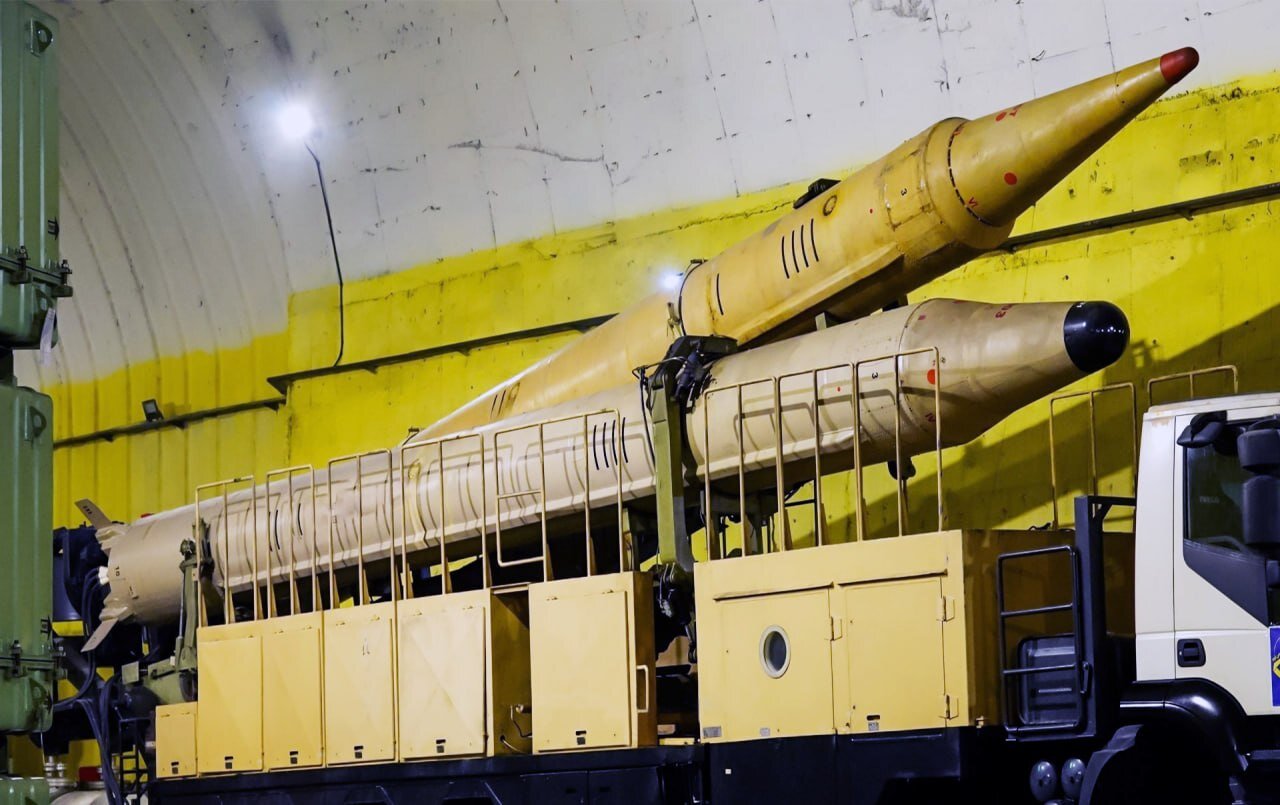
TEHRAN – Iran’s Armed Forces reported a series of air defense and naval engagements in the Persian Gulf and the Strait of Hormuz, coupled with a high-profile visit by the chief of the Islamic Revolution Guards Corps (IRGC) to one of the country’s underground missile cities.
The developments, announced by the IRGC and the Army on Saturday, underline Tehran’s message that it retains full surveillance over southern waters and airspace and will respond to any violation.
New air defence downs intruding drone off Bushehr
In a statement issued at 17:00 Iran time on Saturday, the IRGC Public Relations said air defense units of the IRGC Aerospace Force had intercepted and destroyed a hostile reconnaissance drone after it violated Iranian airspace.
The statement said the drone was shot down in the northern Persian Gulf, in waters opposite the coasts of Bushehr, using what it described as a new and advanced IRGC air defense system, with precise and effective fire.
The IRGC stressed that any violation of Iran’s airspace is unacceptable, adding that enemy attempts to use a wide range of reconnaissance and military equipment will be met with vigilance, readiness and a decisive response.
The announcement came hours after the IRGC said on Saturday morning that the 58th US MQ-9 drone had been intercepted and hit in the skies over the Strait of Hormuz.
Vahidi visits missile city as new launcher unveiled
On Saturday, IRGC Commander-in-Chief Major General Ahmad Vahidi visited one of the IRGC’s missile cities to inspect its capacities, accompanied by Brigadier General Seyed Majid Mousavi, commander of the IRGC Aerospace Force.
During the visit, a new twin launcher for liquid-fuel missiles of the Aerospace Force was unveiled.
Vahidi said the NATO secretary general had acknowledged 5,000 flights by all NATO countries in support of operations against Iran, a figure he described as an admission of the scale of mobilization against the country.
What is happening to our enemies is only the beginning, he said, adding that their humiliation will be seen and that truth will prevail over falsehood.
Mousavi said the Aerospace Force is ready around the clock to carry out the orders of the Commander-in-Chief and the IRGC command. He said the force’s capabilities have increased in the interval between the two wars, with new surprises and effective systems added to its combat organization.
There will be no hesitation in exercising power and confronting threats, Mousavi said, adding: the field is in Iran’s hands and we determine the battlefield.
Strait of Hormuz: mines, tankers and the 58th MQ-9
The IRGC also detailed what it described as a US attempt on Friday night to facilitate the passage of tankers and the unauthorized transfer of cargoes through the Strait of Hormuz.
According to operational reports cited by the IRGC, the US Army employed extensive air cover, including refueling aircraft, F-16, F/A-18 and F-35 fighters, P-8 Poseidon maritime patrol aircraft, several helicopters and MQ-series drones.
During those movements, two severe incidents involving explosions and fire were recorded for tankers in the southern part of the Strait, the IRGC said. The first occurred near Khasab port and the second early Saturday about three kilometers off the coast of Ghanam Island. The IRGC Navy’s public relations attributed the explosions to violating vessels striking naval mines.
The IRGC added that its new advanced air defense system destroyed a US MQ-9 reconnaissance-combat drone that was tasked with surveillance and air cover for the operation in the western Strait of Hormuz.
The IRGC Navy warned that any transit through the Strait of Hormuz with navigation systems switched off, via unauthorized routes and without coordination with the IRGC Navy’s traffic control center, will be treated as a violating transit and cooperation with the US Army and will be dealt with decisively.
Army: from east to west of strait under control
Army spokesman Brigadier General Mohammad Akraminia visited Army units in the south during the same period, meeting commanders and personnel in Bandar Abbas, Kuhestak, the coastal line, Sirik and Jask.
He said the Armed Forces maintain full awareness of naval developments, stressing that from the east to the west of the Strait of Hormuz is under monitoring and control, and that operational readiness in controlling regional waters is evident.
Personnel of the Army’s Navy are monitoring the area around the clock with high morale, he said, adding that from the east of the strait to the northern Indian Ocean is under the Navy’s strategic control.
Akraminia said the United States pursued a set of objectives ranging from weakening nuclear and missile capabilities and dismantling the resistance front to changing the political structure, territorial disintegration and weakening Iranian identity. Judging by the attacker’s declared goals, he argued, the enemy failed to achieve its strategic objectives despite damage inflicted on the country.
He added that the readiness and motivation of personnel deployed on the eastern coasts of the strait have forced the enemy hundreds of kilometers back, saying Iran is stronger than before in both hard and soft domains and that the United States has no option but to accept Iran’s logical and legitimate conditions.
Separately, the Army Public Relations said on Friday evening, indigenous Army Air Defense systems deployed in the south, operating under the country’s integrated air defense network, detected and tracked a US F-16 fighter over the Persian Gulf. After tracking, the systems fired a missile toward the aircraft, and the explosion in its vicinity damaged the jet, forcing the pilot to abort the mission and make an emergency landing at one of the nearest regional airports.
Leave a Comment