The Silicon Valley kill chain
Iran urges UN oversight as CENTCOM’s open embrace of military AI raises fears of automated war and civilian harm
TEHRAN – Iran’s warning at the United Nations Security Council this week was not only about bombs and missiles. It was about the software behind them.
Addressing a Council briefing on Tuesday on the “maintenance of international peace and security in an era of rapid technological change,” Ambassador and Charge d’Affaires Gholamhossein Darzi said rapid technological advances are changing the nature of warfare, increasing the risks of escalation, miscalculation and civilian casualties.
“Technology must serve humanity and be used for exclusively peaceful purposes, not aggression, domination or violations of state sovereignty,” Darzi told the Council.
He then went further, accusing the United States and Israel of weaponizing artificial intelligence in what Tehran describes as two wars of aggression against Iran in June 2025 and February 2026. In particular, he said, published reports confirm the use by the United States of advanced systems including Maven, associated with Palantir Technologies, and Claude, developed by Anthropic, during operations on 28 February 2026 to analyze intelligence, identify and prioritize targets and provide strike coordinates.
“Neither advanced technology nor the involvement of private companies can shield the United States or the Israeli regime from accountability for flagrant violations of their obligations under international law,” Darzi said, according to Iranian state media IRNA and CBS News coverage of the session.
A Warning in the Security Council
Darzi’s statement, delivered on 24 November 2026 in New York, framed AI not as a futuristic risk but as a present weapon. According to the full text published by IRNA, he argued that the weaponization of AI and its use as an instrument of aggression and conflict escalation raises serious concerns, citing the June 2025 and February 2026 confrontations.
The format mattered as much as the words. The Council debate was convened specifically on conflict resolution in an era of rapid technological change, a theme pushed by a growing number of member states worried about autonomous weapons, cyber operations and AI-enabled decision-making.
Iran used that platform to link three arguments: first, that technology must remain under inclusive, intergovernmental governance centered on the United Nations, not limited or selective processes; second, that the use of AI in targeting increases the likelihood of unlawful strikes; and third, that outsourcing critical military functions to private tech firms does not remove legal responsibility from states.
Tehran’s position, as presented by Darzi, is that the security and military dimensions of AI must be addressed within the UN framework with participation of all states. That call echoes long-standing demands from the Global South for a legally binding instrument on autonomous weapons, so far resisted by major military powers.
From Project Maven to Maven Smart System
At the heart of the controversy is Maven. Originally launched by the Pentagon in 2017 as the Algorithmic Warfare Cross-Functional Team, Project Maven was designed to accelerate the adoption of machine learning for intelligence, surveillance, target acquisition and reconnaissance, particularly analysis of drone video and geospatial intelligence.
Google was an early contractor but withdrew in 2018 after employee protests. Palantir then became the prime systems integrator for what is now called the Maven Smart System (MSS), a Pentagon-wide software platform that fuses intelligence from dozens — by some accounts more than 150 to 179 distinct data sources — into a single operational picture.
According to analyses by the Center for Strategic and International Studies (CSIS) and Pentagon statements, MSS is now described as production-level across almost all U.S. combatant commands, including CENTCOM, EUCOM, INDOPACOM, and others, as well as NATO’s Allied Command Operations, which acquired MSS NATO in March 2025.
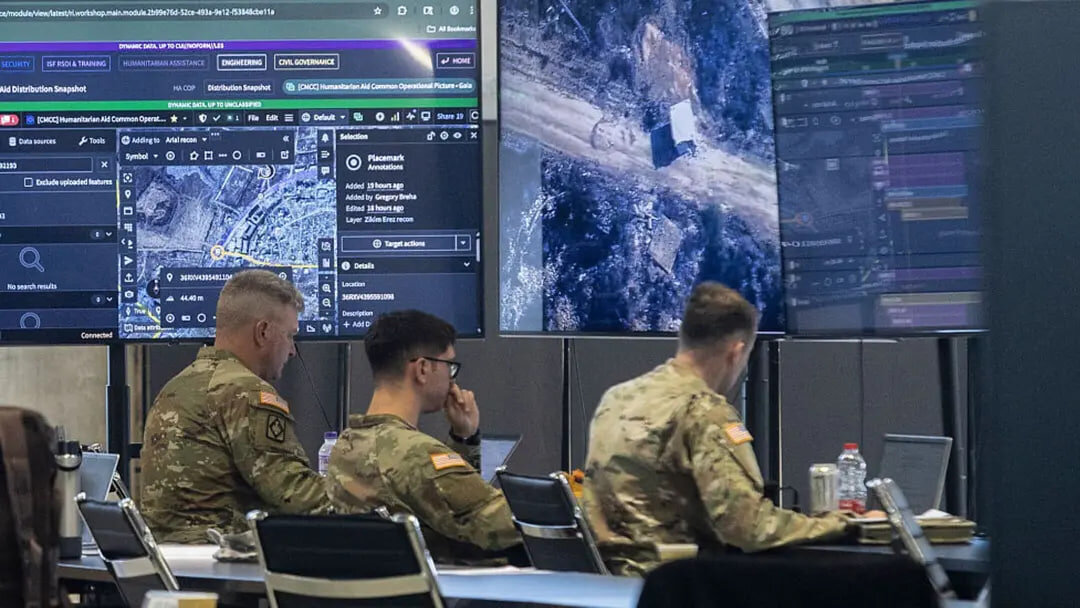
MSS does not fire weapons itself. Palantir stresses that humans remain responsible for selecting and approving targets. What it does, according to company documentation and U.S. officials, is collapse a workflow that once required eight or nine separate systems into one interface: computer-vision models detect objects in satellite or drone imagery, data-fusion tools cross-reference signals intelligence, open-source information and classified military databases, and recommendation algorithms propose and rank candidate targets and even suggest which munition or platform to use.
CENTCOM, under commanders including Gen. Michael Kurilla and later Adm. Brad Cooper, became the most aggressive early adopter. After the Oct. 7, 2023 attacks, CENTCOM shifted Maven from exercises such as Scarlet Dragon to real combat use. By early 2024, officials said Maven had supported more than 85 airstrikes in Iraq, Syria and Yemen and helped locate rocket launchers and Red Sea vessels.
Iran was different in scale. During the first 24 hours of what the Pentagon called Operation Epic Fury, the United States used MSS to help strike more than 1,000 targets, a tenfold increase over what was possible in the pre-MSS era, according to CSIS. The Washington Institute for Near East Policy reported more than 1,000 targets in the first 24 hours and more than 13,000 targets over 38 days, with AI-enabled systems fusing hundreds of intelligence sources to generate recommendations at unprecedented speed.
Claude Inside the Kill Chain
If Maven is the chassis, Claude was described as part of its reasoning layer. In 2024, Palantir partnered with Anthropic to integrate Claude models into Palantir’s Artificial Intelligence Platform running on Amazon Web Services, including on classified networks. By late 2024, the Pentagon began integrating Claude into Maven workflows to help process data and support decisions.
Defense analysts describe Claude not as the sensor that spots a building, but as a sophisticated interface that synchronizes other modules, summarizes intelligence, drafts assessments and helps operators navigate vast data. As The Economist’s defense editor Shashank Joshi and Defense
One have explained, the targeting process still formally runs through stages: build a database of possible targets and no-strike lists, vet with intelligence agencies, apply legal review, produce air tasking orders, execute and assess battle damage. MSS with Claude, officials say, compresses at least some of those stages from days or hours into seconds.
CENTCOM Commander Adm. Brad Cooper said in March 2026 that American forces were using advanced AI tools to process information and accelerate military decision-making. A sworn Pentagon court filing on 15 June 2026, cited by Darzi and reported by U.S. media, went further, stating that a Grok Gov model operating through the Department’s Maven Smart Systems enabled U.S. forces to deploy over 2,000 munitions to 2,000 distinct targets within 96 hours.
Other firms were also in the stack. Anduril’s Lattice system is reported to have integrated sensor data to support situational awareness, while AWS provided cloud infrastructure. But in Tehran’s narrative — and in much Western coverage — two names dominate: Palantir as the system integrator and Anthropic as the model provider.
Anthropic’s position has since become complicated. The company, which publicly emphasizes AI safety, confirmed in July 2025 that Claude had been integrated into classified government workflows through Palantir. By 2026, some public program histories list Anthropic as having withdrawn from Maven contracting, amid internal and public debate about use of its models in lethal targeting. The company has said Claude does not directly provide targeting recommendations but helps with analysis, a distinction critics say collapses in practice when analysis flows directly into a kill chain.
2,000 Munitions in 96 Hours: Speed Beyond Human Review?
The figure cited by Darzi — 2,000 munitions on 2,000 targets in 96 hours — is central to Iran’s legal and humanitarian argument. Even if technically accurate, Tehran and independent arms-control researchers ask, can meaningful human review survive that tempo?
U.S. officials present speed as a virtue and a necessity. Adm. Cooper and the Pentagon’s Chief Digital and Artificial Intelligence Officer have argued that AI helps planners do days of work in seconds and move faster than adversaries can react. Palantir Chief Technology Officer Shyam Sankar reportedly called the Iran campaign the first major AI-driven war.
Critics, including Defense One and former Pentagon officials, warn of the opposite effect: the speed of target acquisition can overwhelm the ability to verify targets. DOD policy still requires that all targets be selected by humans, but human approval can become perfunctory — a “rubber stamp” — when operators face hundreds of AI-generated recommendations, contradictory intelligence and time pressure.
That concern is not theoretical. Modern targeting depends on authoritative military intelligence databases that describe the function of buildings, combined with live feeds. If a database entry is outdated, if open-source data on civilian movement is missing, or if operators expect the software to flag inconsistencies that it was never designed to catch, errors propagate faster than before.
Darzi’s claim is precisely that: that Maven and Claude were used to analyze intelligence, identify and prioritize targets and provide coordinates for the Feb. 28 strikes, thereby compressing the decision cycle to a point where human review could not keep pace. U.S. investigations into specific civilian-casualty incidents, discussed below, suggest at least some CENTCOM personnel shared that expectation gap.
The Minab Tragedy and the Question of Accountability
No incident has focused the debate more than the strike on a girls’ school in Minab. According to Bloomberg, Pentagon investigators found that flawed intelligence, outdated imagery and overreliance on AI contributed to a missile strike that killed more than 120 children, while other reports put total casualties at 175. A Tomahawk missile struck the school after the site, with an uncorrected classification as a military facility, was fed into Maven along with other potential targets.
Bloomberg, citing officials involved in the investigation, reported that inside CENTCOM, some personnel relied too much on the AI embedded in Maven Smart System and expected it to flag stale information or inconsistencies. Palantir, the report said, subsequently built new capabilities into Maven to re-review underlying intelligence to identify disqualifying factors and flag inaccuracies human review may have missed. The Pentagon’s Maven office also added open-source feeds to better track civilian movement and refined workflows for refreshing and vetting planned targets.
Drone Wars UK and other monitoring groups have argued the Minab case illustrates a broader pattern also seen in Gaza and elsewhere: AI-assisted targeting that drafts legal justifications and battle-damage assessments within the same interface risks normalizing rapid approval.
For Tehran, Minab is evidence of a war crime enabled by algorithm. For Washington, according to official statements, it was a tragic failure of process that prompted reforms, not proof the system is inherently unlawful. For international lawyers, it raises the key test under international humanitarian law: distinction, proportionality and precautions in attack. Who is responsible when a database is wrong, the software does not catch it, and a human approves within seconds?
Darzi anticipated the corporate defense. Private-sector involvement, he said, cannot absolve states of responsibility. That mirrors the position of many legal scholars: under the law of state responsibility, conduct directed or controlled by a state remains attributable to it, even if implemented through contractors, and obligations under the UN Charter and Geneva Conventions cannot be outsourced.
Palantir has repeatedly said its software does not make lethal decisions and that the government retains primary responsibility for the quality of information fed into Maven. Anthropic has emphasized its safety policies and use-case restrictions. Neither company has accepted liability for specific strikes. That leaves families of victims, in Iran and elsewhere, with little clarity on where to seek remedy — a gap Tehran now seeks to exploit diplomatically.
Who Governs Military AI? Iran’s Call for UN Oversight
The final part of Darzi’s speech looked forward. He called for the security and military dimensions of AI to be addressed within the UN through an inclusive intergovernmental process, rather than limited initiatives led by tech-exporting states.
That demand lands in a crowded diplomatic field. Talks under the Convention on Certain Conventional Weapons on lethal autonomous weapons systems have dragged on for a decade without a binding treaty. The U.S. has promoted a Political Declaration on Responsible Military Use of AI and2019 Department of Defense AI ethical principles, emphasizing human judgment, while rejecting a preemptive ban. China, Russia, the EU, the African Group and others have advanced competing proposals.
Iran’s intervention adds a new precedent: a state that says it has been on the receiving end of full-scale AI-enabled warfare demanding accountability after the fact, not just preventive rules. Tehran is effectively asking the Council to treat AI-enabled targeting the way it once treated aerial bombing or drones — as a method of warfare that must be measured against the Charter’s prohibition on aggression and IHL’s protection of civilians.
Leave a Comment