Tehran's strategy is to create a coalition against American hegemony
The collapse of the Soviet Union caused the bipolar system to disappear and the transition phase to begin. Despite the different narratives after the Cold War, it can be said that the term "transitional phase" is the best definition for the current state of the international system.
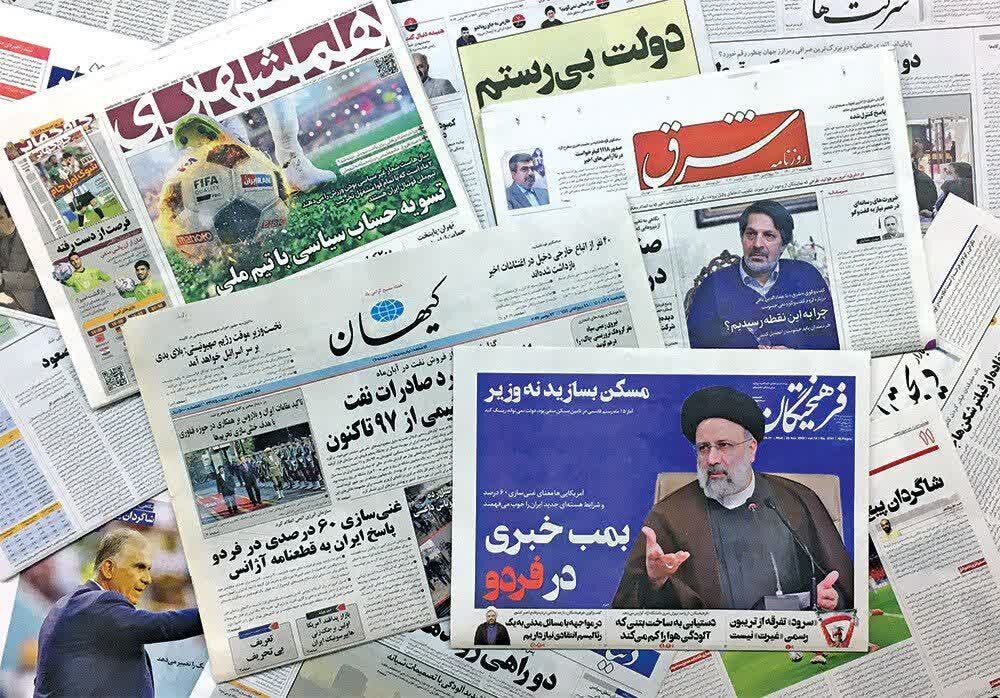
The Iran newspaper wrote: The strategy of the Islamic Republic in this era is to create an unwritten alliance between the great powers against the U.S. hegemony and to expand relations with these countries.
Referring to the new world order and new alliances between countries, the newspaper wrote: Iran, as a revisionist (uneasy with the status quo) regional power in the international system, has had a successful experience in creating alliances and coalitions during the past 10 years.
Iran is looking for an alliance in the economic and strategic fields with China, Russia, and the Shanghai Cooperation Organization.
Iran seeks to play an important role in the transitional period to be one of the influential countries in the future international order, which does not seem to be unipolar.
Therefore, forming alliances with great powers in transition period is one of the strategies of Tehran.
Etemad: Ambiguous prospects of relations with China
Etemad refers to the president's visit to China and writes: Whenever the pressure of the Western countries against Iran increases, Iran leans more to China and Russia, but it seems that the Eastern countries do not have the ability to create dynamism in Iran's economy, and they also are not able to respond to Iran's needs for investment, technology, etc.
Meanwhile, the other case is the 25-year contract between Iran and China. It should be reminded that China draws up different models of 25-year contracts with different countries that none of them are alike, and it should be seen what kind of contract with Iran is.
While Raisi is also trying to prepare the ground for more participation of the Chinese in Iran's economy, it is said that the 25-year contract between China and Iran is not so privileged.
In general, Iran should try to maintain balance in its relations with the West and the East and obtain maximum benefits from relations with different countries.
Arman-e-Melli: Iran and China: Long-term and not strategic relationship
In an article in Arman-e-Melli, Seyed Jalal Sadatian, the former ambassador of Iran to Britain, writes: Iran and China are looking for long-term cooperation in 25 years, which some have referred to as a strategic agreement, but China in its relations with other countries, including Iran, never uses strategic contracts, rather long-term and specific relationships.
During the Trump era, Iran tried to increase its relations with China and solve some of the sanctions-related difficulties, and in this regard, Iran's exports to China reached 12 billion dollars and the same amount as China's exports to Iran.
This is noteworthy especially as China is competing with the West and has always provided a significant part of Iran's needs. Of course, the Chinese have not met Iran's needs as Iran expects, because Beijing does not want to create challenges in its relations with the West.
If Iran expects China to favor Iran in its relations with the West and sacrifice its own interests, Iran's cooperation with China will not deepen, the former diplomat remarks.
Aftab Yazd: Fight against terrorism entails a multifaceted approach
Aftab Yazd writes: The growth of terrorist and extremist groups in West Asia has always been one of the most important concerns of people and some countries in the region.
In the meantime, "some actors in the region" have defined their security in the insecurity and instability of other countries, but others, for example, Iran, have tied their security to the security of others.
In its formal and informal meetings with regional players, Iranian officials have been always insisting on "security convergence" and “regional dialogue” in line with promoting stability and security, but these endeavors have not borne results due to opposition by some countries.
The campaign against takfiris requires a "multifaceted fight" which include countering Wahhabism, and Salafism and their training centers, blocking their media and social networks, informing the general public of extra-regional countries, and encouraging European countries to help fight terrorism.
Khorasan: Al-Khalifah sells land to stay in power
Khorasan wrote: Bahrain's Al-Khalifah regime has started selling land to the Zionists, and the media reported the sale of an offshore island of the country for $21 million to Tel Aviv.
Certain Arab sheikhdoms of the Persian Gulf, which have been doing the best of their abilities and competing each other in surrendering to the United States, have been trying to get closer to Washington and the Zionist regime in recent months due to the increasing tensions in the world and the region.
The Al-Khalifa regime, which has no legitimacy among its people and sees its throne in danger, is trying to stay in power for a few more days with bilateral agreements with Tel Aviv.
Arabic-language news websites said TV7 Israel News reported that Israeli company Himnota, which is owned by the ultra-right Jewish National Fund (JNF), bought a private island with an area of 9,554 square meters for $21.5 million in an auction.
Khorasan believes that the Manama regime is asking for help from Tel Aviv to deal with its own people by selling its land.
Leave a Comment