Iranian psychological warfare on social media and the strategic blindness of the West
When Lego-style social media videos become a weapon in psychological warfare

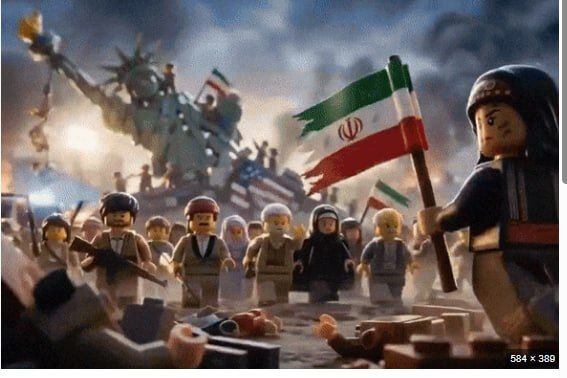
There comes a moment when an analyst must acknowledge that their conceptual tools are no longer sufficient to describe the reality they are observing. The Lego-style animations produced by the Iranian media entity Explosive Media — American warships exploding in colored plastic, Israeli aircraft turned into falling horses, figurine soldiers storming beaches under pixelated flags — represent one of those moments.
Not because they are aesthetically impressive, though they are executed with remarkable technical competence, but because they raise a question that Western geopolitical analysis does not know, or refuses, to ask correctly: what does it mean when highly qualified young Iranians, holders of doctorates and skilled in generative artificial intelligence, voluntarily choose to produce Shia Islamic resistance content?
The reflexive response of Western analysts, and especially American and Israeli ones, is predictable and, methodologically, deficient: it must be a government channel. It must be the IRGC or the Ministry of Culture and Islamic Guidance or some Islamic Revolution Foundation. No one can truly believe in this. No one can voluntarily choose this form of expression. Therefore, the flawed conclusion is that someone is paying them.
This conclusion is not only factually mistaken, it is the symptom of a deeper epistemic illness: the inability to conceive that a person with access to all the intellectual resources of global modernity can be, simultaneously and without contradiction, a practicing Shia Muslim and a sophisticated producer of resistance content. This inability is not neutral. It produces strategic blindness with measurable consequences in foreign policy decisions.
The Avini Doctrine in the Age of the Algorithm
To understand what Explosive Media is doing, one must first understand what Seyyed Morteza Avini did. The Iranian filmmaker documented the Iran-Iraq War front from the inside, from the combat trenches, with a camera on his shoulder and the conviction that his mission was not to express himself, but to let reality speak directly to the viewer's heart. His central principle — explicitly cited by the Explosive Media team in the only interview ever granted from inside Iran — is the refusal of self-narration: do not place yourself, as a media producer, at the center of your own frame. When you do that, Avini said, the story loses its power. It no longer strikes hearts. It becomes a selfish spectacle.
Transposing this principle into the social media context of 2025–2026 has operational consequences that no Western manual of information warfare anticipated. The anonymity of Explosive Media's producers is not an operational security measure, as they themselves state with complete clarity:
“It is not a matter of security. It is a matter of faith.”
Through this choice, the team eliminates the greatest vulnerability of any personality-based media project: there is no face to be discredited, attacked, doxed, or compromised. There is no influencer whose personal credibility can be undermined. There is only the content. And the content speaks for itself.
Western counter-influence operations are calibrated to target identifiable actors: you find the person, analyze their past, locate their contradictions, discredit them personally, destroy their credibility, and with it the project they represent. Against a faceless project, this strategy has no point of application. You cannot discredit a silhouette in the shadows.
The impact of gamification
An analysis of the content distributed on social media reveals that the use of Lego-style animations is not merely an aesthetic or creative choice, but an advanced form of gamification — a transformation, at the level of collective perception, of the conflict into a game, with direct effects on how the global public perceives the reality of war. By converting military events and political actors into playful sequences, the conflict is transposed into a familiar and accessible cognitive register, which produces a significant reduction in critical resistance and an exponential increase in distribution.
Empirical data confirm the scale of this phenomenon. The digital campaign generated over 145 million views and approximately 9.4 million direct interactions (likes, shares, comments), with more than 37,000 coordinated content items identified within a short time interval. These figures indicate not only virality, but a systemic capacity for production and dissemination, comparable to large-scale state media operations.
The impact, however, is not merely quantitative, but profoundly qualitative. Gamified content operates on the basis of a double coding: on the surface, it is perceived as entertainment; in depth, it conveys political and ideological messages. This ambiguity enables it to cross algorithmic and cultural barriers. According to an analysis conducted by Prof. Narges Bajoghli of Johns Hopkins University, for the first time in more than fifteen years of monitoring, the content generated in this context produced a convergence of algorithms across the entire U.S. political spectrum, from the far right, MAGA, to the far left. This phenomenon is exceptional and indicates a rare efficiency in the propagation of geopolitical messages. And it should be worrying for the United States, which has lost this battle of perceptions.
Gamification thus produces an effect of democratizing the conflict: the public is no longer merely a spectator, but becomes an indirect participant, through sharing, commentary, and reinterpretation. The conflict is internalized as a “narrative game,” in which every user contributes to the propagation of a version of reality. In this sense, Lego is not merely a visual tool, but a mechanism for integrating the audience into the dynamics of the conflict.
In parallel, this strategy has a direct effect on the adversary's credibility. Through the repetition and archiving of political statements, reinterpreted in a playful format, a progressive erosion of symbolic authority is produced. In the case of the United States, this erosion is visible in the way official discourse, especially that of Donald Trump, is transformed into viral satirical material, contributing to a decline of trust in American strategic communication on a global scale.
Another essential element is the replicability of the model. The campaign analyzed demonstrates the existence of a clear operational pattern: the use of diplomatic missions as distribution nodes, the production of AI content with a pop-cultural aesthetic, and the exploitation of the adversary's internal vulnerabilities. This model has already been observed in other geopolitical contexts and is likely to be adopted by other states, including major actors such as China or Russia. Thus, what initially appears as a contextual innovation is, in reality, an emerging doctrine of information warfare.

The theoretical foundation of this approach is explicitly expressed at the doctrinal level. According to a statement attributed to Iran's Supreme Leader Ali Khamenei in 2024, “media is more effective than missiles, aircraft, and drones in forcing the enemy's withdrawal and in influencing hearts and minds.” This assertion is not rhetorical; it reflects a profound strategic shift: the prioritization of the media field over the conventional kinetic one.
In this context, the reference made by the authors of the Lego-style videos — in the interview conducted on their own Facebook page — to the martyr Morteza Avini acquires structural relevance. As mentioned earlier, Avini was one of the first theorists to conceptualize media as an extension of an ethos of sacrifice and authenticity, in which the message prevails over the author. Through his exceptional media materials during the Iran-Iraq War, he created a narrative model in which reality is conveyed not as information, but as lived experience, with emotional and moral impact on the community.
This paradigm is found directly in the structure of the current campaign. The anonymity of the authors, the refusal of monetization, and the emphasis on authenticity and sacrifice are not accidents, but expressions of a coherent intellectual tradition. In the Avinian logic, media is not a space for self-exposure, but an instrument for the transformation of collective perception.
In conclusion, the gamification of conflict through Lego-style animations represents a strategic innovation with significant global impact. It combines cultural accessibility with psychological sophistication and is supported by an articulated media doctrine that exceeds the framework of classical propaganda. Through its scale, efficiency, and replicability, this model redefines the parameters of contemporary information warfare and confirms that, in the digital age, victory is no longer determined exclusively by military superiority, but by the capacity to shape perceptions on a global scale.
Plastic as a psychological weapon
The choice of the Lego aesthetic is, at first glance, paradoxical. Why would a serious military force represent grave armed conflicts through colored plastic figurines? The answer, once articulated, becomes evident in all its strategic elegance.
The Meta, YouTube, and TikTok platforms have invested hundreds of millions of dollars in automated detection systems for violent content, war imagery, and military propaganda. A tank exploding in real footage is detected and removed within hours. A Lego tank exploding in colored plastic animation passes through the social media filter. Not because this is a technical gap that will be corrected, but because, from the standpoint of the moderation algorithm, it is a toy. It is children's content. It is harmless.
Beyond the technical circumvention of algorithmic censorship, however, the Lego aesthetic operates at a deeper psychological level. The human brain associates representations in colored plastic with play, with childhood, with the inoffensive. Normal cognitive defenses against incendiary political content are partially deactivated by this association. The viewer lowers their guard. And the ideological message enters through a door that the receiver has left open precisely because the aesthetic seemed safe.
There is, however, a third layer, perhaps the most important from the perspective of psychological warfare: the systematic ridicule of the adversary. To represent the USS Harry Truman or Israeli F-16s as Lego figurines is an act of ontological diminution. You do not portray your enemies as feared and respected forces. You reduce them to the level of a child's plastic toy. And when the Explosive Media team receives an animation from a fan depicting their building attacked by Trump's order and immediately turns the aircraft into falling horses, this is information warfare as a form of psychological “judo.” Humor is, in the theory of psychological warfare, one of the most destructive weapons against authority and fear.
The generation that dismantles stereotypes
The most important dimension of the Explosive Media phenomenon is also the most difficult to accept for mainstream geopolitical analysis: its authenticity. These people are not paid. They are not coerced. They are young academics with specializations in media, psychology, and foreign policy, who have gone into debt to sustain the project and who anchor their practice in an intellectually elaborated media philosophy.
This reality is incomprehensible to an analytical framework built on the premise that intense religiosity is incompatible with intellectual sophistication. This premise is a secular European prejudice exported as universal, which collides with a wall of reality in the Iranian context. Iran has one of the highest literacy rates in the world. Sharif University in Tehran, whose students and professors are explicitly mentioned in Explosive Media's content, is the Iranian equivalent of MIT. Many of its graduates are practicing Shia Muslims. There is, in their minds, no contradiction between mastering generative artificial intelligence and believing in the Hidden Imam Mahdi.
This generation's choice to produce and consume Shia Islamic resistance content is, in this light, an informed choice, not the product of ignorance or manipulation. The episode of Dr. Zarei, the Sharif University professor who taught his class in the bombed classroom, is invoked by the team as a symbol of this intellectual-religious resilience.
Analysis that ignores this reality, and that reduces every expression of popular Iranian support to paid propaganda, does not analyze Iran. It analyzes its own prejudices about what Iran ought to be.
When Iran is attacked — militarily, economically, in media — it is not only the state apparatus that is activated. What is activated is a collective identity in which nationalism and Shia religiosity are inseparable. The “rally around the flag” phenomenon, well documented in social psychology, acquires in the Iranian context an additional amplitude precisely because the overlap between national identity and religious identity is deeper than in any other context in the region.
What Western analysis cannot understand, and why it matters
Explosive Media and the Lego-style videos represent something that the Western analytical framework is not equipped to fully understand: a project of information warfare that is simultaneously authentic in terms of motivation, technically sophisticated, doctrinally coherent in philosophical terms, and strategically effective.
To accept the authenticity of this phenomenon means to accept that millions of young, educated, globally connected Iranians voluntarily choose Islamic resistance as a form of political and identitary expression. This acceptance detonates two pillars of the dominant Western narrative: the premise that sanctions and economic pressure will generate internal political change by alienating the population from the regime, and the premise that modernization and education inevitably lead to secularization and the adoption of Western liberal values.
Both premises are false in the Iranian case. Sanctions have consolidated, not eroded, Iranian identitary cohesion. Education has not produced secularization, but a more sophisticated and more militant religiosity. This reality is so inconvenient for the American geopolitical paradigm that it is easier to deny it — classifying every expression of it as paid propaganda — than to integrate it and reformulate policies accordingly.
The decades-long price of this blindness has been immense. It continues to be immense. And the Lego animations on Facebook, with millions of likes and hundreds of thousands of organic shares, are among the visible symptoms of this failure of understanding. Not of Iran's absolute power. Of the West's absolute limits in knowing its adversary. And from this also follows the fundamental failure of its own intelligence resources, which fail to break out of the patterns of prejudice and of outdated models of thought.
Context: Shia Islam and the Iranian generation Z
The Explosive Media phenomenon cannot be understood outside of a broader context: Iran has one of the highest literacy rates in the world, universities of international standing, and a young generation with full access to all global platforms.
This generation's choice to produce and consume Shia Islamic resistance content is, in this light, an informed choice, not the product of ignorance or manipulation. The episode of Dr. Zarei, the Sharif University professor who taught his class in the bombed classroom, is invoked by the team as a symbol of this intellectual-religious resilience.
Analysis that ignores this reality, and that reduces every expression of popular Iranian support to paid propaganda, does not analyze Iran. It analyzes its own prejudices about what Iran ought to be.
Ghalibaf's formula and the full spectrum of strategic communication
On 13 April 2026, Mohammad Bagher Ghalibaf — Speaker of the Iranian Parliament and an IRGC general with extensive operational experience — posted on X a mathematical formula: ?O_BSOH > 0 ? f(f(O)) > f(O), accompanied by a map of gasoline prices around the White House and the message that Americans will be nostalgic for four- to five-dollar gasoline. The post generated 4.2 million views.
This is not a joke or an operationally encrypted message. It is a strategic deterrence message addressed to a specific audience: the analysts, decision-makers, and officials capable of decoding it. The formula says, in the language of applied mathematics, that any increase in pressure on Iran produces compound, nonlinear, larger effects on the one applying the pressure. Lego for the masses, a mathematical formula for the elites; the same ecosystem, different audiences, deliberate architecture.
Nevertheless, what is very important to retain from this message is not only the content, but the manner in which it was communicated. The Guardian notes in an article that IranWire, a self-styled independent Iranian journalism platform, investigated the author of the X feed of Ghalibaf, and that the real author is allegedly a political ally of Ghalibaf based in the United States. If confirmed, this demonstrates that the pro-regime Iranian diaspora in the United States functions as an operational actor in the American information space, with a level of penetration that exceeds mere external production.
How a digital campaign reshaped the map of global perception in 46 days
46 days after the outbreak of hostilities between the United States and the Islamic Republic of Iran, the kinetic balance of the confrontation remains uncertain. The perceptual balance, however, has already closed. Iran has won the image war that Washington appeared to have lost before even beginning it. The figures are in themselves a verdict: over 145 million views for pro-Iran content produced or coordinated through diplomatic missions and the affiliated network of creators, 9.4 million direct interactions, 37,000 pieces of content identified by the monitoring platform Cyabra, 40 million cumulative views on Facebook and X, while TikTok concentrates 72% of the global exposure to the Iranian narrative.
The measurable effects of this convergence can be read in the polling figures. In the United States, the Pew Research Center documents that 59% of Americans believe Washington made the wrong decision in attacking Iran, 45% consider that the military action is not going well, and, by a two-to-one ratio, they believe that the war will make the country less safe in the long term. President Trump's approval for the handling of the conflict fell to 34% in the Quinnipiac survey of 25 March. Ipsos, in the interval of 10 to 12 April, reported that only 24% of Americans considered that the military decision was worth the costs, while 54% reported a direct negative personal financial impact attributed to the war. Gasoline prices above four dollars per gallon and the energy crisis described by the International Energy Agency as the most severe in history have anchored American skepticism in the domestic economy, and the Iranian campaign had the simple task of translating this discomfort into political narrative.
In Europe, where the public was already predisposed toward criticism, the scale of the effect is greater. In France, Ipsos BVA records in April a 74% disapproval of American actions, eleven points higher than in the previous month, while 75% disapprove of Israel's actions. In Spain, 76% oppose the military intervention, and Madrid permanently withdrew its ambassador from Tel Aviv on 11 March. In the United Kingdom, 57% oppose American action. The posts by the embassies in London with Rumi and Twain, in The Hague with Inside Out aesthetics, in Berlin referencing Der Spiegel, in Moscow with Don Quixote, in Sweden with Linkin Park and Rachel Corrie, and in Vienna with the warning 18+ war crime were precisely calibrated to local sensibilities and values. The result is not a revolt of European public opinion against Washington, but an increase in the internal political cost for any European government that would continue to unconditionally support the American or Israeli position.
The Global South was the theater in which the campaign operated with the least effort and the greatest gain. In South Africa, Zimbabwe, Nigeria, India, Thailand, Indonesia, and Afghanistan, the Iranian civilizational narrative — grounded in the Cyrus Cylinder, in seven thousand years of civilization, in resistance to Alexander the Great and to the Mongols — met publics with their own memory of Western colonialism. The embassy in Pretoria surpassed one hundred thousand followers during the conflict. The Arab Opinion Index 2025, with more than forty thousand respondents in fifteen countries, documents a massive rejection of normalization with Israel, and the Iranian campaign did not create this predisposition, it exploited it. In India, the world's most populous country, 80% were actively following the conflict, with concerns tied to energy prices and the cost of living, not to the security of the Iranian regime.
The Arab dimension of the campaign is distinct and less visible to the Western observer. Iran operates two narratives simultaneously: one addressed to the West, built on humor, Epstein, and the incompetence of the Trump administration, and another addressed to the Arab world, built on sovereignty, hegemonism, and solidarity.

The most subtle result of the psychological war is the erosion of the credibility of American strategic communication. Every unexecuted threat by President Trump — from Power Plant Day to Bridge Day, from the Stone Age to the promise to throw Iran into oblivion — has been archived, edited, and redistributed by the Iranian missions. An Iranian consulate published a scoreboard with twelve declarations of victory and seventeen announcements of Iran's destruction, which circulated globally in meme format. The acronym TACO, Trump Always Chickens Out, has become common currency in informed circles. The Cambridge analyst Neil Lavie-Driver has synthesized the mechanism in a formulation that will endure: the Iranians use popular culture against the number one of popular culture, the United States, in order to sow sufficient discomfort with the conflict to force the West to yield.
Conclusion: The shift in global perception
Iran is rewriting the game: from two-dimensional chess on a flat board with predefined moves to three-dimensional chess.
Beyond the raw numbers of virality, the true stake is something else: the shift in global perception of Iran. We are no longer speaking only of visibility, but of an evident increase in what specialists call likeability — that capital of sympathy, empathy, and openness that a state manages to earn in the eyes of the international public.
Through these productions, Iran frontally breaks the patterns constructed over decades in Western media. The rigid image, associated exclusively with tension and isolation, is replaced by one uncomfortably different: a creative, sophisticated state, capable of operating intelligently in the cultural and digital register. Without official speeches and without classical propaganda, the global public is placed before a reality it can no longer ignore: a high level of education, substantial academic communities, and a media culture that knows exactly what it is doing.
And the move is a strategic one. You are not told what to think about Iran; you are left to interact directly with its cultural products. Precisely this unfiltered exposure erodes the dominant narratives and draws Iran out of the zone of shadow into which it had been pushed. In place of a simplified image, there emerges one far more dangerous for its adversaries: complex, nuanced, credible.
Furthermore, these materials do not merely circulate; they reactivate interest in Iranian culture. Without official campaigns and without classical cultural branding, they subtly suggest a profound artistic tradition, reinterpreted in a contemporary language. It is a calculated combination of the old and the new, the symbolic and the viral, which builds an image of continuity and refinement — exactly the opposite of earlier stereotypes.
The consequence? The impact does not stop at “engagement.” It is a shift in substance, a recalibration of the way Iran is perceived globally. We are no longer speaking of reactions, but of a strategic repositioning in the collective Western imagination.
And perhaps the most uncomfortable truth for Iran's adversaries is this: we are not witnessing merely a competition between states, but a conflict between ways of thinking about power. Some are still playing chess on a two-dimensional board. Others have already moved the game into a multidimensional space, where the strongest no longer wins, but the one who knows how to control perceptions. And in this game, Iran is no longer catching up: it leads.
Editorial analysis based on primary sources: Facebook/Reels captures from Explosive Media, the Persian-language interview of the Tell Us Iran team, and the English transcript of the same interview.
Leave a Comment