Realistic expectation from China
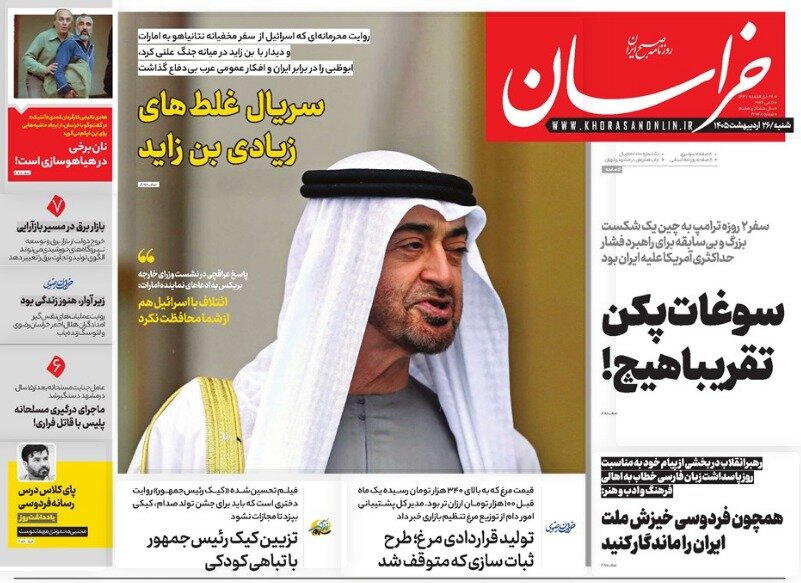
Khorasan examined Trump’s trip to Beijing and its impact on the war with Iran. According to the paper, the U.S. president had planned to defeat Iran and use that major achievement as leverage to extract political and trade concessions from his Chinese counterpart. But now, his biggest supposed advantage has turned into his biggest challenge.
Trump will apply heavy pressure on Xi Jinping to persuade Iran to reopen the Strait of Hormuz. Although the closure of the Strait harms China in the short term, in the long run, it weakens Washington’s geopolitical position and strengthens the yuan. Given Beijing’s extreme caution in international affairs and its preference to operate within the existing global order, it is likely that the press conference or final statement of Trump’s visit will include language urging Iran to reopen the Strait of Hormuz. Iran, for its part, should take steps such as selling oil at offshore terminals to draw China more deeply into the issue.
Donya-e-Eqtesad: Europe at a crossroads of destiny
Donya‑e‑Eqtesad highlighted Europe’s position at a decisive crossroads. On one side lies the war in Ukraine and the possibility of direct confrontation with Russia; on the other, disruptions in the Strait of Hormuz and threats to Middle East energy flows have pushed Europe’s energy security to its narrowest point. Reports now suggest that the EU is considering investment in alternative Middle East energy routes that bypass the Strait of Hormuz. However, a strategic perspective requires Europe to think beyond short‑term tactical solutions. A strategic partnership with Iran—if not a necessity—is at least a logical option grounded in geopolitical realities. Such a partnership would not only secure energy flows but also contribute to regional stability. Iran has demonstrated not only control over its vast gas reserves but also effective influence over the entire Persian Gulf energy chain. Ignoring this reality risks reducing Europe to a passive actor in global energy dynamics.
Hamshahri: Trump’s troublesome admission
Hamshahri discussed a problematic admission by Trump. The paper said: Trump appears eager to show that economic pressure from the war will not force him to retreat. Yet this posture may backfire. Trump behaves as though he possesses unlimited power, but this approach becomes troublesome when confronted with political and social realities. A recent example was his verbal slip this week—saying that during the war with Iran, he does not think about its economic consequences or the financial situation of Americans. Republicans tried to justify his remarks, claiming he was misunderstood, but even his vice president, J.D. Vance, had to emphasize that the administration does care about people’s economic hardships. Trump may want to project strength, but this strategy could work against him, especially since the war with Iran is unpopular among Americans and many believe its economic cost is not worth it.
Ettelaat: Iran as the architect of a new order in the Persian Gulf
Ettelaat analyzed Iran’s growing role in shaping a new order in the Persian Gulf. Recent developments around the Strait of Hormuz and the region have been rapidly evolving. A new game is emerging over control, security, and order in one of the world’s most sensitive waterways, and Iran’s role as a key player has become more prominent than ever. Iran now occupies a more decisive position: decisions regarding shipping routes, insurance policies, and global responses to regional crises are increasingly influenced directly by Tehran. Policies that may appear economic on the surface are, in reality, powerful tools for managing regional security, safeguarding national interests, and shaping a new order. The Strait of Hormuz is no longer just a waterway—it has become a symbol of national power and determination. The new game has begun, and Iran is the central and decisive actor.
Siasat-e-Rooz: From BRICS convergence with Iran to the exposure of the UAE
Siasat‑e‑Rooz evaluated Araghchi’s effective presence at the BRICS meeting in India. The meeting of BRICS foreign ministers, attended by Araghchi, became both a platform for major BRICS members to align with Iran in condemning the US–Israeli military aggression, and an arena where the UAE was exposed for its destructive role during the Ramadan War by siding with the US and Israel against Iran and regional security. The BRICS meeting took place under the shadow of the Ramadan War and the Strait of Hormuz crisis. Despite this, Araghchi’s participation—along with his clear articulation of Iran’s principles and the revelations about the UAE’s irrational behavior—helped lay the groundwork for a new structure within BRICS that strengthens the bloc’s global role.
Leave a Comment