Iran does not fear Trump’s threats
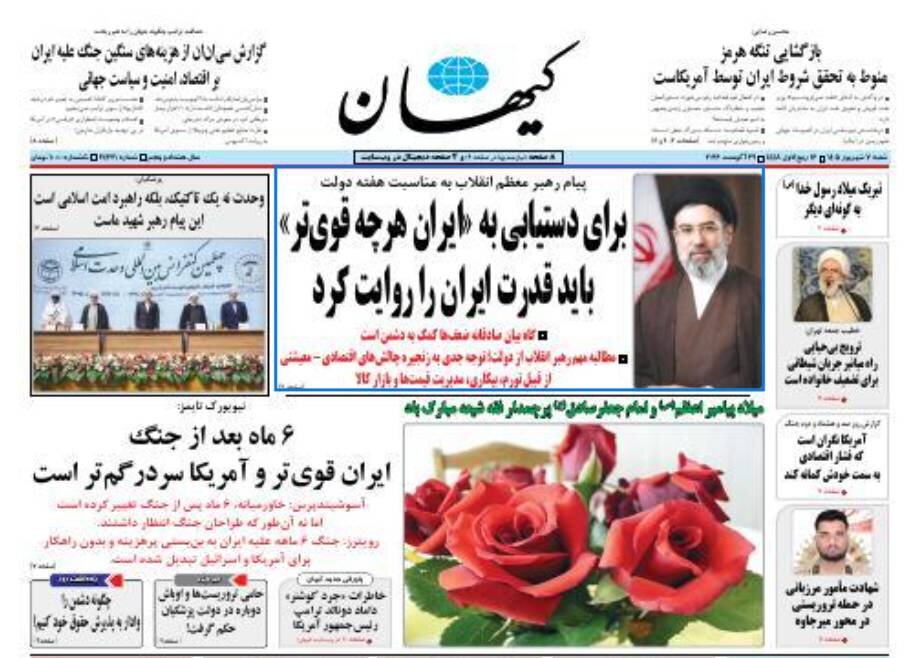
Kayhan, in an article, pointed to Iran’s strength in the face of the United States threats. If we review Trump’s statements over the past six months, we repeatedly encounter phrases such as “Iranians are tough.” All of these remarks were made at moments when he had previously threatened Iran, Iran ignored the threat, and the United States was ultimately forced to back down.
Kayhan, in an article, pointed to Iran’s strength in the face of the United States threats. If we review Trump’s statements over the past six months, we repeatedly encounter phrases such as “Iranians are tough.” All of these remarks were made at moments when he had previously threatened Iran, Iran ignored the threat, and the United States was ultimately forced to back down. The solution in dealing with such an enemy is to respond to every threat with a stronger counter‑threat — and to act on it. With such an approach, we will undoubtedly push the enemy to a point where it refrains from repeating threats against Iran and accepts our rights. In this context, the most destructive political behavior is showing weakness in the face of enemy threats, speaking of diplomacy and negotiation with him, and thereby opening the way for further threats.
Iran: Building an intra‑regional security order
The Iran newspaper, in an analysis of the Qatari prime minister’s visit to Tehran, wrote: Tehran, following intensive consultations between Iran and Muscat to jointly manage the Strait of Hormuz, once again returned to the center of regional diplomacy. This time, the visit of Sheikh Mohammed bin Abdulrahman Al Thani, Qatar’s prime minister, came as part of Doha’s ongoing mediation efforts to untie the remaining knots of the recent crisis and take another step toward reviving the Islamabad agreement. The trip created an opportunity for Tehran and Doha to deliberate on a more strategic question: To what extent can the security of the Persian Gulf and the Strait of Hormuz be ensured through strengthened cooperative mechanisms among regional countries — without relying on the intervention or presence of extra‑regional actors? If sustained, this approach could, out of the current crises, gradually lay the groundwork for the emergence of an intra‑regional security order.
Sobh‑e‑No: The defeat of the regime‑change camp
Sobh‑e‑No, in a commentary, addressed the failure of the anti‑Islamic Republic project. Today’s conditions are no longer the same as the early days of this project. At the beginning, the opposing camp could hide its internal disagreements under the shadow of a shared goal, relying on the illusion of imminent victory. But now, as one declared objective after another has failed to materialize, that shared goal no longer has the power to conceal internal divisions. When the project of overthrow does not succeed, the conflict inevitably shifts from the external battlefield into the camp itself — and the question becomes not only “How do we defeat Iran?” but also “Who caused us to fail?” Thus, not only do Iran’s internal sources of stability increase the risk of failure for the enemy’s new strategy, but the fragmentation and disarray within the enemy camp itself have become one of the most significant factors strengthening the likelihood of its defeat.
Arman‑e‑Emrooz: What is Witkoff seeking?
Arman‑e‑Emrooz analyzed Steve Witkoff’s recent efforts to finalize the revival of the Islamabad understanding and his diplomatic engagement with regional mediators. This move comes at a time when tensions surrounding the Strait of Hormuz and US–Iran relations remain high, and various parties are seeking ways to reduce the crisis. American negotiators are waiting to see how Iran will respond to this pressure — and whether Tehran is willing to offer concessions in exchange for easing certain restrictions. This complex process requires precise coordination among multiple actors, and any progress could have wide‑ranging effects on regional stability. Witkoff’s push to finalize the revival of the Islamabad understanding marks a turning point in recent developments and shows that, despite public tensions, back‑channel communication remains active. The future of these efforts depends on the flexibility of the parties involved and the mediators’ ability to identify common ground.
Etemad: The White House’s hidden objective fails
Etemad, examining the White House’s concealed objective, wrote: The hidden goal of the White House was to complete the project of regional consensus‑building and force Arab capitals into joining an anti‑Iran coalition. The Iranian diplomatic apparatus, through its smart strategy of separating the accounts of neighboring states from Washington’s agenda and activating “neighbor‑focused diplomacy,” thwarted this plan. By sending reassuring signals — while also warning of the dangers of regional countries becoming platforms for US aggression — Tehran turned Washington’s regional bases from points of coalition connectivity into vulnerable and costly points, paving the way for de‑escalation with Persian Gulf states. An evaluation of this record shows that Washington completely failed to achieve its main goal: the computational collapse of Tehran and the extraction of a new surrender document. By relying on hard power variables generated on the ground, Iran’s diplomatic apparatus transformed the maximum‑pressure strategy into a costly dead‑end for the White House, and the Islamabad agreement was born precisely at this point of deadlock.
Leave a Comment