Sirous Moqaddam turns Minab tragedy into “Empty Grave”
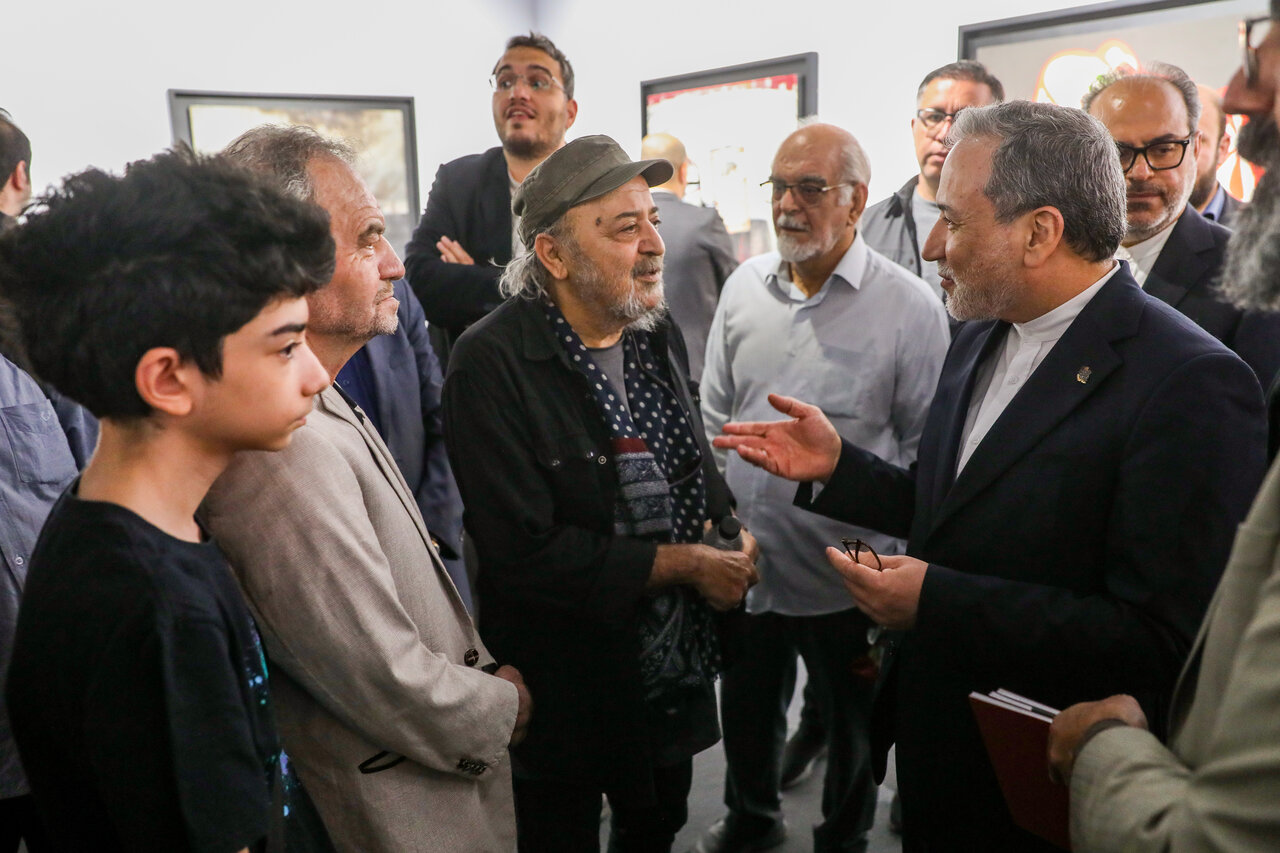
TEHRAN- Iranian filmmaker and painter Sirous Moqaddam says his deep personal attachment to southern Iran and his encounter with the families of the Minab school victims inspired him to create “Empty Grave,” a painting dedicated to the children killed in the tragic attack on a school in the southern city of Minab.
In an interview with the Tehran Times, Moqaddam spoke about the motivation behind the work on the sidelines of the opening of the group exhibition “Minab School,” which brings together works by a number of prominent contemporary Iranian visual artists in response to the tragedy.
The exhibition opened on Friday, August 28, at the Art Bureau in Tehran. Organized by the Nam Cultural and Artistic Institute, the exhibition features works created voluntarily by Iranian artists seeking to preserve the memory of the children and teachers who lost their lives in the attack.
“I was proud to be part of this gathering, and I had the opportunity to create and present the painting ‘Empty Grave’ for the exhibition,” Moqaddam said.
He recalled that efforts had begun among artists to organize a collective exhibition following the tragedy, saying that the opportunity to participate in the project carried a particular significance for him.
“I have several kinds of personal attachment, but most importantly, I am a child of the south myself, and I have a special attachment to this part of the country,” he said.
Moqaddam said his connection with the victims became more personal after meeting the family of Makan Nasiri, a seven-year-old missing martyr.
“When I became acquainted with the Makan’s family and witnessed their grief and sorrow, I considered it my duty,” he mentioned.
The artist said that a subsequent meeting with families of the Minab victims in Mashhad further shaped his approach to the subject.
“After that, at a meeting in Mashhad with the families of the Minab martyrs, I decided to create a more specific work. From that moment on, the idea that there should be a painting of an empty grave in this collection remained in my mind,” he explained.
For Moqaddam, the empty grave serves as a powerful image of absence. Rather than depicting the moment of the attack itself, the painting focuses on what remains afterward: a space that should have been filled by a child whose life was cut short.
The choice of the subject also reflects the broader role that the “Minab School” exhibition seeks to give to art: turning an individual tragedy into a lasting visual record.
The exhibition was organized in the aftermath of the February 28 attack on the Shajareh Tayyebeh elementary school in Minab, Hormozgan province. The strike occurred as students were beginning their school day, killing and injuring a large number of people.
According to Iranian authorities, the final death toll from the attack reached 168, while at least 95 others were wounded. The victims included children and teachers, making the incident one of the most devastating episodes of the conflict that began that day.
The tragedy has since become a major subject of remembrance in Iran, with artists turning to painting and other forms of visual expression to preserve the memory of the victims.
At the opening of the exhibition, Iranian Foreign Minister Abbas Araghchi described the students killed at the school as symbols of heroism for the Iranian people and stressed that the incident would not be forgotten or forgiven. He also highlighted the ability of art to preserve historical events and communicate messages in ways that speeches and written statements sometimes cannot.
“The works are documents of the legitimacy and victimhood of the Iranian people and the children who were deliberately and unjustly targeted in this war,” Araghchi said at the opening.
Moqaddam’s “Empty Grave” is among the works that approach the tragedy not simply as a historical event but as an emotional experience for the victims’ families and the wider community.
The exhibition includes works by a wide range of established Iranian artists, among them Behzad Shishegaran, Gholam-Ali Taheri, Morteza Asadi, Kazem Chalipa, Ali Nedai, Hassan Yaqouti, Abdolhamid Ghadirian, Mostafa Goudarzi, Nasser Seifi, Jamshid Haqiqatshenas, Seyyed Masoud Shojai Tabatabai, Kamyar Sadeqi, Seyyed Ali Mirfattah, Mahyar Charmchi, Mostafa Qorbani, Hossein Einibakhsh and Mohammad-Ali Naderi, alongside Moqaddam.
The collective nature of the exhibition is significant, as the artists participated voluntarily and sought to address the tragedy through different visual languages. While some works recall the victims directly, others use metaphor, symbolism and abstraction to explore loss, grief and remembrance.
The exhibition consequently functions both as a memorial and as an artistic response to the tragedy. Its organizers have sought to ensure that the memory of the victims remains present through contemporary Iranian art.
The role of art in preserving the memory of the Minab victims has also been emphasized by officials. Araghchi said at the opening that paintings, films, poetry and music can convey messages that may not be fully communicated through conventional diplomatic statements or speeches. He expressed hope that the exhibition could eventually be presented in other countries so international audiences could learn about the Iranian children who were killed.
“Minab School” will remain on display at the Art Bureau in Tehran through September 22, offering visitors an opportunity to view the artists’ different interpretations of the tragedy and the lives lost.
On February 28, the Shajareh Tayyebeh girls' elementary school in Minab, Hormozgan province, became the site of a devastating massacre as the United States and Israel initiated their strikes against Iran.
While dozens of girls and boys aged between 7 and 12 were beginning their lessons, the school was targeted by a missile strike that caused the building to collapse, trapping children and teachers beneath the rubble. Iranian authorities confirmed a final death toll of 168 people, with at least 95 others wounded, marking one of the most harrowing incidents of the conflict's opening day.
Despite attempts by US and Israeli authorities to distance themselves from the carnage as images of the tragedy spread across social media, detailed forensic and digital investigations have painted a starkly different picture.
An analysis by Al Jazeera’s digital investigations unit, utilizing over a decade of satellite imagery and recent video clips, revealed that the school was a clearly distinct civilian facility, separated from any adjacent military sites for at least ten years. Furthermore, witness accounts and satellite-based analyses confirmed that the school was triple tapped by three separate, deliberate strikes, leaving no doubt about the nature of the attack.
The international community has faced mounting evidence regarding the responsibility for this atrocity, with investigations from major global outlets including The New York Times, BBC Verify, CBC, and NPR all concluding that the United States was responsible for the strike.
These findings have raised fundamental questions about the intelligence used to justify the bombing, as the patterns of the strike suggest a direct targeting of a civilian educational institution. The Minab school tragedy now stands as a somber testament to the immense human cost of the aggression and a focal point for those demanding international accountability.
SAB/
Leave a Comment