Housing Foundation announces allocation of 70,000 rural land plots to applicants
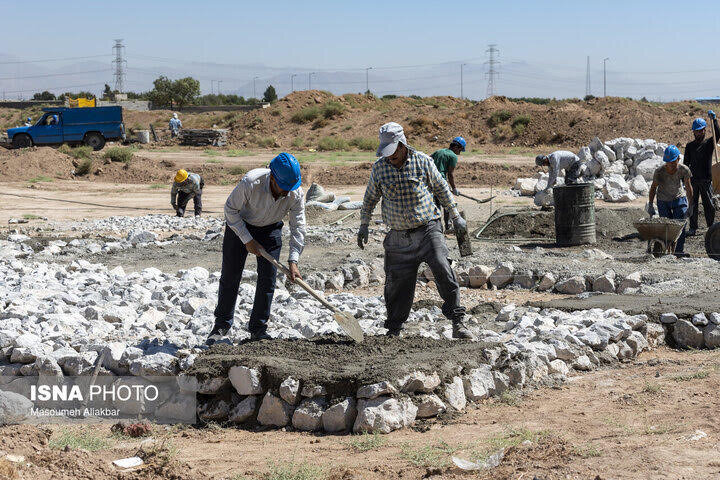
TEHRAN- The head of the Housing Foundation of the Islamic Revolution said: Under the Housing Foundation’s legal mandate in the Seventh Plan, 70,300 land plots in villages have been allocated, and information on 320,000 units has also been uploaded to the relevant system.
According to an ISNA report, Manouchehr Khajeh-Dalouei, during the signing of a memorandum of understanding with Resalat Bank to finance “Home of Hope” housing, stated: Under the Housing Foundation’s legal duty to provide land and rural housing in the Seventh Development Plan, so far 70,300 land plots in villages have been allocated, and information on 320,000 units has also been uploaded to the relevant system.
Stating that in some villages we face restrictions in providing land, he added: In a significant portion of villages, sufficient land is not available from natural resources, and to provide the land needed by applicants, action must be taken through agreements with owners.
The head of the Housing Foundation, stating that the foundation had drafted a directive for reaching agreements with owners, said: The Court of Administrative Justice has raised ambiguities about this directive, and as a result, implementation of this part has been suspended.
Khajeh-Dalouei continued: Follow-ups are underway to resolve these ambiguities and redraft the legal framework so that it becomes possible to reach agreements with owners and allocate the residential share of the agreed lands to rural applicants.
He expressed hope that with the drafting of a new legal framework, it will be possible to provide land for housing applicants in the vast majority of villages.
In another part of his remarks, the head of the Housing Foundation of the Islamic Revolution, while explaining the details of the Home of Hope plan, said: Under this plan, construction of 200,000 residential units for disadvantaged groups has been envisaged, and so far executive operations for about 105,000 units have begun.
Referring to the conditions for benefiting from the Home of Hope plan, he stated: Applicants must belong to disadvantaged groups and must not have previously used government housing facilities; meaning their Form “J” must be green.
According to the head of the Housing Foundation, eligible applicants across the country can use the capacities of this plan, and the Ministry of Transport and Urban Development is responsible for providing land in existing cities and new cities. The required land is also provided to applicants free of charge.
Khajeh-Dalouei, referring to the planning carried out for the construction of 200,000 units under Home of Hope, added: Based on the report received up to Saturday, executive operations for about 105,000 units have begun, and the plan is progressing at an appropriate pace.
Regarding measures taken to provide the land needed for the plan, he said: The Housing Foundation has concluded a memorandum of understanding with the National Land and Housing Organization to provide land for 50,000 residential units, of which 25,000 units will be built in new cities. Land provision and allocation are being carried out under these memoranda.
The head of the Housing Foundation considered the direct participation of applicants in the construction process to be one of the main features of Home of Hope and explained: In this plan, unlike some centralized housing projects, the people themselves participate in the process of constructing residential units, and the Housing Foundation has taken responsibility for following up on matters related to permit issuance and other executive stages.
Khajeh-Dalouei continued: In the design and technical matters, measures have also been taken in cooperation with the Construction Engineering Organization, and specific structural systems have been designed for the construction of the units so that applicants can use these models if they wish.
In another part of his speech, the head of the Housing Foundation referred to support for households covered by support institutions and said: For eligible applicants covered by the Imam Khomeini Relief Committee or the State Welfare Organization, a 400 million toman non-repayable grant for housing construction has been envisaged.
He stated: In this regard, agreements have been concluded with the Relief Committee and the State Welfare Organization. According to him, for the current year, agreements have been made regarding the provision of housing for 52,000 units, and under the agreement with the Relief Committee, the provision of housing for 44,000 units has been considered.
EF/MA
Leave a Comment