Iran fears neither war nor the deception of negotiations
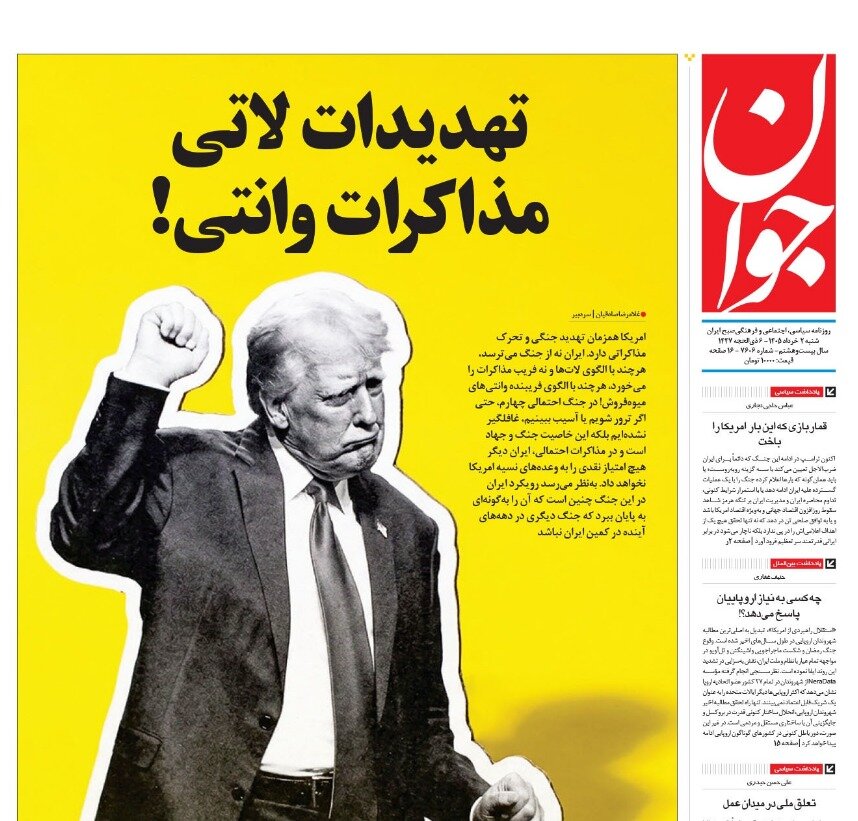
Javan highlighted Iran’s strength in both wartime and negotiation contexts. According to the paper, neither war can be considered inevitable nor ruled out, and negotiations can neither be fully trusted nor dismissed.
Iran has shown that this time it intends to end the war at a moment and in a manner that removes the shadow of conflict from its future for decades. The United States cannot obtain through negotiation what it failed to achieve through war. Some argue, in contrast, that Iran also cannot gain through negotiation what it did not secure through war, and that the country is now besieged and must seek a solution. The response is that Iran defended itself and did not lose; therefore, it fears neither renewed war nor negotiations. It sees the consequences of both paths as positive for its future. For this reason, few fair‑minded analysts inside or outside Iran—especially foreign observers—would deny that “Iran will emerge from this war victorious, with a bright future ahead.”
Shargh: Regional atmosphere between war and diplomacy
Shargh examined the uncertain situation that has emerged after the start of the ceasefire. It wrote that diplomacy has always been the first tool to prevent crises and the last path to ending wars. Even after military conflict begins, negotiation and dialogue are what can pave the way back to stability. Now, however, after 40 days of war and more than forty days of ceasefire, the regional atmosphere appears more complex and ambiguous than before. The region is currently suspended in an in‑between state: the war has not fully ended, and diplomacy has not yet produced a lasting outcome. Nevertheless, there remains no alternative more effective or less costly than diplomacy for exiting the crisis. For this reason, evaluating the performance of the country’s foreign policy during the ceasefire has become one of the most important topics in the political and diplomatic arena—an era in which, alongside ongoing threats and increasingly complex regional dynamics, the diplomatic apparatus has faced a difficult test.
Arman-e-Emrooz: Negotiations enter a sensitive and unprecedented phase
Arman-e-Emrooz commented on the second visit of Senator Mohsin Naqvi, Pakistan’s Interior Minister, to Tehran, noting that his second trip in less than a week reflects the urgency of the current diplomatic moment. Border security, trade, energy, and regional stability are at the top of the agenda. News sources have pointed to Pakistan’s efforts to hold a second round of talks before the unspecified ceasefire deadline expires. These developments come as the region continues to face numerous political and security challenges. The visit—taking place within a single week—signals a diplomatic shift by the United States and Islamabad aimed at advancing regional and nuclear negotiations. Naqvi has likely conveyed Washington’s response to Iran’s recent proposals to officials in Tehran. Given Pakistan’s active mediating role in Iran–US talks, this trip could be key to assessing Washington’s position and preparing the ground for a new round of dialogue.
Siasat-e-Rooz: Negotiation is not the problem; the enemy is not trustworthy
Siasat-e-Rooz analyzed the views of certain groups in Iran regarding the West. According to this analysis, there are those who believe that unless Iran reconciles with the United States, establishes relations with it, and yields to Washington’s demands, the country’s situation will not improve. This Western‑leaning mindset exists across various structural sectors—political, economic, and cultural—and remains active. However, there is no opposition to negotiation itself; even those skeptical of talks are not against negotiation per se, but rather distrust the other side, fully aware of the long history of US and European breaches of commitments toward Iran. They do not view negotiation as a cure‑all. Now, in the midst of an imposed war, expectations for positive, decisive outcomes from Iran–US talks mediated by Pakistan should not lead to a halt in the country’s internal progress.
Kayhan: We must not relinquish the Strait of Hormuz
Kayhan emphasized the strategic importance of controlling the Strait of Hormuz, stating that this is currently Iran’s greatest point of strength—and the enemy’s greatest vulnerability. If the goal is to contain the enemy, lift sanctions, improve economic conditions, and achieve deterrence and a permanent end to war, all these objectives converge in the Strait of Hormuz. This leverage must not be surrendered easily. Media outlets, citing the head of the International Energy Agency, reported that global oil will enter a red phase by summer, and Bloomberg wrote that if the Strait of Hormuz remains closed, the world economy will enter a “devastating crisis.” This is precisely why the enemy has been forced into negotiations—specifically over the Strait of Hormuz. Just as the enemy will never abandon the leverage of sanctions, Iran must never relinquish its leverage over the Strait.
Leave a Comment