What happens if both Bab al‑Mandab and the Strait of Hormuz are closed?
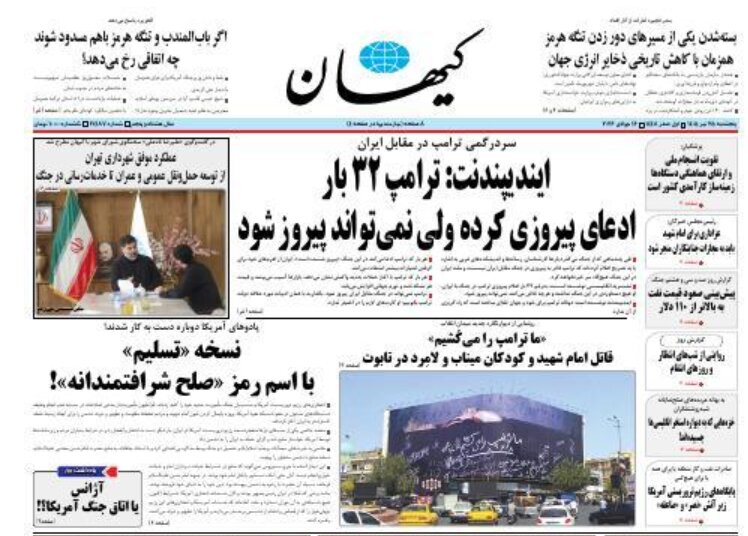
Kayhan, in an article, examined the events that could follow the closure of the two strategic waterways, Bab al‑Mandab and the Strait of Hormuz. According to Kayhan, the convergence of security threats in these two strategic chokepoints would push global trade into a new phase—one in which rising transportation costs, disruptions in oil exports, pressure on the Suez Canal, and the spread of crisis to major world economies would be only part of the potential consequences of a simultaneous shutdown of these vital passages.
Kayhan, in an article, examined the events that could follow the closure of the two strategic waterways, Bab al‑Mandab and the Strait of Hormuz. According to Kayhan, the convergence of security threats in these two strategic chokepoints would push global trade into a new phase—one in which rising transportation costs, disruptions in oil exports, pressure on the Suez Canal, and the spread of crisis to major world economies would be only part of the potential consequences of a simultaneous shutdown of these vital passages. Moreover, the closure of both straits would effectively disable Saudi Arabia’s most important alternative route for bypassing the Strait of Hormuz. Under such conditions, Saudi Arabia, Egypt, China, and major energy‑importing economies such as Europe, India, Japan, and South Korea would be among the main victims, and the scope of the crisis would expand from a regional conflict into a widespread global economic crisis.
Iran: Washington’s dream; shifting the balance after the war
The Iran newspaper analyzed the goal behind the new round of US pressure and military aggression against Iran. It wrote that the main US objective at this stage is not merely to start a new conflict, but to disrupt the balance that emerged during the 40‑day war. During that period, Iran—relying on offensive capability, social support, its geopolitical position, and especially the leverage of the Strait of Hormuz—managed to raise the cost of continuing the war for the US and its allies, thereby imposing a new deterrent balance on the crisis. This balance forced Washington to retreat from some of its initial goals and move toward the Islamabad understanding. From this perspective, recent attacks and threats should be seen as an attempt to test the durability of that balance—an effort to assess whether Iran can still use its strategic levers to impose costs on the other side. For Trump, displays of power are not only a tool of pressure but also a means of repairing his damaged credibility.
Donya‑e‑Eqtesad: Maximum pressure is a failed policy
Donya‑e‑Eqtesad addressed the US’s unsuccessful policy toward Iran. For nearly half a century, Washington has treated “maximum pressure” as a strategic doctrine, yet the result has been nothing but failure. The core assumption of this policy is clear: sanctions, isolation, sabotage, and military pressure will eventually eliminate Iran’s power. But this never happened. Iran remains a decisive actor in geopolitical equations. The recent war provided the latest opportunity to test the maximum pressure strategy. The US calculation was that sufficient pressure on Tehran would either force it into compromise or cause its collapse. But Iran did not become an obedient actor, nor did its political system fall. Although maximum pressure weakened parts of Iran’s defensive capacity, it did not turn Iran into an insignificant player. The outcome is a country that has been harmed but has become more resilient against external pressure—and more inclined toward China and Russia.
Sazandegi: A war against the Persian Gulf
Sazandegi offered another perspective on the Iran–US conflict in the Persian Gulf, arguing that what is happening around the Strait of Hormuz and the strategic waterways of the Persian Gulf is not merely a military or security issue—it could become an environmental crisis with long‑term consequences for all coastal states. But the issue is not only the environment; it is security itself. The Persian Gulf is now the intersection of competition among Iran, the US, Israel, Arab states, and emerging powers. Each actor speaks of energy security and balance of power, yet all ignore one reality: pollution recognizes neither borders nor power rivalries. Perhaps the greatest geopolitical mistake today is imagining that security can be preserved without protecting the environment. War can be halted with a ceasefire, but pollution cannot. The Persian Gulf today needs cooperation more than warships, because no defense system can contain the threat that arises from environmental destruction.
Jam‑e‑Jam: The central pillar of our policy is the defense of national interests
Jam‑e‑Jam analyzed the goals of Iran’s diplomatic team in negotiations with the US. It wrote that the negotiating team—whether in Pakistan or earlier in Oman with Qatari mediation—consistently stated that Iran does not trust the US because Washington has repeatedly broken its commitments. Nevertheless, Iran entered negotiations to defend its national interests and security, as billions of dollars of Iranian assets have been held abroad under US pressure and must be released. Reaching an understanding with an enemy is pursued to secure national interests, alongside demonstrating Iran’s military power, which serves as the backbone of the negotiations. Without that power, negotiations would yield no results. Still, the central pillar of Iran’s policy toward the US and other adversaries remains the defense of national interests.
Leave a Comment