Iran proposes UNESCO developing intl. framework to safeguard scientists
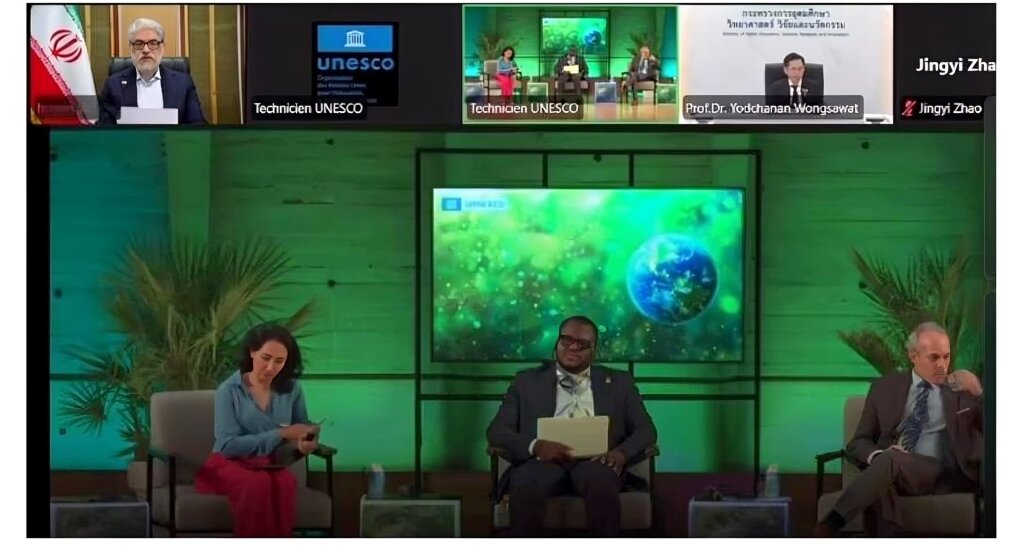
TEHRAN – Minister of Science, Research and Technology Hossein Simaei-Sarraf has delivered a lecture at the 2026 global conference on the International Decade of Sciences for Sustainable Development, proposing that UNESCO member states establish an international framework to protect scientists, universities, and research institutions against military attacks.
He urged UNESCO to implement and reinforce the proposed framework through the adoption of binding resolutions and treaties to help science always remain part of the solution to global issues and challenges.
Conducted as a hybrid event, the conference took place from July 15–17 at UNESCO Headquarters in Paris.
Attending the conference online, Simaei-Sarraf raised a question about how science can play a role in addressing global challenges while the science and scientific community are under threat, Mehr news agency reported.
“Challenges we are discussing today are not abstract for my country, but are rooted in recent and deeply painful experience within the span of a single year.
Thousands of innocent civilians and many scientists have been killed or injured as a result of [US-Israel] military aggressions. The Islamic Republic of Iran considers these attacks incompatible with the principles of international law, the United Nations Charter, and the values that UNESCO seeks to uphold in the fields of education, science, and culture.
Regardless of political differences, one principle must remain beyond dispute: scientists, universities, research institutions, and scientific infrastructures must never become victims of crises and conflicts.
Scientists must be empowered to continue advancing knowledge for the benefit of humanity. Universities and research institutions must be respected and protected as strategic assets serving all humankind,” he highlighted.
The International Decade of Sciences for Sustainable Development (2024–2033), proclaimed by the United Nations and led by UNESCO, represented a pivotal global movement to harness the full spectrum of scientific disciplines for the accelerated achievement of the Sustainable Development Goals.
It brought together global stakeholders to take stock of progress, spotlight science-driven solutions and help shape a resilient and inclusive post-2030 future.
Connecting leaders from government, academia, industry, civil society and Indigenous knowledge communities, the Conference served as a premier global platform to assess progress, share solutions and forge the partnerships needed to mobilize science for sustainable development at scale.
Under the theme “Science in action: Charting a sustainable and equitable future for all,” the event spotlighted how transdisciplinary research, open science and strengthened science–policy–society interfaces can drive more inclusive and equitable futures for all.
Attacking universities is a “crossing of red lines”: science minister
In June, Simaei-Sarraf said that attacking universities is a crossing of red lines, highlighting that the United States and Israel targeted many universities and educational centers in the country during the recent war.
When a university is targeted, in fact, one of the most authentic centers of culture and civilization is attacked, and the harm is directed at the entire scientific community of the world, msrt.ir quoted Simaei-Sarraf as saying.
The official made the remarks while addressing the tenth meeting of the Shanghai Cooperation Organization (SCO) Education Ministers, which took place in Minsk, Belarus, on June 16. A delegation led by the science minister attended the meeting.
Elaborating on the US-Israeli military attacks on Iran, destruction, and assassinations of Iranian universities and scientists in the past year, he emphasized that universities should be safe havens for thought, dialogue, and hope, rather than victims of conflicts.
The official raised a question, asking participants, “Will the international community allow the most authentic centers of civilization to fall victim to violence?”, and urged the global scientific community and international organizations to adopt a clearer, more responsible, and decisive stance in defending the security of universities, scientists, and scientific centers.
Silence in the face of these aggressions will lead to constant violence against science and civilization, he added.
MT/MG
Leave a Comment