Beyond presence: Iran’s opportunity for Judicial diplomacy in BRICS
The world is moving through a profound geopolitical transition. The international order that emerged in the aftermath of the Second World War continues to shape global institutions, but the distribution of economic, political and strategic power has changed dramatically. Emerging powers and countries of the Global South are increasingly seeking a greater role in shaping the rules that govern international relations.
In such a moment, participation in multilateral institutions cannot be reduced to attendance at official meetings or diplomatic ceremonies. The real question is whether countries can move beyond presence toward influence—from being rule-takers to becoming participants in rule-making.
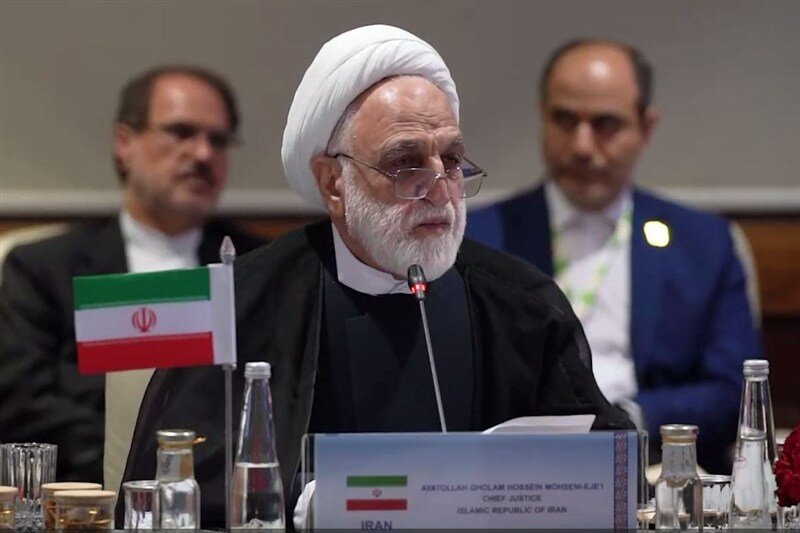
It is against this broader backdrop that the visit of Iran’s Judiciary Chief, Gholam-Hossein Mohseni-Ejei, to India and his participation in the BRICS judicial meetings should be viewed.
At the invitation of India’s senior judicial authorities, Mohseni-Ejei is visiting New Delhi at the head of a high-level Iranian delegation. The agenda includes participation in specialized panels and working groups, bilateral meetings with judicial officials from BRICS countries, and discussions on issues connected with global trade and international legal cooperation.
The significance of this visit, however, extends well beyond judicial relations.
It represents an opportunity to place law and justice at the center of the debate over the emerging international order.
BRICS and the emergence of a new multilateral landscape
BRICS was initially understood primarily through the lens of economic cooperation, trade and financial coordination. Yet its evolution over recent years suggests a broader ambition: to provide a platform for cooperation among emerging powers and countries of the Global South on a growing range of economic, political and institutional issues.
Its expanding membership and increasingly diverse geographical and economic composition have brought issues such as trade, investment, energy, technology, development finance and global governance into its broader agenda.
This does not mean that the existing international order is about to disappear or that BRICS represents an immediate replacement for established global institutions. The reality is more complex.
The international system is undergoing a period of transition in which established institutions remain influential while simultaneously facing questions over representation, legitimacy, double standards and their capacity to respond effectively to major global crises.
This transition creates an important strategic choice for countries such as Iran.
They can either remain observers of the emerging changes or seek to participate actively in shaping them.
The distinction is crucial: participation is not the same as influence, and influence ultimately depends on the ability to contribute to institution-building and rule-making.
National power has a legal dimension
Iran’s participation in BRICS therefore should not be viewed solely through the prism of economic or political opportunities.
There is also a legal dimension.
No sustainable economic order can exist without a reliable legal infrastructure. International trade requires legal certainty. Investment requires enforceable contractual rights. Cross-border business requires effective mechanisms for resolving disputes.
An investor entering a foreign market is concerned not only with tariffs, infrastructure and market size. The investor also needs to know what happens if a contract is breached, which authority has jurisdiction, how disputes will be resolved, whether judgments or arbitral awards can be enforced, and how effectively the legal system protects legitimate commercial interests.
For this reason, judicial security is an essential component of economic security.
The development of trade among BRICS members will inevitably increase the need for stronger mechanisms of judicial cooperation, arbitration, mediation, mutual legal assistance and enforcement of judgments.
This is where judicial institutions can contribute to the economic objectives of BRICS.
Judicial diplomacy as an instrument of economic cooperation
Courts and judicial institutions are often perceived as actors that enter the picture only after a dispute has occurred.
In the contemporary international economy, this understanding is too narrow.
A predictable and efficient judicial system can reduce transaction costs and legal uncertainty before disputes arise. Cooperation among judicial authorities can facilitate cross-border commerce, strengthen confidence among businesses and improve the enforceability of rights.
Judicial diplomacy can therefore serve as a bridge connecting law, economic cooperation and foreign policy.
For BRICS, this dimension deserves greater attention.
As economic relations among its members expand, judicial cooperation can become part of the institutional infrastructure supporting those relations. Areas such as mutual legal assistance, extradition, transfer of sentenced persons, enforcement of judgments, mediation, commercial arbitration, combating transnational organized crime, cybercrime, corruption and money laundering are no longer exclusively domestic concerns.
They are increasingly transnational challenges requiring transnational solutions.
Iran can make a meaningful contribution to this process.
From domestic judicial transformation to international engagement
Iran’s judicial transformation should also be considered within this wider international context.
Judicial reform is not limited to improving domestic procedures, reducing delays, expanding digital services or increasing access to justice. These reforms are essential, but they represent only one dimension of a modern judiciary.
The nature of contemporary crime and commerce has changed.
Organized crime networks operate across borders. Financial crimes involve multiple jurisdictions. Assets can be transferred almost instantly between countries. Cybercrime disregards territorial boundaries. Commercial disputes increasingly involve parties, contracts and assets located in different legal systems.
A modern judiciary must therefore be capable not only of operating efficiently at home but also of cooperating effectively abroad.
This is the essence of judicial diplomacy.
Judicial diplomacy does not mean that courts should interfere in foreign-policy decision-making. Rather, it means using the capacity of legal institutions to protect national interests, strengthen international cooperation, exchange judicial experience and defend the rights of citizens and the state within the framework of international law.
Direct dialogue between judicial authorities, cooperation between courts and legal institutions, mutual legal assistance agreements and participation in international mechanisms for dispute resolution are increasingly becoming important elements of modern statecraft.
Giving Iran’s voice a legal dimension
The current circumstances also give the Iranian delegation’s participation in BRICS an important international-law dimension.
Mohseni-Ejei has stated that one of the objectives of the visit is to explain Iran’s position regarding the attacks and acts of aggression it attributes to the United States and Israel, and to convey the concerns of the Iranian people to the international community.
In international affairs, however, there is an important distinction between a political statement and a legal argument.
Political messages may attract attention, but legal arguments can be documented, examined and preserved within international institutions and legal processes.
Questions concerning sovereignty, territorial integrity, the prohibition of the use of force, state responsibility and the lawful exercise of self-defense are not merely political slogans. They are subjects governed by international law and must therefore be articulated through evidence, legal reasoning and reference to applicable international norms.
This is particularly important in a world in which the credibility of international law is increasingly being tested by armed conflicts and geopolitical rivalries.
If Iran seeks to make its voice heard effectively, presenting a documented and legally grounded narrative can complement political and diplomatic efforts.
The language of law can give greater institutional durability to a country's position because legal arguments can be reflected in official documents, expert discussions, diplomatic negotiations and international legal proceedings.
This is an area in which judicial diplomacy and traditional diplomacy can complement one another.
India: more than a host
India’s role as host also adds an important bilateral dimension to the visit.
Iran and India share deep historical and civilizational ties, while their contemporary relations encompass economic, political, regional and strategic interests.
The judicial dimension of this relationship should not be underestimated.
Stronger cooperation between the legal and judicial institutions of the two countries could contribute to greater legal certainty in bilateral economic relations and provide additional support for trade, investment and regional connectivity.
As commercial and transport links between the two countries develop, legal cooperation becomes increasingly important.
Economic corridors require legal corridors as well.
From participation to rule-making
Ultimately, the importance of Iran’s participation in BRICS should be understood within the larger transformation of the international system.
The rules of the next phase of global governance have not yet been fully written.
This creates both uncertainty and opportunity.
Countries seeking a meaningful role in the emerging order cannot rely solely on their economic weight, geopolitical position or political alliances. They must also possess the institutional and legal capacity to contribute to the creation of new mechanisms and norms of international cooperation.
For Iran, BRICS can become one of the platforms through which such capacity is exercised.
Its judicial institutions can contribute to the development of practical mechanisms for legal cooperation among member states, support secure and predictable economic relations, promote alternative dispute resolution and strengthen collective responses to transnational crime.
At the same time, Iran can use such platforms to present its legal positions on international disputes and violations of international law through a documented and reasoned framework.
National power in the twenty-first century is therefore not measured only by military capability or economic strength.
It also includes the ability of a state to defend its legal rights, protect its citizens and businesses, cooperate effectively with foreign judicial institutions and contribute to the evolution of international rules.
This is why the Iranian Judiciary Chief’s participation in BRICS should be viewed as more than a diplomatic visit.
It is an opportunity to connect Iran’s domestic judicial transformation with the changing architecture of global governance.
The real test, however, lies beyond participation itself.
If Iran can transform its BRICS engagement into sustained institutional cooperation, legal initiatives and an active program of judicial diplomacy, it can move from simply being present in the emerging order to having a voice in shaping it.
The future international order is still being written.
For countries of the Global South, the strategic question is no longer simply where they will stand in that order.
It is whether they will have a role in writing its rules.
BRICS is becoming one of the important arenas in which that process is unfolding.
For Iran, judicial diplomacy can be one of the instruments through which its participation becomes influence—and through which law and justice become not merely the subjects of international cooperation, but part of the architecture of a more balanced global order.
Hassan Babaei is assistant Professor of International Law, Science and Research Branch, Islamic Azad University
Leave a Comment