A confession that shook the United States
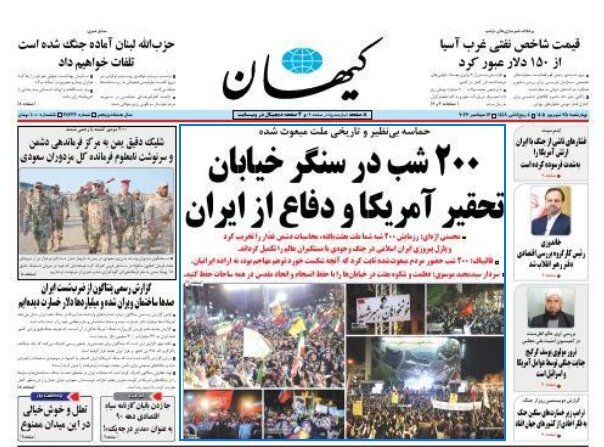
Kayhan, in a note, addressed the first official Pentagon report acknowledging the scale of damage the United States suffered in the war against Iran. The US has incurred tens of billions of dollars in losses and has lost hundreds of military buildings and installations.
Trump launched the war with very specific goals like overthrowing the Islamic Republic, destroying Iran’s nuclear, missile, and drone capabilities, etc. But none of these objectives were achieved, and new problems emerged: Iran closed the Strait of Hormuz, the global economy entered crisis, inflation rose, and American farmers suffered losses. As the war dragged on and Iran launched extensive, heavy attacks on at least 20 US bases across eight regional countries, it became clear that many of these bases had suffered billions of dollars in damage and were no longer usable. The revelation triggered a political earthquake in the United States, prompting Trump and Pete Hegseth to deny the report quickly.
Resalat: Sending false signals of calm is dangerous
Resalat, in an analysis, warned about the most dangerous strategic trap at the current moment: sending “false signals of calm” to global markets. Iran’s diplomatic and media apparatus must be extremely vigilant so that news about the Oman talks is not framed by Western media as a sign that the reopening of the Strait of Hormuz is imminent. The reasons for this caution are: neutralizing Iran’s greatest leverage, buying time for war‑planners in the White House, and preventing public opinion from becoming conditioned. Iran must state clearly that the Oman understanding is a post‑war document, and until the White House ends its warmongering and accepts Tehran’s conditions, the energy and global transport crisis gripping the West will not end. The Muscat agreement should be presented to the world as proof of Iran’s responsibility and sovereign rights.
Sobh-e-No: The Salalah meeting had already been decided on the battlefield and in diplomacy
Sobh-e-No, in an article, assessed the reasons behind the cancellation of the Salalah meeting in Oman. The purpose of the meeting was to unveil a new plan for regulating traffic in the Strait of Hormuz and organizing maritime movement in this strategic waterway. But the meeting was postponed indefinitely. A closer look at recent developments shows that the cancellation was a direct result of a fundamental shift in the regional balance of power: significant advances by Ansarallah, the resistance front’s control over two strategic straits (Bab al‑Mandab and Hormuz), and explosions along Saudi Arabia’s east‑west pipeline and disruptions in its oil exports. The cancellation benefited Tehran, reinforcing the new strategic reality. Iran now watches calmly as developments unfold in ways that increase its strategic weight in the Persian Gulf. In essence, the Salalah meeting encountered a reality that had already been shaped on the battlefield and in diplomacy, long before any agreement could be drafted on paper.
Etemad: Iran must strengthen its initiatives
Etemad, in an interview with Amir Asgar, senior researcher and strategic security analyst, discussed Iran’s policy and initiative in the current situation. According to Asgar, alongside diplomatic engagement with Persian Gulf states, Iran must intensify its influence in Yemen and alternative energy routes—both militarily and diplomatically. Iran must be the actor that determines what happens in the Strait of Hormuz. If Iran loses initiative and the control of escalation—whether diplomatic or military—falls into American hands, Iran will face serious challenges. This is not an issue that can be simplified under the assumption that it can be resolved solely through negotiations, because it directly concerns national security. The postponement of the meeting could allow Iran to take control of escalation management through other channels, a matter that is vital for the country.
Shargh: Tehran and Baghdad work to contain the fallout of ongoing regional developments
Shargh, in an analysis, examined the gradual reopening of the Iran–Iraq border, describing it as a sign of Tehran and Baghdad’s efforts to manage the consequences of ongoing regional developments on bilateral relations. These developments, if they continue, could affect the economic, security, and commercial ties between the two countries. The attack on infrastructure that serves as Saudi Arabia’s alternative route to the Strait of Hormuz, combined with conflicting claims about the origin of the attack and Baghdad’s security responses, shows how any incident in the region’s tense environment can quickly escalate from a limited security event into an issue with political, economic, and regional dimensions. In such circumstances, Iraq’s investigation into the origin of the attack and related actors becomes even more important. What is clear for now is the effort by Tehran and Baghdad to maintain coordination and prevent escalation, while Saudi Arabia simultaneously works to protect one of its most important oil transit routes.
Leave a Comment