National event on ‘Iran’s biodiversity’ being held

TEHRAN – Organized by the Department of Environment (DOE), the national event on Iran’s biodiversity kicked off on Saturday in Sari, Mazandaran province, and will run till Sunday.
The two-day event is being held concurrently with the International Day for Biological Diversity, which is celebrated annually on May 22, IRNA reported.
Shina Ansari, the head of the DOE; Farrukh Toirov, the representative of the Food and Agriculture Organization of the United Nations (FAO) in Iran; and Ayshanie Medagangoda – Labé, the representative of the United Nations Development Program (UNDP) in Iran, attended the event.
Considering Iran’s biodiversity in different regions, the event is scheduled to come up with strategies that would improve the quality of biodiversity conservation.
The event comprised two sections. The first part was conducted this morning in the presence of the head of DOE. The poster of the national biodiversity campaign, and three books on biodiversity, namely ‘Mammals of Iran’, ‘Global biodiversity framework’, and ‘Statistical yearbook of Iran’ were unveiled in this section.
The second section started on Saturday afternoon and will continue till Sunday afternoon, hosting specialized panels on biodiversity. The panels on Saturday covered different topics such as the global biodiversity framework and the requirements of the framework implementation in the country, the national biodiversity action plan, strategic plans and measures for biosafety, and biosphere reserve programs.
The event also serves as a platform for the participants to exchange ideas on challenges, capacities, and the implementation of strategies.
The specialized panels on Sunday will focus on three main issues, including ‘Scientific, integrated and participatory management of ecosystems’, ‘Ecosystem resilience to ecological and human threats’, and ‘Preservation and restoration of animal species’.
Some 27 articles were submitted to the event; out of which nine were selected to be presented at specialized panels on Sunday, and the rest of the articles will be showcased in the form of posters at the event venue.
Iran ranks among the top 20 countries in the world for biodiversity and is home to a variety of plant and animal species. However, in recent years, certain actions have destroyed habitats and pushed many species to the brink of extinction.
So far, more than two million plant and animal species have been identified in the world, of which 43,000 exist in Iran. In fact, there are 11 types of ecosystems in the world, including aquatic, terrestrial, natural, and artificial ecosystems. Iran has 9 of these 11 ecosystems. Also, out of the 42 types of wetlands in the world, 41 types have been identified in Iran.
According to the Department of Environment, some 2,000 animal species, including mammals, birds, reptiles, amphibians, and inland fish, and about 1,200 fish species have been identified in the country’s ecosystems. Of these species, 210 mammal species, 640 bird species, 300 reptile species, 23 amphibian species, and 350 inland fish species can be mentioned.
According to statistics, Iran can be considered the cradle of genetic diversity in the world. Even in international classifications, it is considered among the countries with high biodiversity. However, Iran’s biodiversity, like the rest of the world, faces many challenges such as habitat destruction, overhunting, drought, and climate change.
Studies show that 148 vertebrate species in the country are endangered, including critically endangered species, endangered species, and critically vulnerable species.
Given the current circumstances, let’s all join hands to protect biodiversity, because the future of the Earth, the future of life, and the future of the next generations depend on our decisions and actions today.
A national comprehensive plan has been developed, setting its strategic goals for the conservation and sustainable use of biodiversity by the Iranian calendar year 1430 (March 2051-March 2052).
In May 2025, President Masoud Pezeshkian issued an order, obligating the DOE to prepare a comprehensive plan for the preservation of biodiversity in the country, covering different environmental sectors.
In this line, several meetings have been convened with the participation of faculty members, environmental experts, and managers, as well as NGOs, IRNA reported.
During the meetings, the participants agreed on five main goals: promoting the integrity and resilience of biodiversity, conserving biodiversity for sustainable use, equitably sharing the benefits derived from genetic resources, raising public awareness, enhancing specialized knowledge, and modern technologies for effective biodiversity management, strengthening financial resources and national mechanisms for the implementation of the comprehensive strategic plan for biodiversity.
Finally, the national biodiversity conservation program will be revised based on the national biodiversity strategies and action plan (NBSAP3) by relevant executive agencies, academic experts, and non-governmental organizations, to be approved by the DOE.
DOE chief: Biosecurity is intertwined with national security
Addressing the event, the head of the Department of Environment (DOE), Shina Ansari, said that ‘biosecurity is tied to national security’, highlighting that biodiversity conservation is a prerequisite for the country’s sustainable development.
The official stressed that biodiversity serves as the foundation of the country’s biological, economic, and cultural security, noting that nature conservation should not be considered a secondary issue.
“Nature and habitat conservation should be pursued with the participation of local communities, scientific governance, and cooperation of all sectors,” she noted.
Referring to the theme of International Day for Biological Diversity, ‘Acting locally for global impact’, she said the theme is a reminder of the role of local communities, emphasizing that any effective measure to protect nature has to begin in villages, cities, forests, and wetlands.
The official noted that the media and national NGOs play a key role in raising public awareness and promoting environmental protection.
“Holding the national biodiversity event in the vicinity of Hyrcanian forests is a symbol of our national responsibility in one of the world’s most important biodiversity hotspots. Smart governance of nature must be based on science, constant monitoring, and inter-sectoral partnership,” Ansari noted.
Highlighting that more than 19 million hectares of the country’s land are under the supervision of the DOE, she said improving regional management using modern monitoring tools, training rangers, and enhancing infrastructures that safeguard the environment are among the top priorities of the DOE.
Ansari went on to say that restoring the role of the DOE in implementing the principles of the Convention on Biological Diversity is one of the most important measures of the current administration, which contributes to integrating policies and implementing Iran’s commitments to biodiversity.
Referring to President Masoud Pezeshkian’s order to develop a strategic plan to preserve biodiversity, Ansari said preservation of biodiversity is a national, cross-sectoral, and intergenerational responsibility.
Elaborating on the DOE measures in protecting endangered species like the Persian cheetah and yellow deer, Ansari said public participation, along with scientific collaborations, has always yielded positive results.
Currently, DOE supervises more than 1.34 million hectares of wetlands in the country, which is an important step to strengthen wetland protection. Habitats, forest degradation, land-use change, and unsustainable development are among the major threats to biodiversity; the last two imposed wars against the country have severely damaged the wetland and coastal ecosystems, Ansari further noted.
The official went on to say that environmental protection and development should not be disregarded in conflicts. Rather, the development should be based on land capacities and principles of sustainable development.
FAO: Without biodiversity, food production would be at risk
Farrukh Toirov, the representative of the Food and Agriculture Organization of the United Nations (FAO), delivered a speech, saying that without biodiversity and ecosystem services, food production itself would be at risk.
“For FAO, this message strongly resonates with our mandate and global work. Because biodiversity is not a standalone environmental issue. It is the living foundation of agrifood systems, food security, livelihoods, ecosystem resilience, and sustainable development,” he stressed.
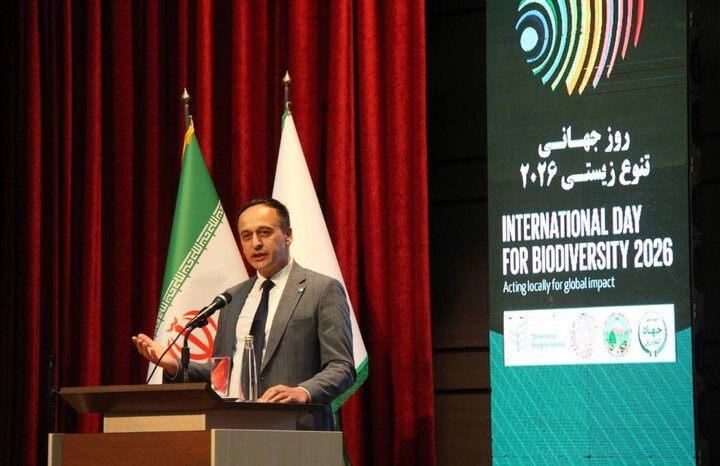
“This narrowing of biodiversity makes food systems increasingly vulnerable to climate shocks, pests, diseases, and market disruptions.
Iran is recognized as a country of significant global biodiversity importance. Iran’s remarkable climatic, topographic and ecosystem diversity supports rich biological resources, including more than 8,200 plant species, around 197 mammal species, 535 bird species, 227 reptile species, 21 amphibian species, 160 freshwater fish species, and over 700 marine fish species,” the FAO representative added.
“Iran is also home to several globally important and some endangered species, including the Asiatic cheetah, Persian leopard, and important populations of migratory birds and endemic species.
This rich biodiversity, together with valuable genetic resources and the presence of wild relatives of many important crop and livestock species, places Iran among the region’s biologically significant countries.
At the same time, these valuable natural assets face increasing pressures from climate change, water scarcity, land degradation, and habitat loss, further underlining the importance of strengthened conservation and sustainable management efforts.
For a country such as Iran—with rich ecological diversity, unique genetic resources, and important but vulnerable natural ecosystems—these linkages are especially relevant,” Toirov highlighted.
UNDP implementing two projects
Ayshanie Medagangoda – Labé, the UNDP representative in Iran, addressed the participants, saying that Iran was one of the first members of the Convention on Biological Diversity. The country’s efforts in forming the Ramsar Convention show its concern for the environment and biodiversity.
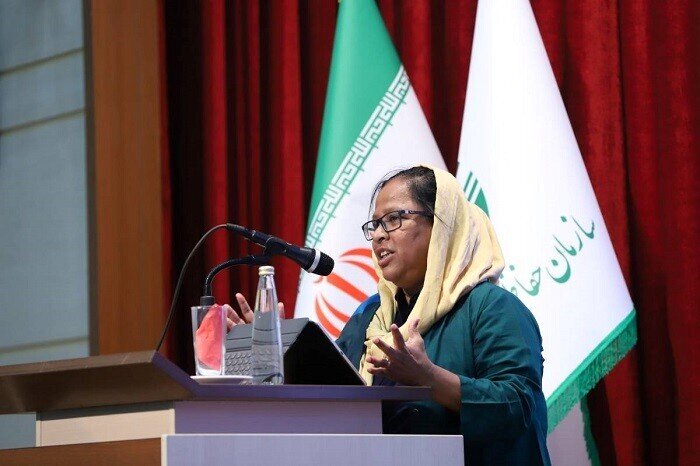
“Two plans to protect biodiversity against global warming in two protected areas in Semnan and Yazd provinces are being implemented in cooperation with the UNDP and the Department of Environment,” she added.
Acting locally for global impact
This International Day for Biological Diversity, under the theme “Acting locally for global impact”, a powerful idea is placed at the center: major changes begin on a small, local scale. The success of this plan to reverse biodiversity loss depends on the strength of local actions—on the commitment of communities, organizations, and governments working together.
As the global community is called to re-examine our relationship to the natural world, one thing is certain: despite all our technological advances, we are completely dependent on healthy and vibrant ecosystems for our water, food, medicines, clothes, fuel, shelter, and energy, just to name a few.
This involves respecting, protecting, and repairing our biological wealth.
MT/MG
Leave a Comment