SCO slams US-Israeli aggression, Ayatollah Khamenei’s assassination and sanctions on Iran

TEHRAN — Leaders of the Shanghai Cooperation Organization (SCO) signed a joint statement on Tuesday, reiterating the Eurasian bloc’s denunciation of the unprovoked US and Israeli attacks on Iranian territory.
The joint statement, titled the Bishkek Declaration, affirmed the member nations’ position condemning the “military strikes on the territory of the Islamic Republic of Iran, which have resulted in numerous civilian casualties and significant damage to the country’s economy.”
“Such actions violate the principles and norms of international law and the UN Charter and create serious risks to international peace, security and stability,” the declaration stated at the conclusion of the two-day summit, which began on Monday.
This year’s SCO summit, hosted by Kyrgyzstan, marked the organization’s 25th anniversary and established a joint position on West Asia, global security, and economic cooperation. The grouping’s leaders also backed Iran’s rights as a member of the Nuclear Non-Proliferation Treaty (NPT) to have access to a peaceful nuclear program. The declaration was signed by Chinese President Xi Jinping, his Russian counterpart Vladimir Putin, Indian Prime Minister Narendra Modi, and Pakistani Prime Minister Shehbaz Sharif, among other leaders of SCO member nations.
“Member States express their sincere condolences to the people and Government of the Islamic Republic of Iran on the tragic death of Supreme Leader Seyyed Ali Khamenei, and to the families of the victims,” the declaration added.
The 10-member Eurasian bloc used the anniversary text to press for a “representative, democratic, and equitable multipolar world order,” rejecting bloc-based and confrontational approaches to international affairs. The declaration noted progress toward establishing an SCO Development Bank during Kyrgyzstan’s chairmanship, with leaders also supporting Iran’s expedited entry into the SCO Interbank Consortium.
Iranian President Masoud Pezeshkian was among the SCO leaders who delivered speeches and held high-level talks with his counterparts on the sidelines of the summit. Pezeshkian stated that a return by the US to a policy of pressure and threats risks derailing diplomatic efforts to end the economically punishing war in the region.
“The repeated violation by the United States of its commitments under the Islamabad memorandum of understanding showed… the absence of effective enforcement guarantees, and a return to a policy of pressure and threats could derail the path of diplomacy,” Pezeshkian said. On Monday, US President Trump threatened to hit Iran hard after tit-for-tat attacks, which included an Iranian missile barrage fired at US bases in Jordan in response to a new US act of aggression against Larak Island.
Pezeshkian also denounced the recent US-Israeli war against Iran, describing it as aggression against the fundamental principles of the UN Charter and international law. He criticized the “disappointing” performance of the United Nations and the Security Council in dealing with developments in Gaza, Lebanon, and the aggression against Iran.
The US and Israel launched their illegal war of aggression against Iran on February 28 by assassinating the Leader of the Islamic Revolution, Ayatollah Seyyed Ali Khamenei, along with senior military commanders. On the first day of the strike, a US Tomahawk missile attack against a school in the southern city of Minab also killed 168 people, most of whom were schoolchildren.
Forty days later, on April 8, Washington and Tel Aviv were forced to accept a ceasefire amid Iran’s resistance, successful retaliatory operations, and a powerful grip on the Strait of Hormuz. However, the US imposed a naval blockade on Iran in violation of the deal. Furthermore, the US breached its commitment under a memorandum of understanding that Trump remotely signed with Pezeshkian on June 17. The latest US violation came to light following a strike against Larak Island on Sunday night, which was met with a strong Iranian retaliatory response. Pezeshkian has said Iran will “immediately” reciprocate if the US fulfills its commitments under the MoU.
Elsewhere in his remarks at the SCO summit, Pezeshkian proposed three economic initiatives: deepening financial and banking cooperation and establishing an SCO bank; creating an export and investment insurance union; and forming an SCO energy consortium. Discussing security issues, Pezeshkian proposed establishing a strategic security studies center within the organization.
“The Islamic Republic of Iran has proposed the establishment of a strategic security studies center of the Shanghai Cooperation Organization,” he said, adding that the center could draw on the scientific and expert capacities of member states to identify emerging threats, assess security developments, and provide specialized recommendations for strengthening regional security and stability.
Pezeshkian also expressed Iran’s readiness to participate actively and constructively in efforts to enhance the organization and support new initiatives aimed at strengthening its cohesion, effectiveness, and convergence. He also met with his SCO counterparts on the sidelines of the summit, including the Chinese and Russian presidents.
Putin: Russia stands in solidarity with Iran
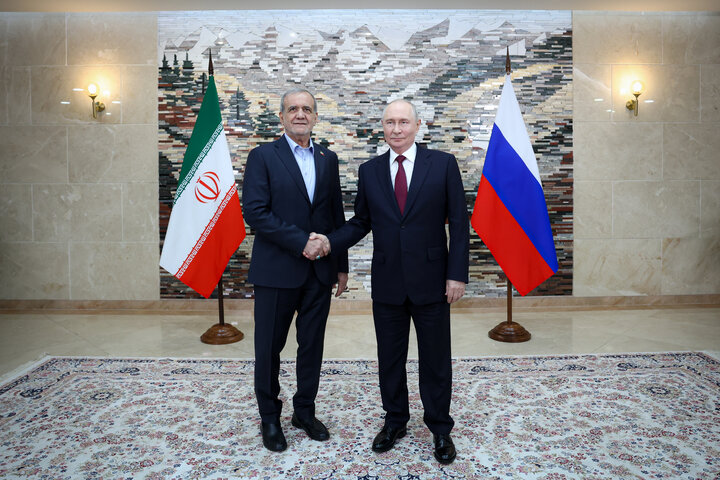
Pezeshkian thanked Russian President Vladimir Putin for Moscow’s stance during the US-Israel war on Iran during their first meeting since the conflict began in February.
“We appreciate and thank you for your positions at every stage, both during the period when the fighting and acts of aggression were taking place and under normal circumstances when the United States was imposing sanctions on us, both at the United Nations and in international forums,” Pezeshkian told Putin. “This shows that our relationship is a strategic relationship; it is not an ordinary relationship,” he added.
Putin also said Russia and Iran will maintain their economic and trade relationship despite the current military and political environment. He added that Russia stands in solidarity with Iran.
This year’s summit took place in Bishkek under the motto: Together for Sustainable Peace, Development and Prosperity.
The SCO began in 1996 as a security bloc, dubbed the “Shanghai Five.” It was formed by China, Russia, Kazakhstan, Kyrgyzstan, and Tajikistan to settle border disputes following the end of the Cold War and the collapse of the Soviet Union. In June 2001, the grouping evolved into the SCO and expanded to include Uzbekistan, with headquarters in Beijing. In 2017, the bloc expanded to include India and Pakistan. Iran and Belarus were added as full members in 2023 and 2024, respectively.
In addition, the organization has 14 key dialogue partners, including Saudi Arabia, Qatar, Egypt, Turkey, Myanmar, Sri Lanka, and Cambodia. SCO member states account for 43 percent of the world’s population and 23 percent—nearly a quarter—of the global economy.
Leave a Comment