Miscalculation behind attacks on Iran’s infrastructure
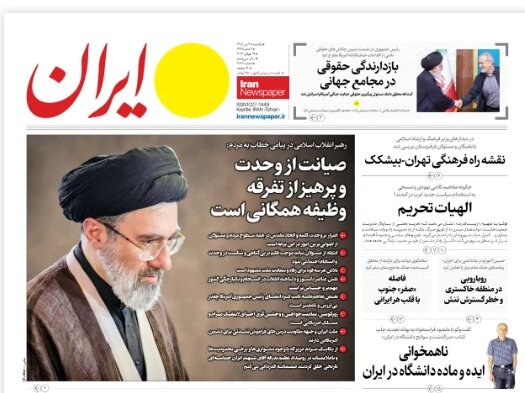
The Iran newspaper, in an article, examined the recent US attacks and argued that targeting public infrastructure is less a sign of strength and more evidence of a strategic shift after Washington failed to achieve its goals on the ground. When declared objectives cannot be met through confrontation, the effort shifts toward imposing economic and psychological costs on the population as a substitute for military success.
Still, experience shows that the Iranian people have not retreated under such pressure; rather, they have defended their national rights with greater cohesion. The Islamic Republic has repeatedly demonstrated that it will respond to any hostile act in a way that is both proportionate and deterrent. This approach is not driven by adventurism but by the need to reinforce deterrence and prevent future aggression.
Sobh-e‑No: A war that shapes the future
Sobh-e‑No, in an explanation of the significance of the Persian Gulf conflict, wrote that this war is a contest for “claiming advantage” in the geography of power. For Iran, the Strait of Hormuz is no longer merely a strategic waterway for oil exports; it has become a platform for demonstrating power and a permanent bargaining tool. By showcasing its ability to control this vital passage, Iran sends a message to the world: global energy security is impossible without Tehran’s consent, and any shift in the regional balance must bear Iran’s signature. This is more than a defensive reaction—it is a “strategic offensive” aimed at cementing Iran’s role as a determining force. Iran can manage the costs of sanctions and pressure with patience, because it sees the ultimate goal not as geographic survival but as the preservation of its historical role. What happens in the Strait of Hormuz reflects Iran’s intention to rewrite the rules of the game for both adversaries and allies.
Siasat‑e-Rooz: A clumsy attempt at separation
Siasat‑e-Rooz, in its editorial, addressed J.D. Vance’s recent remarks. Vance claims that the pro‑Israel lobby is spending millions to disrupt negotiations between Iran and the United States. According to the paper, the US has effectively launched a proxy war on behalf of Israel, while simultaneously giving that regime a green light for its actions in Palestine, Lebanon, and Syria. At the same time, Washington is creating a buffer zone for Israel by involving Lebanon in conflict with Hezbollah and supporting Saudi attacks on Yemen. In other words, the paper argues, the White House still prioritizes Israel above all else, and Vance’s rhetoric is merely a deception aimed at the American public—70 percent of whom, it claims, want their country to distance itself from Israel. The editorial adds that Vance’s “clumsy separation” is meant to trap Iran into the miscalculation of believing there is a divide between Israel and the US, thereby shifting Iran’s priorities away from comprehensive defense, deterrence, and retaliation for the casualties of the 12‑day war and Ramadan, and toward diplomacy.
Vatan‑e-Emrooz: The race to recover
Vatan‑e-Emrooz, in its analysis, highlighted the strength and speed of Iran’s infrastructure recovery after enemy attacks. The paper argues that in recent years a new concept has entered security discourse: “the race for recovery.” Experience from recent wars shows that sometimes the speed of repairing a bridge, restarting a power plant, or restoring the electrical grid matters more than the attack itself. A country that can rapidly rehabilitate damaged infrastructure demonstrates the institutional and managerial capacity needed to navigate crises. This is the lesson many analysts emphasized during the US –Iran conflict, praising Iran’s national ability to recover and quickly return daily life to normal. In other words, strategic advantage is not only the ability to strike—it is the ability to continue.
Leave a Comment