Melbourne exhibition highlights victims of Minab school attack, Gaza war
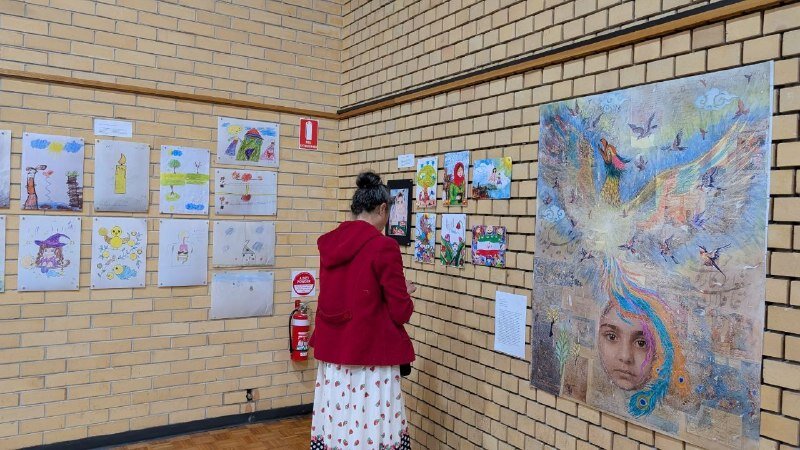
TEHRAN- The Sydney-based Benevolent Iranian Women Association (BIWA), invited by the Campaign for International Cooperation and Disarmament (CICD) and the Unitarian Peace Memorial Church Melbourne, held the “Bombs for Peace” art exhibition at the Melbourne church last week.
The church’s Sunday prayer service opened with a memorial for the child victims of the Minab school attack and a condemnation of what organizers described as atrocities committed by the United States and Israel in West Asia.
Australian anti-war activist John Shipton, the keynote speaker, reviewed what he described as a longstanding pattern of US and Israeli military and political interventions, referring to events ranging from the 1948 Nakba and the 1953 overthrow of Iran’s democratically elected prime minister, Mohammad Mosaddegh, to recent conflicts in West Asia.
Shipton also drew parallels between these historical events and the Minab school tragedy, in which more than 168 students, teachers and staff were killed, according to the organizers.
For her part, BIWA President Masoomeh Alaibakhsh spoke about the beginning of the new academic year in Iran and the reopening of schools. She presented figures on student and teacher casualties in recent conflicts, along with information on damage to schools and educational centers.
Alaibakhsh expressed hope that such tragedies would not be repeated and stressed the need for those responsible for attacks on civilians and educational institutions to be held accountable under international law.
The event continued with a tour of the exhibition and a screening of “Minab: An Independent Inquiry,” a documentary directed by Maryam Sadr. The film examines the circumstances surrounding the Minab school attack and presents documents and other evidence concerning Shajareh Tayyebeh School, which had functioned solely as an educational institution for more than a decade.
The screening was followed by a live discussion with Sadr, who spoke about her firsthand experience visiting the Minab school site and interviewing families of the students who were killed in the attack.
The documentary created a somber atmosphere among the audience, while visitors from different nationalities and backgrounds expressed solidarity with families affected by recent conflicts, particularly children. Many also voiced hopes for lasting peace and security around the world.
The exhibition featured two main sections focusing on Iran and Palestine.
The Iran section displayed works by Iranian-Australian artists, drawings by Iranian children who had experienced war, and artworks created by students of the Minab school who were killed in the attack. Portraits of the child victims and their school assignments, including classroom drawings and free-form illustrations reflecting their interests and aspirations, attracted considerable attention.
The Palestine section was presented by the Iranians Friends of Palestine NSW (IFOPNSW) and featured artworks depicting the suffering in Gaza and Palestine. The section included works by Palestinian artists living in Gaza, as well as Australian and Palestinian artists based in Australia.
The organizers said they hoped similar events held in communities and cities across Australia would help raise awareness of the impact of recent conflicts in West Asia and preserve the memory of children who were killed or affected by the wars.
SAB/
Leave a Comment