Iranian researchers win gold at INOVA International Invention Show
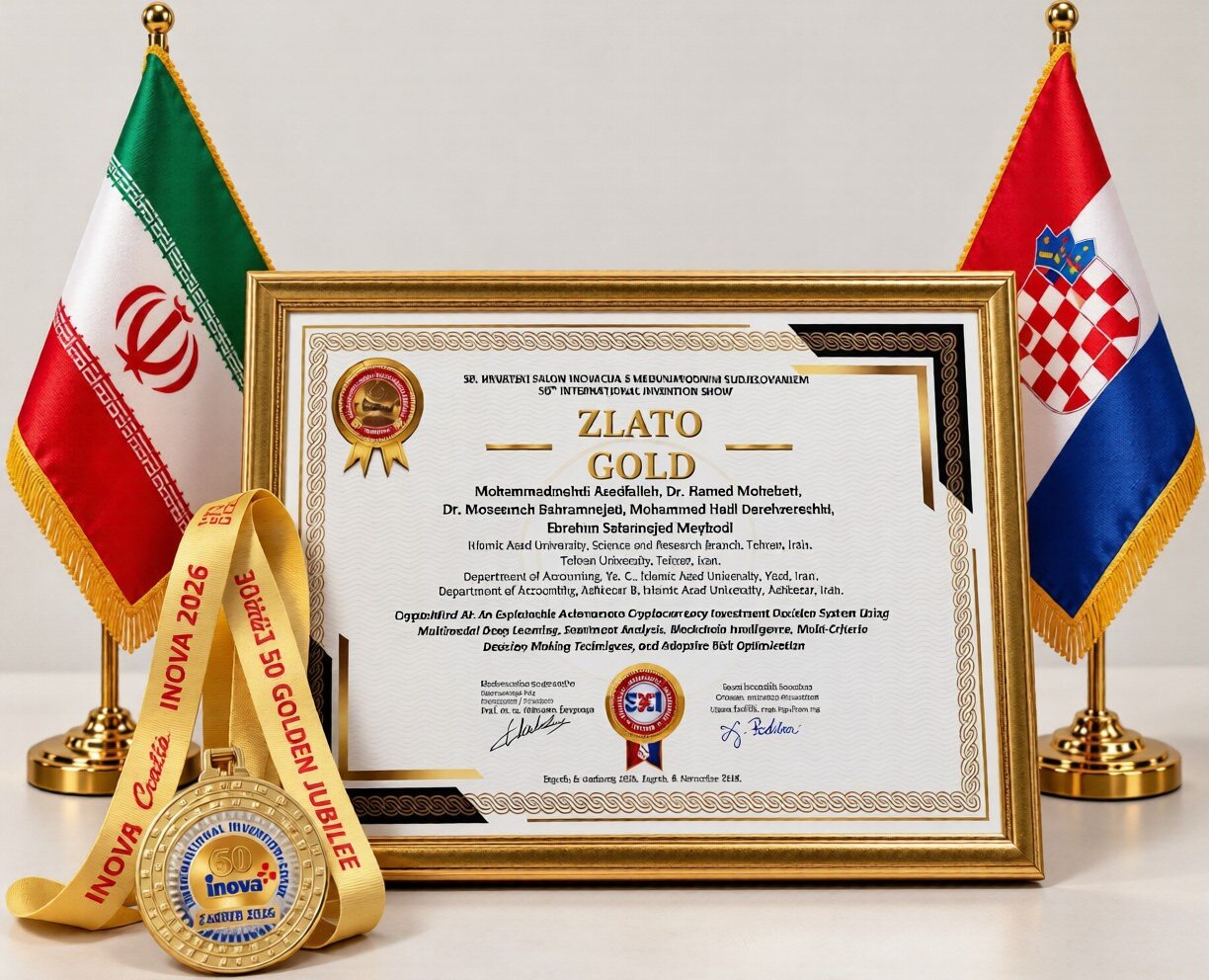
TEHRAN – A team of five Iranian researchers won a gold medal at the 50th International Invention Show, INOVA Golden Jubilee, held in Zagreb, Croatia, from October 1 to 4.
The team earned the award for its project, titled CryptoMind AI: An Explainable Autonomous Cryptocurrency Investment Decision System Using Multimodal Deep Learning, Sentiment Analysis, Blockchain Intelligence, Multi-Criteria Decision-Making Techniques, and Adaptive Risk Optimization.
The project was jointly presented by Mohammad Azadfallah, Hamed Mohabbati, Mohammad-Mehdi Darehzereshki, and Ebrahim Safarinejad-Meybodi from Islamic Azad University, along with Moazameh Bahramnejad from the University of Tehran.
This year’s event brought together representatives from 57 countries, featuring more than 600 innovative projects.
Established in 1971, INOVA is one of Croatia’s longstanding invention exhibitions, providing a platform for presenting and promoting innovative technical achievements. What began as a small regional exhibition at the Zagreb Technical Museum has grown into an international event that has showcased thousands of domestic and international inventions over five decades.
Iran’s presence in world’s top 2% of scientists nearly doubles
The number of Iranian researchers included in the world’s top 2% of scientists has nearly doubled, rising from 1,154 in 2020 to 2,678 in 2026, according to Scopus data provided by Elsevier.
An analysis of the rankings shows a steady upward trend in the number of Iranian researchers recognized among the world’s top 2% of scientists over the past several years.
The number rose to 1,701 in 2021 and 1,941 in 2022, before increasing to 2,137 in 2023 and 2,514 in 2024. The figure reached 2,678 in 2026, ISNA reported.
The majority of Iranian researchers are from 30 universities and scientific centers; the University of Tehran, with 123 researchers, is placed first. Followed by Tehran University of Medical Sciences (112), Shahid Beheshti University of Medical Sciences (75), and Iran University of Science and Technology (74).
Tabriz University of Medical Sciences with 66 researchers, Iran University of Medical Sciences with 64 researchers, University of Tabriz with 61 researchers, and Tarbiat Modares University with 56 researchers are placed fifth to eighth.
Also, the number of highly cited Iranian researchers in the career-long index has experienced threefold growth, rising from 433 in 2020 to 1,380 in 2026.
Some 794 out of 1,380 researchers, amounting to 57.5 percent, are from 30 universities and scientific centers. University of Tehran (with 91 researchers), Sharif University of Technology (53), Amirkabir University of Technology and Tehran University of Medical Sciences (each with 48 researchers), and Iran University of Science and Technology (45), University of Tabriz and Tarbiat Modares University (each with 40 researchers) rank first to fifth.
Stanford University’s list of “World’s Top 2%” scientists is based on a 2 percent or above percentile rank, or the top 100,000 by c-score (with and without self-citations). This prestigious list identifies the world’s leading researchers, representing approximately 2 percent of all scientists worldwide.
It encompasses standardized data on citations, h-index, and a wide range of bibliometric indicators. Researchers are classified into 22 scientific fields and 174 sub-fields, drawing from Scopus data provided by Elsevier through ICSR Lab.
The esteemed ranking, derived from Scopus database data, highlights researchers whose work has had a significant impact across various scientific disciplines.
The ranking is based on a composite indicator (c-score) calculated from six citation metrics: Total citations (NC), H-index (H), Hm-index (H-index adjusted for the number of authors), Citations to single-author papers (NCS), Citations to single or first-author papers (NCSF), Citations to single, first, or last-author papers (NCSFL).
MT/MG
Leave a Comment