Minab school tragedy will never be forgotten or forgiven, Iran FM says
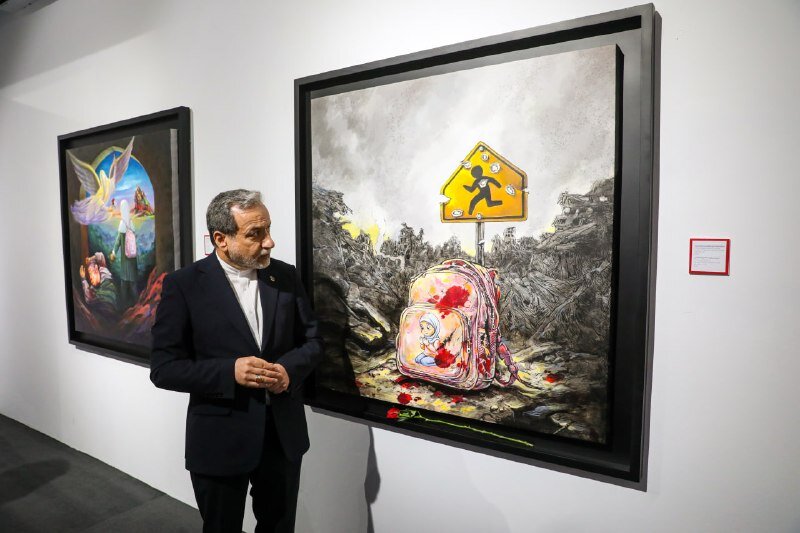
TEHRAN- Iranian Foreign Minister Abbas Araghchi said the tragedy at a school in Minab, southern Iran, will never be forgotten or forgiven, describing the students killed in the incident as a symbol of heroism for the Iranian people.
Araghchi made the remarks on Friday at the opening ceremony of the group exhibition “Minab School,” held at the Art Bureau of the Islamic Ideology Dissemination Organization in Tehran.
The exhibition has been organized by the Nam Cultural and Artistic Institute and features works by a number of prominent contemporary Iranian painters.
“The students of this school have become an epic for the Iranian people. We will never forget or forgive this incident, nor will we erase it from our memory. We will continue to pursue it,” Araghchi said.
He emphasized the power of art to preserve historical events and convey messages, saying a single painting can sometimes communicate with an audience and leave an impact equivalent to several speeches and books.
“These works are documents of the legitimacy and victimhood of the Iranian people and the children who were deliberately and unjustly targeted in this war,” the foreign minister said. “Although we lost them, they have become heroic symbols for the Iranian people.”
Araghchi expressed hope that the exhibition could be taken to other countries, allowing international audiences to see the works and learn about what happened to the Iranian children.
“I hope we can take this exhibition abroad, country by country, and show it to people,” he said, adding that those who claim to defend human rights should see the artworks depicting the consequences of the conflict.
The foreign minister also highlighted the role of art in diplomacy, saying paintings, films, poetry and music can convey messages in ways that written statements and speeches often cannot.
He noted that Iranian artists produced numerous works during the recent conflicts, including music, video productions and visual artworks, stressing that such efforts should continue so that future generations and international audiences understand the sacrifices made by the Iranian people during the 12-day and 40-day wars.
Araghchi said the Foreign Ministry's public diplomacy department is responsible, among other things, for cultural and artistic diplomacy. He added that the ministry is ready to support Iranian artists and facilitate the presentation of exhibitions such as “Minab School” abroad.
He also said the Foreign Ministry's legal department has been documenting what he described as crimes committed by the United States and Israel during recent wars against Iran. According to Araghchi, four or five volumes of documentation have so far been compiled, while the ministry is continuing to document the impact of economic sanctions.
The minister criticized what he described as the politicization of human rights by Western countries, saying that while Western governments issue numerous statements concerning individual cases in Iran, they have failed to take comparable action over the deaths of Palestinians in Gaza.
“Our policy is completely clear: We genuinely believe in human rights in Iran and have always defended the rights of the Iranian people,” Araghchi said, stressing that Tehran would not allow human rights to be used as a tool for political exploitation.
The exhibition features works by artists including Behzad Shishegaran, Sirous Moqaddam, Gholam-Ali Taheri, Morteza Asadi, Kazem Chalipa, Ali Nedai, Hassan Yaqouti, Abdolhamid Ghadirian, Mostafa Goudarzi, Nasser Seifi, Jamshid Haqiqatshenas, Seyyed Masoud Shojai Tabatabai, Kamyar Sadeqi, Seyyed Ali Mirfattah, Mahyar Charmchi, Mostafa Qorbani, Hossein Einibakhsh and Mohammad-Ali Naderi.
Araghchi, Head of the Art Bureau Mohammad-Mehdi Dadman and a number of prominent visual artists attended the opening and visited the exhibition.
“Minab School” will run through September 22 at the Art Bureau, from 9 a.m. to 8 p.m. daily.
On February 28, the Shajareh Tayyebeh girls' elementary school in Minab, Hormozgan province, became the site of a devastating massacre as the United States and Israel initiated their strikes against Iran.
While dozens of girls and boys aged between 7 and 12 were beginning their lessons, the school was targeted by a missile strike that caused the building to collapse, trapping children and teachers beneath the rubble. Iranian authorities confirmed a final death toll of 168 people, with at least 95 others wounded, marking one of the most harrowing incidents of the conflict's opening day.
Despite attempts by US and Israeli authorities to distance themselves from the carnage as images of the tragedy spread across social media, detailed forensic and digital investigations have painted a starkly different picture.
An analysis by Al Jazeera’s digital investigations unit, utilizing over a decade of satellite imagery and recent video clips, revealed that the school was a clearly distinct civilian facility, separated from any adjacent military sites for at least ten years. Furthermore, witness accounts and satellite-based analyses confirmed that the school was triple tapped by three separate, deliberate strikes, leaving no doubt about the nature of the attack.
The international community has faced mounting evidence regarding the responsibility for this atrocity, with investigations from major global outlets including The New York Times, BBC Verify, CBC, and NPR all concluding that the United States was responsible for the strike.
These findings have raised fundamental questions about the intelligence used to justify the bombing, as the patterns of the strike suggest a direct targeting of a civilian educational institution. The Minab school tragedy now stands as a somber testament to the immense human cost of the aggression and a focal point for those demanding international accountability.
SAB/
Leave a Comment