“I Want My Music to Carry a Message of Iranian Unity, World Peace,” says Conductor Paniz Faryousefi
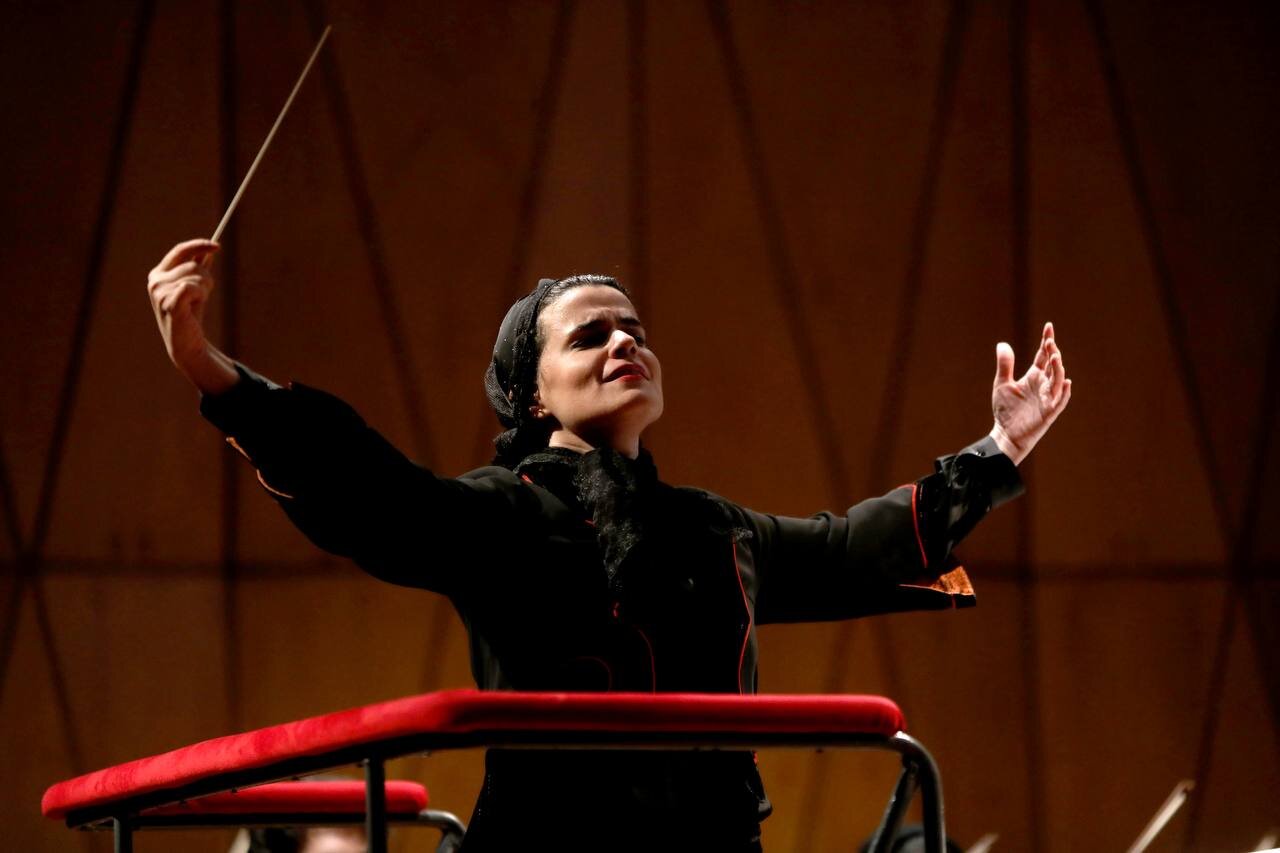
TEHRAN– Violinist and conductor Paniz Faryousefi took the podium of the Tehran Symphony Orchestra at Vahdat Hall in November 2025 (Aban 1404), becoming the first woman since the Islamic Revolution to officially conduct the orchestra — a landmark moment in Iran's post-revolution classical music history. She has also recently conducted the Vivo Orchestra in a concert built around works by Iranian composers in August 24, reflecting on what Iran and its people have experienced over the past year, including the Israeli attack on Iran in June 2025 and the subsequent US-Israeli military aggression against the country in 2026.
In an interview with Tehran Times, Faryousefi discussed both experiences, her participation in the international "A Concert for Unity" project in New York as a representative of the Tehran Philharmonic Orchestra, and her reasons for choosing Iranian works for Vivo's recent concert.
I attended the concert in person, sitting in the audience at Rudaki Hall as the program moved from Handel’s Passacaglia in G Minor and Elgar’s Sospiri, through Tchaikovsky’s Melodrama, into four newly commissioned Iranian works: Mohammad-Reza Tafazzoli’s Elegy, Mani Jafarzade’s Upon Sorrow’s Flow, Hasan Rahimi’s Narme Nevajesh, and Mohammad-Saeed Sharifian’s Sahargah (Dawn). Watching that arc unfold live — from a century-old European lament to newly composed Iranian works carrying the weight of the past year — is what led me to seek out Faryousefi for the conversation below.
The following is the text of the interview.
Tehran Times: For an audience that may be meeting you for the first time, I'd like to begin with one of the most important milestones of your career: in November 2025, you stepped onto the conductor's podium of the Tehran Symphony Orchestra at Vahdat Hall as the first woman to officially conduct the orchestra since the revolution. It was a hugely significant moment in the post-revolution history of Iranian classical music. Could you tell us about your personal experience that night — what was going through your mind, and what did you feel, in the moments before you raised the baton and the performance began?
Faryousefi: For any serious artistic work, the most important moments usually happen before the performance itself. The core of this project took shape during rehearsals with the Tehran Symphony Orchestra, which was a wonderful experience for me. I had the opportunity to work with the country’s most established major orchestra and bring to the stage a program that included two pieces by highly accomplished Iranian women composers, alongside works from the Western classical repertoire.
I should mention that about 15 years ago, Ms. Nazanin Aghakhani, who is not based in Iran, was invited to Tehran to conduct the Tehran Symphony Orchestra. I was playing violin with the same orchestra at the time, and I remember very well how excellent her work was and how effectively she worked with the orchestra. However, as far as I know, that collaboration did not ultimately lead to an official performance. She was the first woman conductor invited to Iran to lead the Tehran Symphony Orchestra, and 15 years later, I had the opportunity to have this valuable experience alongside my good colleagues at the orchestra.
Tehran Times: Before that experience conducting the Tehran Symphony Orchestra, there's another milestone in your career: at the time, as a performer and representative of the Tehran Philharmonic Orchestra, you took part in an international project in New York involving musicians from a range of countries — a project built around the idea of creating unity and peace through music, and one that stood, at the time, as a striking example of music's power to cross geographic and cultural borders. What was it like for you to stand alongside prominent musicians from around the world? In that moment, did you feel you were simply an Iranian musician on stage, or did you feel a particular cultural responsibility on Iran's behalf?
Faryousefi: It was a very sweet experience. The project was called “A Concert for Unity” and, as the name suggests, it was built around the idea of unity. Mahler’s Symphony No. 7, which runs well over an hour, was performed there under the direction of one of the world’s great conductors, Alan Gilbert. Philharmonic orchestras from around the world were invited to take part, and Mr. Arash Gouran, the conductor of the Tehran Philharmonic Orchestra, put my name forward as the orchestra’s representative. I had the chance to be part of this fascinating, high-level artistic project. It carried a great deal of responsibility — both as a performer tackling a technically demanding piece and as a representative of Iran in an international project. I did everything I could to ensure that my participation was carried out in the best possible way.
Tehran Times: After years of experience as a performer, you reached a point where you decided to found your own orchestra independently. When exactly did you make that decision, and what was the main goal behind it? What musical vision did you have in mind for yourself?
Faryousefi: Alongside violin performance — I did a five-year master's program in Armenia — I also completed a course in orchestral conducting, since I'd been interested in the field from a young age, and in Armenia I had the chance to pursue conducting a little alongside my violin studies. After returning to Iran, I worked with youth orchestras, including the orchestra of the girls' music conservatory, and later with a few other institutions, before eventually deciding to have an independent orchestra of my own. Teamwork has always been my core concern, because I believe the most valuable experiences a person can have are far more powerful when they happen collectively — whether it's joy, sorrow, or any deep experience. That matters far more to me than working alone as an artist at home, or thinking only of myself. My main concern over these years has been education and passing on experience to the younger generation of orchestral musicians. That's the approach behind the Vivo Orchestra as well: the young musicians receive training and bring pieces from rehearsal to performance, and we also invite more experienced guest musicians to perform alongside them — a great opportunity for the young players to gain experience and get on stage next to musicians who are, in effect, their mentors. I've always believed orchestral performance as a discipline deserves far more attention; when I was studying in Tehran, this kind of program didn't exist, and I felt it could be very effective now — and through our experience with this orchestra so far, a lot of good has come of it.
Tehran Times: That idea of shared, collective experience — whether positive or difficult — brings me to your recent concert on Monday, August 24 [2 Shahrivar], where you conducted the Vivo Orchestra performing Iranian works. That performance took place roughly six months after the U.S. and Israeli attack on Iran, with further attacks, particularly on southern Iran, in more recent months. Did you have a particular social and emotional vision in mind for this concert, given those circumstances? How much did the events of the past several months shape your decisions about the timing and form of the concert? And did you feel that, beyond being an artistic event, the concert could have an impact on the spirit of solidarity at a time overshadowed by mourning?
Faryousefi: The initial idea behind the repertoire came from what our homeland went through over the past year. I asked the colleagues and dear friends whose works were performed to write a piece for string orchestra, and they did so beautifully: Mohammad-Reza Tafazzoli, Mani Jafarzade and Hasan Rahimi. We also performed a piece by Dr. Mohammad-Saeed Sharifian titled "Sahargah" ("Dawn"), whose theme was somewhat different from the other three.
Those three pieces — especially "Elegy" by Mohammad-Reza Tafazzoli — have always evoked, for me, a sense of national spirit and pride; that same feeling came alive again while we performed it. "Upon Sorrow's Flow" by Mr. Jafarzade likewise evoked the grief and loss we've experienced over these recent months and the past year. Mr. Hasan Rahimi’s piece, “Narme Nevajesh,” was based on a Mazandarani folk melody about the loss of a loved one— a mother, or anyone dear — and he gave voice to that pain. Dr. Sharifian's piece, "Sahargah," which closed the program, had been written earlier, but it matched the mood we had in mind: it carried real hope, a window toward light, toward dawn, and toward good things to come.
The sequencing of the pieces was also designed so the audience wouldn't simply experience a few musical works, but would carry a specific emotional feeling with them after the concert. That said, because music is by nature somewhat metaphysical, I don't think one can say exactly what feeling a listener should come away with — it may stir different emotions in different people — but the arc of the pieces was arranged to fit the spirit of mourning.
Tehran Times: At the start of the program, before the four Iranian pieces, you also performed a few Western classical works. What did it mean to you to place the Iranian pieces alongside well-known Western classical works in this program? What particular experience did you want to convey to the audience through that pairing?
Faryousefi: Before the Iranian works, we performed three pieces — by Handel, Tchaikovsky and Elgar. These are three very well-known figures in Western classical music, and our main expertise is largely in that repertoire, but given the circumstances, I decided to also perform Iranian composers. The choice of those Western pieces wasn't arbitrary, either. For instance, we performed a piece by Elgar called “Sospiri,” meaning “sighs,” which was composed at the beginning of World War I. That historical context was one of the reasons the piece was chosen, and it served as a kind of opening for the concert. We also included a section from Tchaikovsky's opera Melodrama, which was chosen to complement the mood and atmosphere of the concert.
Tehran Times: What you said is true — music is more abstract than something we can say a listener must feel or understand in a specific way. But given the situation the country is in, if listeners anywhere else in the world — in London, New York, or any other city — with no familiarity with Iran's cultural and social context or with what's currently happening, and only a general awareness of the attack that took place, were to hear this concert, what would you like the music and the works you performed to convey to that international audience, without the need for explanation or words?
Faryousefi: That's a difficult question, because each listener's interpretation can be very personal, especially without a specialized understanding of the music. But when it comes to the Iranian pieces, if I had to put it in one word, I'd want it to evoke, for a non-Iranian audience, the unity of Iranians and their staying together — whatever their beliefs or ways of thinking. We are all Iranian, and we will do whatever is needed for our homeland; I'd like that message to come through the works of these Iranian composers. But more broadly, I believe art doesn't belong to any particular geography — it's an international language. Something I've always wished for is that one day there will be peace on Earth, and I want art, truly, to be the force that saves us and brings that about. I want there to be peace among all countries and all people of the world, and I feel art has that power. I'd like the art I create to carry that message too, to every listener, Iranian or not.
Tehran Times: Thank you very much for these insights. To close, is there anything in particular — about this concert, or anything else related to your work as a performer, musician and conductor — that you'd like to share with our audience?
Faryousefi: I've recently begun to pursue orchestral conducting more seriously, both in terms of learning and in terms of the work I'm doing alongside my violin performing. I really hope this creates an opportunity in Iran for more women to consider this field. Even though the number of women conductors is growing worldwide, I hope Iranian women in this field can go on to reach great heights, and that we'll see more women artists in the role of conductor.
Leave a Comment