Kiarostami’s “Where Is the Friend's House?” goes on screen at Athens open-air cinemas
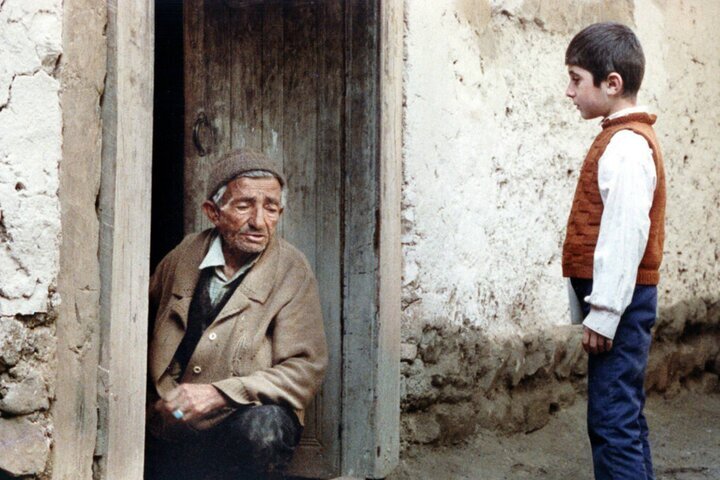
TEHRAN- Abbas Kiarostami’s acclaimed film “Where Is the Friend’s House?” continued its theatrical rerelease in Greece with screenings at two open-air cinemas in Athens on September 26 and 27.
The 1987 film, produced by the Institute for the Intellectual Development of Children and Young Adults (Kanoon), was screened at the Amiko open-air cinema on Saturday, September 26. It was then shown at the Aniksis open-air cinema on Sunday, September 27. Both screenings were held in Persian with Greek subtitles.
The rerelease of “Where Is the Friend’s House?” in Greece began on August 27, and the two Athens screenings were part of its ongoing theatrical run in the country.
The film tells the story of Ahmad, a young schoolboy in a rural village who mistakenly takes home his classmate’s notebook. Concerned that his friend may be punished for not having his homework, Ahmad sets out for a neighboring village to return the notebook.
Through the seemingly simple journey of a child, Kiarostami explores themes of friendship, responsibility, and compassion, while offering an understated portrayal of rural life and childhood.
The film has won several awards since its release, including the Bronze Leopard at the Locarno International Film Festival in Switzerland and the Critics' Prize at the Sao Paulo International Film Festival, and the Pasinetti Award at the Venice Film Festival.
“Where Is the Friend’s House?” is one of Kiarostami’s landmark works and the first installment of his Koker trilogy, which also includes “And Life Goes On” (1992) and “Through the Olive Trees” (1994).
The film has been screened at numerous international film festivals and cinematheques over the decades and continues to feature in retrospectives and programs dedicated to world cinema.
Kiarostami was a film director, screenwriter, poet, photographer, and film producer. An active filmmaker from 1970, he was involved in the production of over 40 films, including shorts and documentaries. He attained critical acclaim for directing “Close-Up” (1990), “The Wind Will Carry Us” (1999), and “Taste of Cherry” (1997). In later works, “Certified Copy” (2010) and “Like Someone in Love” (2012), he filmed for the first time outside Iran: in Italy and Japan, respectively.
He was part of a generation of filmmakers in the Iranian New Wave, a Persian cinema movement that started in the late 1960s and emphasized the use of poetic dialogue and allegorical storytelling dealing with philosophical issues. He is known for his use of Persian poetry in the dialogue, titles, and themes of his films. His films also contain a notable degree of ambiguity, an unusual mixture of simplicity and complexity, and often a mix of fictional and documentary elements. The concepts of change and continuity, in addition to the themes of life and death, play a major role in Kiarostami's works.
Kiarostami, the winner of the Palme d’Or at the Cannes Film Festival in 1997 for his “Taste of Cherry”, died of cancer on July 5, 2016 at the age of 76.
SAB/
Leave a Comment