Herbert Karim-Masihi looks beyond monuments to capture Iran’s cultural heritage

TEHRAN – For photographer Herbert Karim-Masihi, Iran’s heritage is not just a collection of historical buildings and monuments. It is also the story of the people, cultures and beliefs that have shaped the country over thousands of years.
“Iran is a living land that has embraced thousands of years of the lives, cultures, beliefs and experiences of different peoples,” Karim-Masihi told the Tehran Times in a recent interview.
“Everything that has taken shape on this soil, from mosques, churches and temples to palaces, villages and ordinary people's homes, is part of the identity of this land.”
His reflections follow the unveiling last month of his photographic book, “Thousands of Years, Iran”, which depicts various aspects of the country’s historical, cultural and architectural heritage. The book was officially unveiled at a ceremony held at the Museum of the National Bank of Iran (Bank Melli), attended by Tourism Minister Seyyed Reza Salehi-Amiri; Kim Junpyo, South Korea’s ambassador to Iran; Mohsen Seifi Kafshgari, chief executive of Bank Melli; and Amin Arefnia, head of the Bank Melli Printing and Publishing Company.
The event also brought together archaeologists, cultural heritage experts, members of parliament and cultural officials, including Jebrael Nokandeh, head of the National Museum of Iran, and Mohammad Mehdi Asgarpour, chairman of the board of directors of the Iranian House of Cinema, and Gholamreza Amirkhani, head of the National Library and Archives of Iran.
Rather than concentrating exclusively on celebrated monuments, Karim-Masihi's photographs seek to capture the broader cultural landscape of Iran, encompassing different historical periods, religious traditions, communities and aspects of everyday life. He also prefers to leave many images without extensive captions, allowing viewers to engage with them before encountering historical explanations or interpretations.
In the following interview, he discusses the ideas behind his book, his approach to photographing Iran's diverse heritage and the role of personal perspective in documenting the country's past and present.
To begin, could you briefly introduce yourself? Your book, Thousands of Years, Iran, brings together photographs documenting the country’s historical and cultural heritage. What inspired you to undertake this project, and what central idea did you hope to convey through it?
I am Herbert Karim-Masihi, a photographer of this land. For years, I have traveled across Iran, photographing silent monuments and remote landscapes, searching for something that may not be immediately visible: the continuity of life in a country that has changed its appearance many times but has never stopped moving forward.
From my perspective, Iran cannot be reduced to one historical period, associated exclusively with one ruling dynasty or defined by one religion. It is a living land that carries the accumulated experiences of its people.
The soil of Iran is sacred to me, and everything that has grown or taken shape on it is part of that significance. A mosque, a church, a temple, a palace, a village, a home or even a wall built centuries ago by an unknown hand – all belong to the same cultural landscape.
I do not distinguish between a building from the Achaemenid or Sasanian period and one from the Safavid era, or between monuments associated with the Ilkhanids and those belonging to other periods. They are all pieces of a larger whole, and that whole is Iran.
How do you approach photographing Iran's different historical periods without allowing personal beliefs or historical preferences to influence your work?
When I photograph Iran, I try to distance myself from ideological perspectives and historical prejudices. For me, history is a combination of grandeur and defeat, kindness and oppression. I do not want to praise one period simply because of my personal beliefs or affiliations while overlooking another.
We are not merely heirs to the Achaemenids and Sasanians. We are heirs to all the ethnic groups, languages, religions, cultures and ways of life that have developed on this land throughout history.
Perhaps this is why I rarely feel the need to classify or label everything in my photographs. When I tell viewers that this is Iran, I do not want to restrict their imagination with a particular historical name or date before they have even looked at the image.
I want them to see first, feel what they are looking at and then ask themselves: Where is this place? What does this photograph have to tell me?
In the book, you have chosen not to rely heavily on captions or explanatory texts. What is behind this decision?
I wanted the audience to encounter the photograph itself before being introduced to its name or background. I believe written explanations sometimes stand between people and what they are actually seeing.
I want viewers to have the opportunity to experience an image emotionally before learning where it was taken. They can then develop their own interpretation and form a personal connection with it.
This does not mean that historical information is unimportant. On the contrary, understanding the background of a monument or a cultural practice can deepen our appreciation of it. But I believe the first encounter should belong to the image and the viewer.
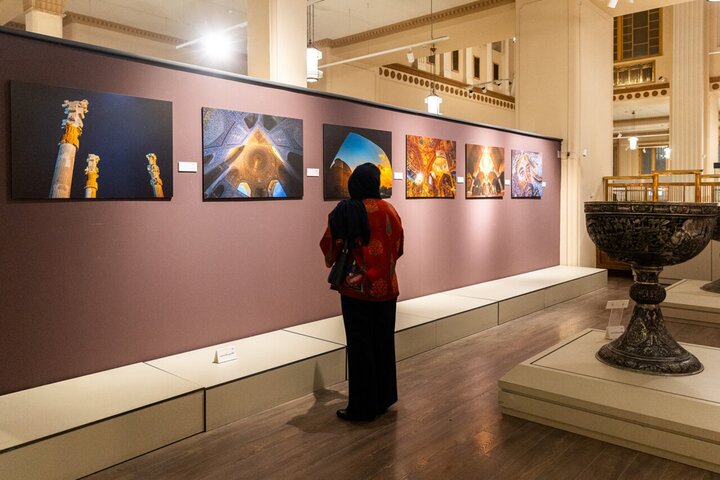
Your photographs focus on monuments and landscapes, but you also emphasize the importance of ordinary people's lives. How do you see the relationship between everyday life and cultural heritage?
One should not look only at magnificent buildings and archaeological remains to understand history. Sometimes history remains alive in the simplest actions of ordinary people.
I remember visiting a village near Persepolis, where I saw a man cleaning his livestock shed. The way he was doing his work reminded me of the continuity of traditional ways of life over thousands of years. At that moment, I realized that our real heritage is not confined to palaces and inscriptions. It also survives in people's language, food, behavior, rituals and everyday lives.
Years ago, I met a Japanese traveler who was travelling from one city to another with a backpack. I asked him why he chose to travel in such a demanding way instead of making his journeys more comfortable.
His answer was simple: many cultures can be better understood among ordinary people.
I have never forgotten that observation. It changed the way I looked at cultural heritage.
When we talk about Iran's heritage, we often think of palaces, columns, inscriptions and monumental architecture. But our heritage is not limited to stones and museums. It is also present in the lives of people who continue traditions, sometimes without even realizing how historically significant they are.
What role do time, light and patience play in your photography, particularly when documenting historical sites?
Photography, for me, is more than recording an image. It is about understanding time and discovering moments.
Sometimes four minutes of sunset can become the entire world of a photographer. That is why I believe a ziggurat should be seen at least once at sunrise. The changing light and the particular moment can reveal a completely different meaning in a historical structure.
There have been occasions when I have stayed in one place for a long time to take a photograph. I have spent so much time there that special moments eventually stop being unexpected. I become familiar with them, anticipate them and learn when they are likely to happen.
This is also why I smile when someone asks whether my photographs have been manipulated in Photoshop. I tell them that I have witnessed these moments in real life. Photoshop may be able to deceive an audience, but I cannot deceive myself about something I have actually seen.
Patience and familiarity with a place are essential. A photograph is not always about arriving somewhere, taking a picture and leaving. Sometimes it requires living with a place long enough to understand its rhythms.
With photography technology advancing rapidly, what do you believe makes an image valuable and enduring?
I have never wanted simply to produce technically superior versions of photographs taken in the past. My objective has always been to see a different world and discover a new perspective.
Technology changes, and the next generation of cameras will undoubtedly offer better image quality. Ten years from now, cameras may be much more advanced, and some of today's photographs may appear technically inferior by comparison.
But what remains in photography is the photographer's vision: what they saw, why they chose to record it and what story lies behind the image.
The technical quality of a photograph matters, but it is not everything. What gives an image lasting value is the perspective and narrative of the person behind the camera.
Finally, what would you most like readers and viewers to take away from “Thousands of Years, Iran”?
I feel that we need to see Iran again, without prejudice, without ideological restrictions and with greater curiosity.
Iran is not something whose past we should simply take pride in. It is a country we must care for, understand and work to protect for the future.
I hope viewers will look beyond familiar historical categories and recognize the connections between the different periods and communities that have shaped this land.
For me, Iran is not just a collection of monuments belonging to different dynasties. It is the shared inheritance of countless generations. Every mosque, church, temple, village, home and landscape has a place in this larger story.
Iran is a story that has been unfolding for thousands of years. Each of us is merely a narrator of one of its chapters, and only for a short time.
AM
Leave a Comment