Grossi’s empty posturing
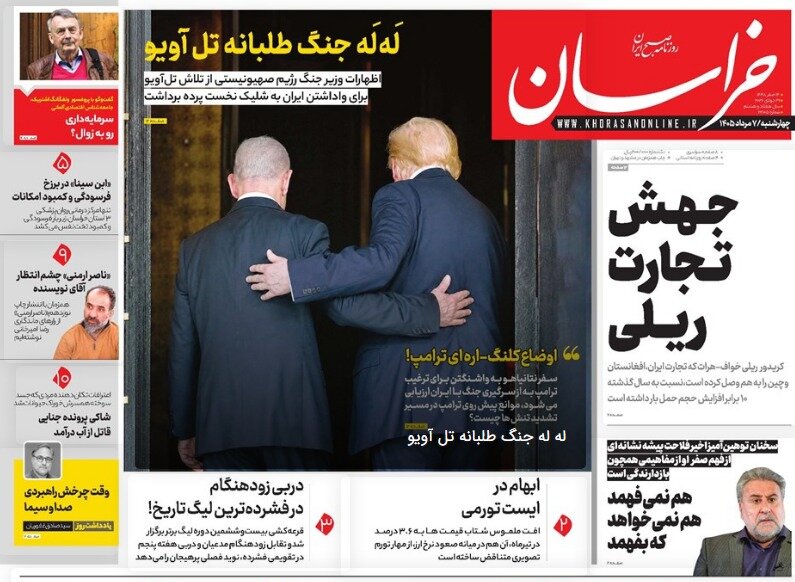
Khorasan commented on recent remarks by Rafael Grossi, Director General of the International Atomic Energy Agency, who said: “How do we save the United Nations from ineffectiveness?” The article argues that Grossi is attempting to present himself as a reformist savior, yet behind these diplomatic gestures lies a clear effort to position himself for the UN Secretary‑General role.
According to the commentary, someone who has been part of the problem and contributed to insecurity cannot claim to offer solutions for global peace and stability. Grossi’s political maneuvering in Iran’s nuclear file and his biased reports — which, the article says, paved the way for adversaries’ excessive demands — are cited as evidence. A figure who played a role in pressuring the Iranian people, the article concludes, cannot now claim to rescue the UN from ineffectiveness. Ultimately, reforming the UN will not be achieved by replacing individuals who themselves have been part of war‑driven and unilateralist agendas.
Shargh: Ukraine’s attack on an Iranian vessel
Shargh dedicated its editorial to Ukraine’s attack on an Iranian ship. According to the piece, while the United States halted its 13‑day campaign on Friday night, Ukraine’s unexpected strike on an Iranian commercial vessel in the Caspian Sea on Saturday has introduced a new turning point in the Iran–US conflict. There is no doubt that this incident has added a new and significant dimension to the war, and some observers describe it as another step toward horizontal escalation — or at least an expansion of the conflict’s consequences. It remains unclear whether this event constitutes the opening of a new front in the war between Iran and the United States. What is clear so far is that Ukraine’s action has linked aspects of the conflict in the Persian Gulf to the war in Eastern Europe. This new development in the Caspian Sea, set against the backdrop of previous actions against Iran, has drawn Ukraine more deeply into Middle East dynamics.
Etemad: An opportunity to consolidate regional standing
In an analysis, Etemad highlighted Iran’s assertive posture in regional affairs. The article argues that Iran is navigating four major regional and global crises: Israel facing its deepest crisis of legitimacy and internal cohesion, the U.S.–Saudi nuclear agreement, the maritime blockade as an economic‑psychological pressure tool, and the transition from a US -centric order toward multipolarity. Under such conditions, what can shape the future is not reactive or short‑term responses, but the design of a comprehensive strategy grounded in intelligence, patience, and full use of diplomatic, defensive, and economic capacities. The Islamic Republic of Iran is now in a position to use this turbulent moment as an opportunity to strengthen its regional standing and reduce strategic vulnerabilities. However, the article warns that serious risks lie ahead — risks that can only be managed through continuous monitoring, coordination among resistance fronts, and reinforcement of eastern alliances.
Sobh-e-No: Oil in the straits’ squeeze
Sobh-e-No examined the oil crisis and the sharp decline in tanker traffic caused by recent conflicts. Oil is now caught in the “tight squeeze of the straits,” facing a deep crisis that has simultaneously affected two vital energy corridors and sent shockwaves through global markets. Conditions in the strategic Strait of Hormuz and Bab al‑Mandab have become highly unstable in recent weeks, with both witnessing a significant drop in tanker movement. At present, three major global oil chokepoints are under pressure. This time, the Strait of Hormuz is not the only route facing security risks. In the Black Sea, Ukrainian attacks on Russian ships and infrastructure have intensified, placing Russia’s oil transit routes under serious threat. The three main global oil corridors — the Strait of Hormuz, Bab al‑Mandab, and Black Sea routes — are simultaneously endangered. Nearly half of the world’s seaborne oil passes through these pathways, with the Strait of Hormuz alone accounting for more than 20 percent of global oil trade.
Vatan-e-Emrooz: The shock of precision strikes
Vatan-e-Emrooz analyzed the rising quality of Iran’s attacks on US bases in the region. The article states that the recent US war against Iran — and Iran’s missile responses — was not a routine exchange of fire. Instead, the confrontation featured a shift in the precision and effectiveness of Iran’s strikes on US infrastructure and military bases. Where Iran’s past operations were often seen as demonstrations of deterrence or political messaging, many experts and analysts now argue that Iran’s latest attacks targeted sensitive points with heightened accuracy, inflicting significant damage on US military systems hosted in Arab countries. Assessments by experts, American commanders, and even media close to the White House all emphasize that Iran’s strikes were broader and more effective than initial estimates. They note that Iran’s recent missile responses exceeded US expectations by a wide margin.
Leave a Comment